Tag Archives: gardening

Non compost mentis

A dear man I work with recently notified several people that he would be having minor surgery next week and would be “non compost mentis” for a few days thereafter. I have yet to determine if this was intentional (his British sense of humor is wonderfully wicked) or was merely fabulously Freudian. You see, this man is a gardener. And not a mere putterer with petunias, mind you, but the kind of gardener who passionately espouses (and actively promotes) the use of soil blocks.

(If you just opened a new tab to Google “soil blocks,” do not fret that this means you are not a serious gardener. It just means you are not quite as far gone as some of us.)

This same gardener revealed this spring that he had acquired chickens, which announcement was met with surprise by some (“Is that legal?”) and envy by others (me). Understandably besotted with his new feathered friends, he has attributed all mental lapses since then to a condition he calls “chicken brain.” As a fellow alektorophile (someone who loves chickens) I am both sympathetic and jealous. I wish I could have chicken brain!

As for being non compost mentis, I’m not sure whether that’s a good thing or not. In a strictly biological sense, a brain that is composting might well be decomposing. I believe mine has been doing that for some time now, the neural pathways so infrequently used that the rest of me hasn’t gotten the news that I’m actually brain-dead.

On the other hand, composting is a lively, fecund process by which otherwise-useless matter is broken down into its essential elements, which can then be put to some other use. It’s kind of nice to think that my brain might be re-purposed, that it might actually yield something that some other organism could find useful.
Here there be dandelions

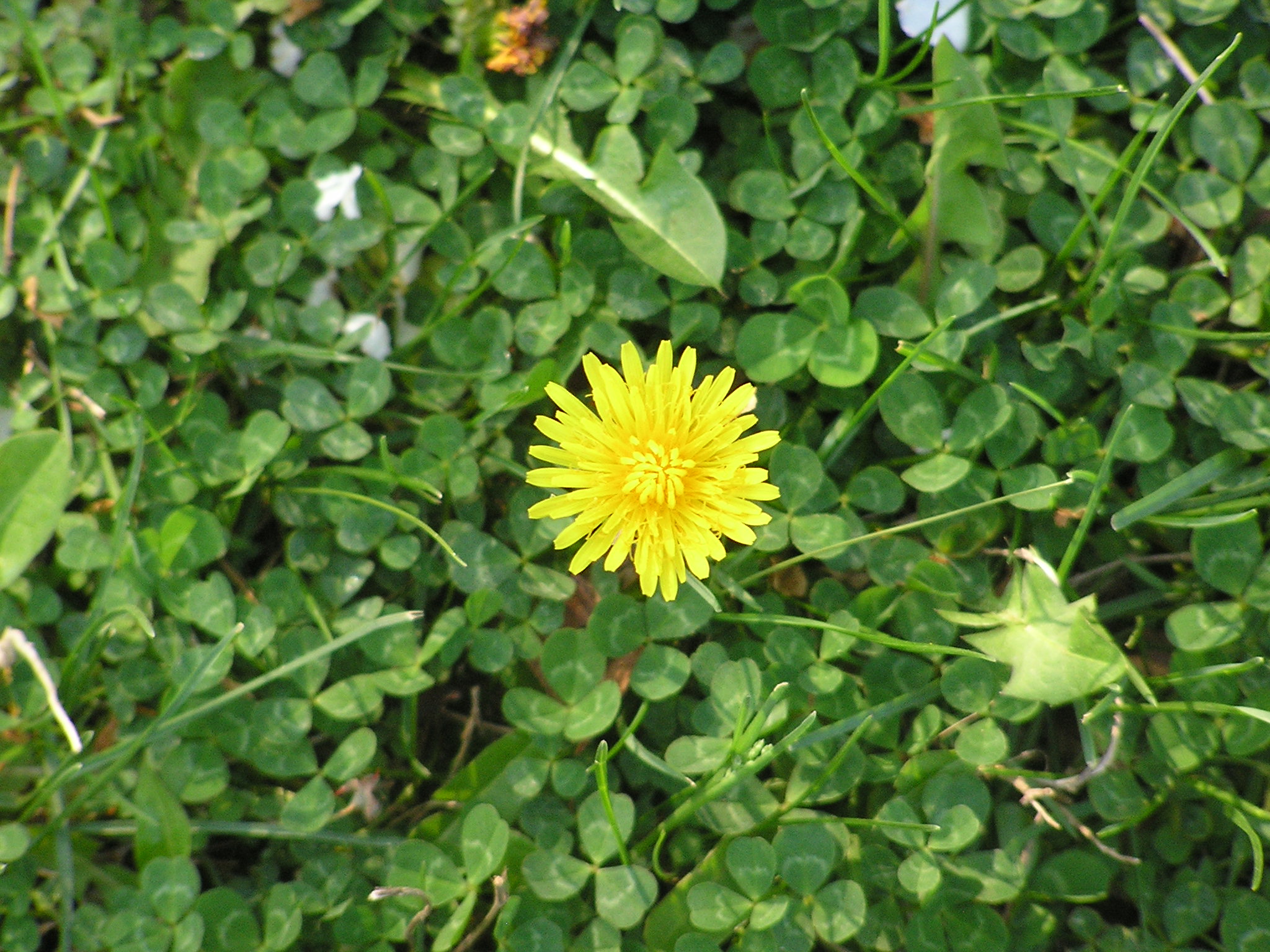
Actual photo of actual dandelion from my actual yard. Note that it is growing in a patch of Dutch white clover. Smart plant!

My yard is full of dandelions!! Whahoo!! Allow me to explain:

Twenty-some years ago, a developer bought a tract of land from a farmer who was retiring and had no one to carry on after him. The land had been used to pasture cattle, being a little too rolling to make easy fields for crops. The developer scraped away the good Kentucky topsoil that had been built up over thousands of years and sold it. Then he graded the rolling hills to make good postage stamp-sized lots and built houses on them, laying sod directly over the compacted clay hardpan that now comprised the soil surface. (I’ll give him credit for one thing, though: he left the existing trees, mostly choke cherry and locust, in the ravines and along the fence rows. I bless him for that.)

The new homeowners dutifully watered and fertilized and pesticided the sod, artificially sustaining it on its tilth-less foundation. They kept this up for fifteen years, maintaining a very respectable-looking lawn of artificial turf. Then some nature-nuts moved in (that’s us) and made the yard quit cold-turkey: no more watering, no more dope.

The first summer was unseasonably cool and rainy, so the yard got a chance to ease into this new, clean life just a bit. The next summer was hotter and drier, and the ill-adapted sod grass fared poorly. We put compost on the yard, but the hardpan had such low absorption capacity that the first good rain washed it away. Crabgrass loves infertile soil with poor drainage, however, and took over the bare patches. We were just glad that SOMETHING was growing.

The next year, we spread Dutch white clover seed. The rains carried much of it away, but enough found a toehold to make a few lush, green patches. Several shallow-rooted species of “weed” began to appear, and we rejoiced: it was a beginning.

Now to the dandelions: last year (year five) was the first year dandelions appeared anywhere other than the raised flower beds. Dandelions have deep taproots; they will not grow where the soil is too compacted to penetrate. Once they do start growing in compacted soil, though, their taproots help to loosen it. Their presence in my yard indicates an improvement in soil quality, both in fertility as well as tilth. There remain places in the yard where they will not yet grow, but this year’s crop is a big step forward.

Another year or two of dandelions and we might be able to grow some grass.

Calling all math nerds!

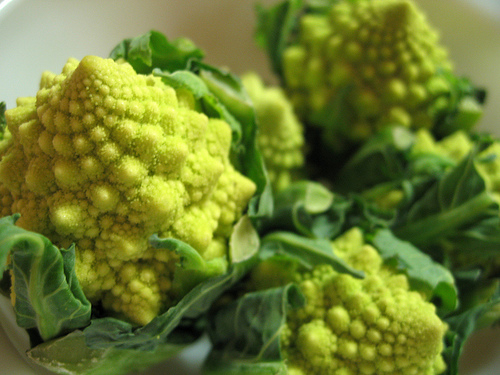
I have discovered a new brain food: Romanesco Broccoli, also known as Roman Cauliflower. The edible flower heads of this incredible brassica grow in chartreuse nested logarithmic spirals. Check it out:

This lovely photo is from The Nutmeg Polymath, whose blog entry on this fabulous fractal food caught my eye and got the wheels turning in my head. If I can figure out how to manage it, you’ll be seeing these babies growing in my yard. How much more ornamental can a vegetable get?

(For more information and amazing photos, visit John Walker’s Fractal Food page.)

Garden delights (an old-fashioned poem)

Will you meet me in the garden
B’neath the rhubarb’s spreading leaves?
We will make for us a bower
And discuss the birds and bees.

Will you come at daylight’s breaking
To the hawthorn wet with dew,
Find with me a guarded nest there
Perfect sized and shaped for two?

Will you share with me the twilight
Of the arbor’s shaded room,
Suffer sweet intoxication
‘Mid the roses all in bloom?

Will you nill you, I shall have you,
Queen of bees and knave of hearts;
‘Tis the dance that we were born for:
Come together, draw apart.

Bulb crazy

I’m afraid I’ve overdone it. Again.

Come fall, a gardener’s thoughts turn to the planting of spring-blooming bulbs, which have to be planted NOW. Last year I waited too long to purchase my bulbs in the mistaken belief that I could get them on clearance if I waited until retailers deemed the season for planting to be over. Not only did I not get any bargains, I had a drastically reduced selection from which to choose. Even then I bought more than I was able to plant, for we ended up having a very wet fall and early winter: my soil is heavy clay and impossible to work while wet. Half of them ended up in the compost this spring, having rotted in their bags in my garage.

A week of clear, dry, autumn weather got me thinking about fall planting and the beautiful mature gardens I left behind when I moved to the Bluegrass. One tulip in particular was my very favorite, a double late tulip called ‘Uncle Tom’ — a deep, rich maroon flower so petaliferous that it looks a peony or an overblown rose. I fired off a wistful email request to my mother-in-law for her to visit my favorite garden center in all the world (Natureworks in Northford CT) and get some bulbs for me.

Wondering if ‘Uncle Tom’ is still available, I went online to see if I could find it. Before I realized what I was about, I had placed an order for 50 bulbs! (I must say I showed remarkable restraint, however, getting the smallest possible quantities of only two narcissi, two tulips, and two alliums, none of which are available in stores around here.)

A couple days later, my dear mother-in-law let me know that she’s bringing me a box of bulbs at the end of the month as requested. In my excitement over finding ‘Uncle Tom’ I had completely forgotten about the email I had sent her!

So now I face the daunting prospect of getting 100+ bulbs in the ground before spring. Luckily, the soil doesn’t usually freeze around here until January or February, so I have a little time.

I just hope we don’t have a lot of rain.

Blathering on

Despite the fact that I’ve been diligently microblogging for several days now, I feel as though I have been terribly negligent of my Daily Compost duties. Never mind that I’ve had bronchitis, a child with H1N1,* and an ongoing mental health crisis — wait, that last bit is standard operating procedure by now — I still feel that I’ve let down the three people who check this blog every now and then.

So here I am today, blathering on. I’ve half a mind not to post this just because it seems so trivial, but I suspect that the nagging sense of guilt and responsibility will triumph in the end. I HAVE been busy doing things, even writerly things; I just haven’t been busy posting to my blog.

I’ve been reading: Acedia and Me by Kathleen Norris; The Two Marys by Sylvia Brown; Tall Dark Stranger by Corrine Kenner; Writer Mama by Christina Katz. I’ve also been taking an online course that has required me to do a fair amount of research, so I’ve been taking lots of notes. (I take a lot of notes when I read, too, even fiction: I like to jot down turns of phrase, images, and words that catch my eye.) I’ve been fretting over a review of Star Trek (2009) that I started right after I first saw it back in May; it’s taken me a while to get my thoughts together, and now I fear it’s too late to be relevant.

What else…I’ve started baking bread again now that the weather has turned cool. I’ve kind of let the garden go because everything is so riotously large and wild looking that the weeds are hardly noticeable. (This is a very bad idea, by the way, because huge quantities of seeds are being produced RIGHT NOW by those same weeds. DON’T TRY THIS AT HOME!) I remind people daily of their chores and responsibilities, make sure that everyone gets where they’re supposed to go with the materials and supplies they’re supposed to have — library books, lunches, clarinets, etc.

All in all, I’m just cruisin’ through the daily round of things. I guess the rhythm of it has had a hypnotic effect on me, lulling me into becoming a non-blogging zombie. Interestingly enough, just writing this post has given me all kinds of ideas for future postings. I just hope I can remember them when I sit down at the computer tomorrow.

*Probable. They stopped testing around here when the CDC placed Kentucky in the “widespread” infection category.

Bloomin’ omission

As I was setting up the hose to water some of my flower beds this morning, I realized I had left out a couple of crucial blooming workhorses from my floral report of yesterday. Both are annuals in my area and I was thinking of perennials, but that’s a poor excuse.

The first is Verbena bonariensis, also known as verbena-on-a-stick. Although a perennial in its native tropical South America, it won’t survive the winters in my zone 6 garden. It’s tall and graceful, with sturdy, widely branching stems and terminal clusters of vivid purple flowers that are a butterfly magnet. It self-sows freely; the single plant I put in last year produced a dozen or so volunteers, most of which I weeded out because of their location. The three plants I let grow have bloomed continuously since early summer, and will keep on blooming until the frost takes them.

The other plants I overlooked are dwarf zinnias. A friend gave me some standard zinnia seedlings last year, but the plants proved to be too large for the spot where I planted them. They bloomed like crazy and attracted humans and butterflies alike, but I had to cut them back repeatedly because they overran the garden path. Determined to have the same great look with less maintenance, I sowed dwarf zinnia seed in the spring and got several plants. They were a little slow to get going, but since they started blooming they’ve not stopped. Best of all, I haven’t had to prune them!

For those wonder why I didn’t start the seeds in the house and get a jump on the season, it’s because of the stupid cat. (For the record, we also have two other cats that are not stupid.) Maybe I’ll see if my friend can start some dwarf zinnias for me next year.

What’s blooming?

It’s another gorgeous day in the Bluegrass — warm and sunny, dry and clear. The sun sits in a brilliant blue sky, though somewhat further south, as the angle of the light visibly reveals. The same rays that scorched a few weeks ago now lie long and warm upon the land, the lingering caress of a lover who is leaving sooner than she would like.

The insects are at their zenith, in a frenzy to gather as much of the season’s bounty as they can hold. Bees are everywhere, their golden hum in the background of nearly every garden. My Sedum telephium ‘Matrona’ has just finished blooming; while it is in full flower, the blossoms are hardly visible for all the bees crawling over the floral heads.

The Geranium ‘Rozanne’ hasn’t stopped blooming since it started several months ago; I’ve had to cut it back twice to keep it from overwhelming not-so-nearby neighbors! It has spread so much in this year, only its second, that I’m thinking of dividing it before next year.

A second crop of self-sown pink evening primrose (Oenothera speciosa) is starting to bloom. I’ve (perhaps foolishly) allowed them to grow where heavy summer rains carried their seeds, outside of the huge bed in which they were originally planted. The established plants go dormant in the heat of summer and look simply dreadful, but I so love the dense carpet of pink flowers they provide in the spring that I can’t bring myself to remove them. Perhaps I should cut them back when the weather turns blistering so they look less unsightly.

Last, but not least, in the perennial department is the Liriope muscari (known locally as monkey grass). Three varieties grow in my evolving gardens: ‘Big Blue,’  ‘Pee Dee Gold,’ and ‘Variegata.’  All three produce fantastic, blue-purple flower spikes in late summer, hence the species name (same as the genus name of the plant commonly known as grape hyacinth).

Clearly my gardens are lacking in those late summer powerhouses, the asters and their kin. I’ll have to work on that for next season. Now where did I put that season of bloom chart?

I’m my own worst lawn ornament

Remember a few years back when those painted plywood cutouts of people weeding were all the rage? They showed a broad bottom clad in a polka dot dress and white bloomers hovering above legs with white ankle socks and black shoes — the view from behind of someone’s grandmother bending over to pick something off the ground.

I was working in the yard today and bent over from the waist to pull a weed just as a car drove by. I realized I had my back to the street, and that I had just presented my own version of the classic lawn ornament. I was wearing black shorts and an oatmeal gray t-shirt so the effect wasn’t quite as dramatic, but I felt suddenly very self-conscious and a little silly. What does it mean when you realize you have become something you’ve laughed about for years?

I’m seriously considering investing in a polka dot house dress and some bloomers as gardening camouflage.

The girls are back (but some of them are guys)

The Spirea japonica started blooming last week, which means that the aphids were out in force. Each slender flower stalk rippled with successive rows of the little life-sucking critters, tended by worker ants who collect the honeydew that the aphids excrete. It looked like a pretty serious infestation, the sort of thing that might cause an industrious gardener to run for the bottle of Ortho spray. I am far from industrious, however, so I decided to let the self-correcting mechanisms of my little corner of the ecosystem play out.

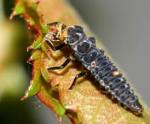
Sure enough, inspection of the bushes a few days later found the flowers in full bloom, their stalks bearing only a few aphid remains. The cause could be found lurking on the undersides of several leaves: ladybug larvae. They looked like tiny black accordians with legs, and they had completely cleared all the aphids from every spirea in the yard.

lady-bug-larvaeEach spring for the past five years this little drama has repeated itself, and each year I feel the same sense of anticipation and affirmation. First I discover the aphid infestation and am tempted to get the hose and blast them all off (a very effective, non-pesticidal response.) Then I counsel myself to wait: if I get rid of the aphids, the ladybugs won’t come. I decide to check back in a few days, and voila! There they are! How can something so entirely predictable feel so miraculous?
Maybe the wonder lies in the fact that even the most probable thing isn’t guaranteed. Something might happen to change it, to keep it from happening as expected. There are thousands of reasons why the ladybugs might fail to appear on my spireas each spring, from environmental conditions to pathogens to just plain bad luck. Some incalculable maze of probabilities has been navigated every spring when they seem to arrive on cue, and I can’t help but feel giddy with joy and amazement.