Tag Archives: rhythms

Let your life surprise you!

To jump-start my writing again, I decided to use an exercise I recall from Barbara DeMarco-Barrett’s wonderful writing book, Pen on Fire. I got the book a few years ago to help me develop a habit of writing, and it went fabulously until I hit a major depressive episode and my life went off the rails. But that’s another story.

The exercise is to use a picture postcard as writing prompt/inspiration. (I’d cite chapter and verse, but I can’t lay my hands on the book at the moment.) Not having a stack of picture postcards handy, I decided my collection of tarot card decks might work just as well.

The last few days I’ve been using the Kitty Kahane tarot, a cartoonish sort of deck with a simple but unusual color scheme. Today I turned up the Wheel of Fortune card, and writing about it led me to some interesting insights.

The Wheel of Fortune card bears certain resemblances to the The World card. Both belong to the Major Arcana, a series of 22 cards that stand for major forces that act in our lives.  The Wheel of Fortune is the eleventh card in this series, and The World is the twenty-second, so it’s not too much of a stretch to imagine they might be related.
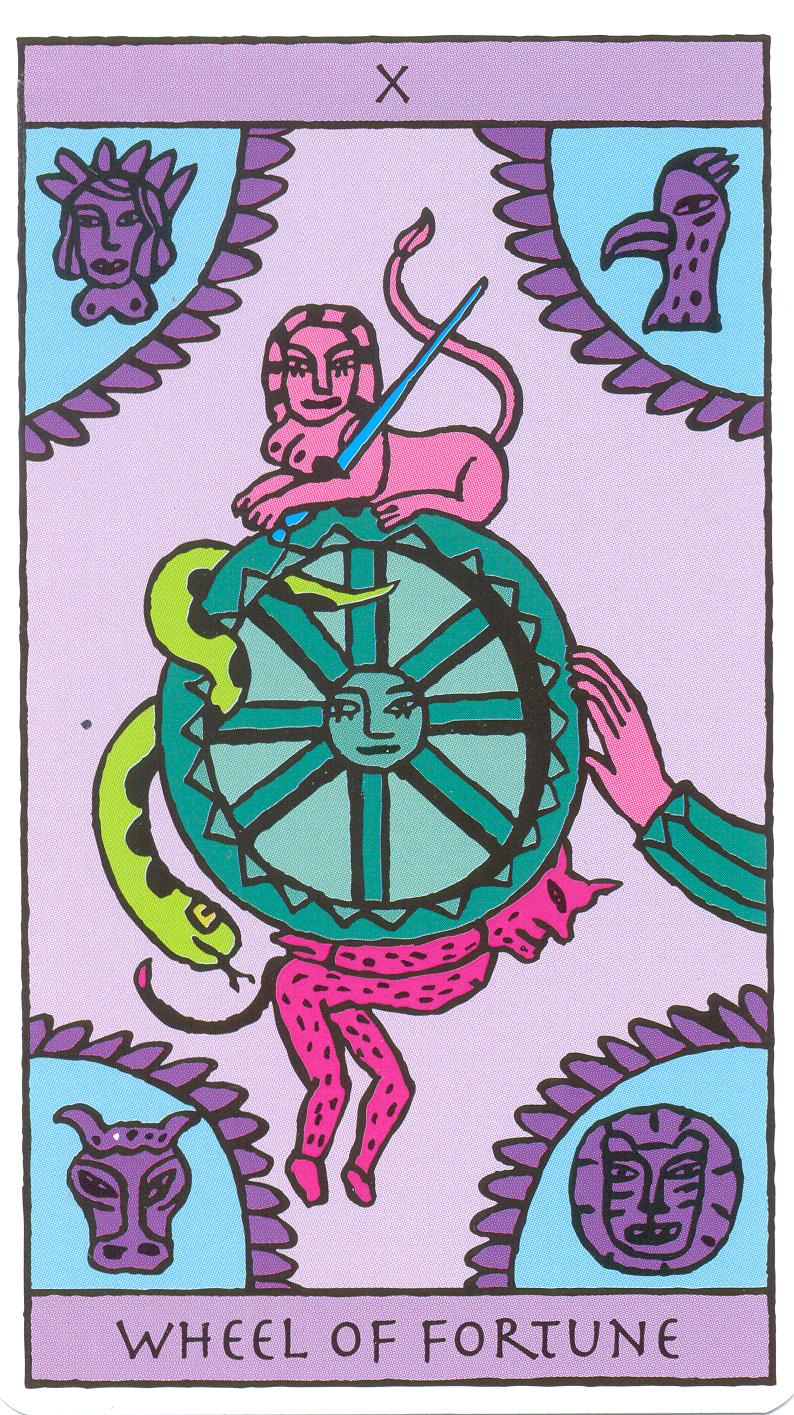
From the Kitty Kahane Tarot

In the corners of the card stand the four symbols of the evangelists. The eight spokes of the wheel might be seen to correspond to the four quarters and four cross-quarters of the year. The hand on the right side of the wheel could be either stopping the movement of the wheel or preparing to spin it. The sphinx on top of the wheel represents wisdom; the sword she holds represents choice and decision. The snake can be a symbol of temptation, though it is also a symbol of renewal and healing. (It almost seems to be tickling the demon’s rear end with its tongue, which makes me laugh.) In bearing the wheel, the demon at the bottom might be serving out some kind of punishment.

The visual movement in the image is from the right, through the hand up to the top of the wheel, where wisdom presides, slithering down the left side with the serpent, to the belaboring demon below. The bad news, no doubt, is that this is the normal progression of things: we start out knowing what we’re about, but succumb to temptation and soon find ourselves toiling beneath the weight of our choices and their consequences. The good news is that the wheel keeps turning. Whether the hand on the wheel is our own or that of the Divine, the wheel has the potential to bring us up again to the top, hopefully the wiser for our experience at the bottom.

The booklet that accompanies the deck has this to say about the card: Much that happens to you is beyond your control. Let your life surprise you!

I rather like thinking about it that way.

(Kitty Kahane Tarot by Kitty Kahane, text by Lilo Schwarz, translated by Charles Warcup, AGMueller Urania, 2006.)


Blathering on

Despite the fact that I’ve been diligently microblogging for several days now, I feel as though I have been terribly negligent of my Daily Compost duties. Never mind that I’ve had bronchitis, a child with H1N1,* and an ongoing mental health crisis — wait, that last bit is standard operating procedure by now — I still feel that I’ve let down the three people who check this blog every now and then.

So here I am today, blathering on. I’ve half a mind not to post this just because it seems so trivial, but I suspect that the nagging sense of guilt and responsibility will triumph in the end. I HAVE been busy doing things, even writerly things; I just haven’t been busy posting to my blog.

I’ve been reading: Acedia and Me by Kathleen Norris; The Two Marys by Sylvia Brown; Tall Dark Stranger by Corrine Kenner; Writer Mama by Christina Katz. I’ve also been taking an online course that has required me to do a fair amount of research, so I’ve been taking lots of notes. (I take a lot of notes when I read, too, even fiction: I like to jot down turns of phrase, images, and words that catch my eye.) I’ve been fretting over a review of Star Trek (2009) that I started right after I first saw it back in May; it’s taken me a while to get my thoughts together, and now I fear it’s too late to be relevant.

What else…I’ve started baking bread again now that the weather has turned cool. I’ve kind of let the garden go because everything is so riotously large and wild looking that the weeds are hardly noticeable. (This is a very bad idea, by the way, because huge quantities of seeds are being produced RIGHT NOW by those same weeds. DON’T TRY THIS AT HOME!) I remind people daily of their chores and responsibilities, make sure that everyone gets where they’re supposed to go with the materials and supplies they’re supposed to have — library books, lunches, clarinets, etc.

All in all, I’m just cruisin’ through the daily round of things. I guess the rhythm of it has had a hypnotic effect on me, lulling me into becoming a non-blogging zombie. Interestingly enough, just writing this post has given me all kinds of ideas for future postings. I just hope I can remember them when I sit down at the computer tomorrow.

*Probable. They stopped testing around here when the CDC placed Kentucky in the “widespread” infection category.

Rhythm and blues

Each community has a different rhythm, created by the movements of its comings and goings, work and play, meetings and partings. The rhythm of the community itself may change over time, depending on how it discerns its own identity in the midst of a changing world. — Jan L. Richardson, Sacred Journeys: A Woman’s Book of Daily Prayer, p. 189

I belong to a community of writers that has various circles of involvement: a large group of people who just pass through, a medium-sized group of people who participate occasionally, a small pool of people who are regulars, a core group of dedicated die-hards, and two facilitators who work in tandem to see to the infrastructure of the community. Change is inherent in such a loose, broad framework, but the high degree of stability in the regular and core groups allows these fluctuations to enliven and energize the community rather than destabilize and dissipate it. Change within those circles of greatest stability, however, may seem like a different matter.

Jan Richardson writes the passage above in her discussion of a community faced with the challenge of continuing to be a community when one of its leaders has suddenly died. She further writes that members have their own individual rhythms within a community, rhythms that also change over time, depending on how they see their roles in the community. When one of the facilitators of my writers group moved out of town a few years ago, she found someone to take her place before she left. This was a major change at a level of deep stability, but members of the community adjusted their roles and adapted quite successfully. The group now faces the loss of a facilitator through an unexpected death. Although this feels far more catastrophic, functionally it isn’t all that different from the previous change in leadership.

I find great comfort in Jan Richardson’s observations about the dynamics of change within a community. The writers group to which I belong is built to incorporate and make good use of change; its flexible structure will accommodate this latest difficulty, even the accompanying pain of sudden loss. Roles will shift, and the rhythms of the community and its members will transform. In a sense, the community will be reborn. I guess that’s not such a bad outcome after all.