Tag Archives: books

Words to live by

“Better to sleep with a sober cannibal than a drunken Christian.”

So says Ishmael, the narrator of Herman Melville’s Moby Dick, shortly after meeting his room/bedmate, the South Seas islander Queequeg. I must say it’s a thought that’s given me pause since I heard it the other day.

If you have not already discovered it, allow me to recommend the Moby Dick Big Read, a fantastic audio project spawned by a 2011 symposium and art exhibition on the whale at Plymouth University. All 135 chapters of Melville’s classic have been read aloud and recorded, to be released for free download, one chapter a day from the middle of September to the middle of January.

I know someone whose father read her Moby Dick as a bedtime story when she was little. She recalls those evenings with warmth and fondness, and believes they instilled in her a life-long love of the sea and all things maritime. Listening to these audio files, I imagine myself a small girl, snuggled beside my friend beneath a billowing comforter in her childhood bedroom. Even the shadows in the corners seem to bend closer to catch the animated cadences of her father’s voice, rising and falling like the sea.

Writing that inspires: Seven Pillars of Wisdom

I’ve been reading T.E. Lawrence’s Seven Pillars of Wisdom, and at times his prose is breathtaking. Here’s what he says about his journey down the Red Sea by boat from Suez to Jidda:

By day we lay in shadow; and for great part of the glorious nights we would tramp up and down the wet decks under the stars in the steaming breath of the southern wind. But when at last we anchored in the outer harbor, off the white town hung between the blazing sky and its reflection in the mirage which swept and rolled over the wide lagoon, then the heat of Arabia came out like a drawn sword and struck us speechless. (p. 49)

I feel like I’m there, standing on the ship’s deck beneath a noonday sun so bright that all color seems muted, trying to hold firm against the assault of that intense heat.

Lawrence describes dozens of different types of sand and stone throughout the book, the way they lie together in valleys or tower over the landscape in layered escarpments.  I can see them in my mind’s eye, and I find myself longing to see them with the eyes of my face as well, to feel them beneath my camel’s feet and hear the sounds they make when traversed by wind and body.

The swept ground was so flat and clean, the pebbles so variegated, their colors so joyously blended that they gave a sense of design to the landscape; and this feeling was strengthened by the straight lines and sharpness of the hills. They rose on each hand regularly, precipices a thousand feet in height of granite-brown and dark porphyry-coloured rock, with pink stains; and by a strange fortune these glowing hills rested on hundred-foot bases of the cross-grained stone, whose unusual colour suggested a thin growth of moss. (p. 72)

His language often evokes images of water, reflecting both the incongruent influence of water on the terrain and the necessary preoccupation with water that underlies the thoughts and actions of desert dwellers.

The hills got lower, with the sand banked up against them in greater drifts, till even the crests were sand-spattered, and at last drowned beyond sight. So as the sun became high and painfully fierce, we led out upon a waste of dunes, rolling southward for miles down hill to the misty sea, where it lay grey-blue in the false distance of the heat. (p. 93)

Such descriptions remind me of the incredible cinematography in Lawrence of Arabia (one of my favorite films of all time), and I realize that the movie’s vast panoramas and sweeping score attempt to express the ineffable qualities of Lawrence’s evocative words. This is what he writes about the great interior expanse of the Arabian peninsula:

We, ourselves, felt tiny in it, and our urgent progress across its immensity was a stillness or immobility of futile effort. (p. 238)

Alas, thus does my own writing seem some days!

(All quotations from the 1997 Wordsworth Edition.)

Camp

I’m back in civilization after a week in the woods with my daughter’s confirmation class (and about 70 other confirmation kids from a dozen congregations). It was peaceful to be off the grid; it was heaven not to have to plan and prepare meals, though I did help with setup and cleanup several times. Because I was a last-minute substitution (our youth minister’s mother had surgery two days before camp began), I had very few responsibilities, so a good chunk of time was at my disposal almost every day.

I put that time to fairly good use. I finished reading a novel I had begun weeks before, and then devoured three more novels I’d brought along. For those keeping score at home, that’s more novels than I read in the twelve preceding months. (I’m so far behind in my reading that it’s statistically unlikely I will live long enough to read all the books in my possession right now – never mind any list I might have.)

All that reading made me realize that I need a new prescription for my glasses. To rest my eyes between bouts of reading, I wrote. I drafted a couple new poems, recorded a few dreams, explored plot ideas that came out of those dreams, and reworked a poem I found when I flipped back through my journal. I was able to write every day, and it was wonderful.

I’m trying to figure out how I can wangle an invitation to camp again next year.

Inspired by Oz

Today, the kids and I watched The Wizard of Oz at the local historic movie palace. It’s amazing the details you can see on the big screen, things that go unnoticed when the film is viewed on television. It used to be broadcast on TV every year when I was growing up, and my family always watched it. Today it dawned on me that I was ten years old before I realized that the scenes in Oz are in color, because we didn’t have a color TV until I was ten.

As a child, the tornado that sends Dorothy to Oz was unspeakably terrifying because tornadoes regularly cut swaths of death and destruction through my community. I spent an obscene number of hours huddled under a table in the southwest corner of our basement, waiting for the storm to rip our house from its foundations. For most of my childhood and into early adulthood, tornadoes were powerful and recurring images in my dreams, and they always looked like that horrible, snaky cyclone in the Wizard of Oz. I have to admit that seeing it on the big screen today was a bit unnerving, even now.

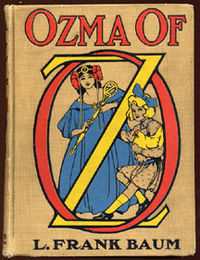
I never actually read the book The Wonderful Wizard of Oz until a few years ago, when I read it to my own children. (We have now read all but three of the 14 Oz novels L. Frank Baum penned.) When I was in fourth grade, my teacher went on maternity leave in the middle of the year and was replaced by a sub who read Tik-Tok of Oz aloud to us after lunch every day. The following year, I received Ozma of Oz as a Christmas present. It remains to this day my very favorite Oz book.

I never realized how progressive Baum’s vision was until I began reading the books to my children. He wrote empowered female characters who stand up for what is right, lead armies and expeditions, and rule nations. He imagined a world in which animals and non-biological entities are people, too. He created a place in which common sense and quick wit hold their own with magic, sometimes even trumping it. And he envisioned a land in which good and evil aren’t entirely rigid concepts – good people can make poor decisions or do things that harm others, and evil people can have a change of heart.

I believe it is this latter quality, this fundamental belief that things are not always what they appear to be and that change is always possible and nearly always happens, that has inspired others to retell the stories of Oz. From The Wiz to Wicked to Tin Man, Baum’s Oz has been reenvisioned in unexpected ways that remain surprisingly true to the original source material. Oz has become a kind of dreamscape, in which familiar images reveal new layers of meaning to successive generations of readers and writers. I think Mr. Baum would be pleased.

Ain’t misbehaving?

I’ve just returned from London, where we encountered groups of young people at every turn, most of them speaking languages other than English. The French-speaking school children were exceptional in their lack of discipline and consideration for other people. They consistently disregarded the direction of tour guides, train conductors, police officers, and their own chaperones. If there was a commotion at a museum, a restaurant, or on the street, the source was nearly always a group of French school kids.

The phenomenon was so apparent and widespread that it became a kind of running joke in our party. French school groups seemed to be everywhere, their disruptive behavior identifying them long before we were close enough to hear them speaking. We kidded that it was no wonder they’d all been sent abroad – their communities were probably relieved to be rid of them. We speculated that this was also the reason they couldn’t get chaperones: most groups had only one adult, maybe two, and 30 or more students. We dubbed them the scourge of Europe, opining that the Huns would be a welcome alternative, swift death by sword being preferable to death by unrelenting aggravation.

In short, I came away with a distinctly unfavorable impression of French children and, by extension, French methods of child-rearing. I hear there’s a new book out extolling French parenting, Pamela Druckerman’s Bringing Up Bebe: One American Mother Discovers the Wisdom of French Parenting. I’ve not read the book, so I don’t know what Ms. Druckerman saw that led her to conclude that American parents could take a page or two from French parents. Perhaps French children are well-behaved at home (which is where Ms. Druckerman probably saw them) and only act like hooligans when they’re not under the watchful eyes of their wise parents. I’m reminded of the genuine wisdom of my father-in-law, who once said of my own children: “They’re going to misbehave at one time or another; isn’t it better for them to do it at home, where you’re there to guide them, than out in public?”

Postscript: I realize it is completely unjust to paint an entire nation or generation with a single, broad stroke. In all fairness, there may have been a number of French school groups that we didn’t notice because they were so well-behaved. It’s quite likely that the groups which drew our attention did so because they were inadequately supervised, and the same children would have been ideal travel companions had they been accompanied by an appropriate number of adults. Nevertheless, I can’t help thinking it oddly significant that we encountered no school groups of other nationality that exhibited similar behavioral issues.

Too much

“Too much of a good thing can be wonderful.” — Mae West

As I wandered the aisles of a large chain bookstore the other day, I experienced a growing sense of unease. I paused between the Philosophy and the New Age Spirituality sections and sought to put my finger on the cause. A few minutes later I murmured, “There are too many books in the world.” Even as one part of my mind reeled in astonishment, I looked about me, nodded my head, and repeated, “There are too many books in the world.”

Coming from a hopeless bibliophile and former aspiring writer, this is nothing less than shocking. Stranger still, my profound love of both reading and writing has led me to this uncomfortable conviction. There are not enough days left to me in this life, nor hours in those days, to read all the books currently in print that I want to read. Likewise, such a surfeit (dare I say glut?) of books makes it extremely unlikely that anything written by me will ever find it’s way into print, let alone to a retailer’s shelf. These twin realizations sank in like fangs, the venom of their import so debilitating that I had to leave the bookstore at once. I may not be able to go back.

I have long been a great fan of Mae West, and the quote at the top of this posting is one I have claimed at times as a personal motto. Now I find myself sadly and reluctantly amending it to fit my present state: Too much of a good thing can be simply too much for me.

Blathering on

Despite the fact that I’ve been diligently microblogging for several days now, I feel as though I have been terribly negligent of my Daily Compost duties. Never mind that I’ve had bronchitis, a child with H1N1,* and an ongoing mental health crisis — wait, that last bit is standard operating procedure by now — I still feel that I’ve let down the three people who check this blog every now and then.

So here I am today, blathering on. I’ve half a mind not to post this just because it seems so trivial, but I suspect that the nagging sense of guilt and responsibility will triumph in the end. I HAVE been busy doing things, even writerly things; I just haven’t been busy posting to my blog.

I’ve been reading: Acedia and Me by Kathleen Norris; The Two Marys by Sylvia Brown; Tall Dark Stranger by Corrine Kenner; Writer Mama by Christina Katz. I’ve also been taking an online course that has required me to do a fair amount of research, so I’ve been taking lots of notes. (I take a lot of notes when I read, too, even fiction: I like to jot down turns of phrase, images, and words that catch my eye.) I’ve been fretting over a review of Star Trek (2009) that I started right after I first saw it back in May; it’s taken me a while to get my thoughts together, and now I fear it’s too late to be relevant.

What else…I’ve started baking bread again now that the weather has turned cool. I’ve kind of let the garden go because everything is so riotously large and wild looking that the weeds are hardly noticeable. (This is a very bad idea, by the way, because huge quantities of seeds are being produced RIGHT NOW by those same weeds. DON’T TRY THIS AT HOME!) I remind people daily of their chores and responsibilities, make sure that everyone gets where they’re supposed to go with the materials and supplies they’re supposed to have — library books, lunches, clarinets, etc.

All in all, I’m just cruisin’ through the daily round of things. I guess the rhythm of it has had a hypnotic effect on me, lulling me into becoming a non-blogging zombie. Interestingly enough, just writing this post has given me all kinds of ideas for future postings. I just hope I can remember them when I sit down at the computer tomorrow.

*Probable. They stopped testing around here when the CDC placed Kentucky in the “widespread” infection category.

A river runs through it

It’s a rare talent that can begin a story with its tragic conclusion and tell it so engrossingly that the reader is nevertheless shocked to arrive once again at the ending. Charles Roe displays such talent in his fourth novel, Barren River, a gripping tale of friendship, betrayal, love, and loss set in the cave country of southern Kentucky.

The story opens with a coroner’s inquest into the death of Morgan Hargett, who met his end while exploring a cave with his best friend Arnie Travers. After being trapped in the cave for hours, Arnie found a way out and returned, too late, with help. Suspicion falls on the survivor in the minds of some, but the jury eventually decides that the death was accidental. Intent on retribution, Morgan’s widow then takes matters into her own hands, plunging the town of Greenfield back into incredulous grief.

After this prologue the narrative shifts to the ill-fated caving excursion, which serves as a backdrop for all but the final chapter of the novel. From the outset there are signs that things will not turn out well: a forgotten rope, a slipped knot, a foothold that gives way. Prepared and provisioned only for a brief scouting foray, Morgan and Arnie find themselves on a full-blown expedition to secure their very survival.

The taut description of their underground ordeal is punctuated by flashbacks to events from the months leading up to the calamitous venture. Morgan and Arnie consider what has happened between them during that time, and between each of them and Verna, Morgan’s wife, and Fern, Arnie’s new love interest. The cave, with its treacherous terrain and disorienting darkness, is eerily analogous to the confusing landscape of human relationships in which the two men find themselves.

As the narrative unfolds within the cave and without, the mystery deepens: what actually took place between them in the chill blackness, and how did Morgan die? The gravity of the situation forces the trapped men to grapple with their inner demons, and each makes choices that ultimately and inadvertently bring tragedy down upon them both.

Barren River has elements of romance, intrigue, mystery, and morality, but as a whole it is a nuanced exploration of the unraveling of the human heart under the quiet frictions of daily living as well as the pressure of extreme circumstances. The principal characters’ joys and struggles are universal and familiar, and the rural small town setting creates an intimacy that deepens their poignancy. Most pleasing of all, it is a tale so well told that the reader is taken as unawares as the characters by the final act of shattering violence foretold in the prologue.

Barren River by Charles L. Roe © 2008 (AuthorHouse)  ISBN: 978-1434376343  248 pages  Paperback  $9.95 (US) www.authorhouse.com/bookstore

Listening to chickens

I have just finished reading Catherine Goldhammer’s wondrous memoir, Still Life with Chickens. I took a chance on it because it had the word “chickens” in the title, and to my absolute delight I found a kindred soul within its pages. I liked Ms. Goldhammer from the very opening of the book:

I did not have a year in Provence or a villa under the Tuscan sun. I did not have a farm in Africa. Instead, my diminished resources dictated a move to a run-down cottage in a honky-tonk town where live bait is sold from vending machines. (p. 1)

Right away the reader knows that this is not going to be one of those soaring, romantic stories from which movies are made. This is not escapist literature. Instead, it is a tale about a woman whose heart leads her more deeply into her own life — not just any life, not the good life or the life she always dreamed of — HER life. And interestingly enough, reading her story placed me all the more firmly in my own life, like a hen settling down to roost. I could imagine myself faced with the same choices, and I could imagine myself choosing as she did for much the same reasons.

It isn’t easy being an alektorophile (someone who loves chickens). Most urban people think of chickens simply as an entree and most rural people think of them as a chore. In truth, few people think of chickens at all. It is rare to find anyone who appreciates and admires chickens as creatures, and rarer still to find someone who gives expression to those feelings. So it was with utter delight that I read what Ms. Goldhammer has to say about chickens.

She introduces the chickens by explaining that they were superficially intended as a bribe to secure her tween-aged daughter’s cooperation with the unavoidable move. A page or two later, however, Ms. Goldhammer reveals deeper motives:

I had wanted chickens for a long time, along with a goat or two, but my husband — who had put up with, but not been happy about, cats, dogs, gerbils, snakes, and fish — had drawn the line at livestock, and I figured I better not push it. (p. 19)

(I feel such affinity with this statement that Catherine and I are henceforth on first-name terms.) She is divorced from her husband, and chickens have come to represent the thousand little sacrifices that people make to be with each other. These “chickens of the mind,” as she calls them, are as much an enticement for her as they are for her daughter; they draw her forward into each next step of her journey, each new day of the life that is becoming more surely hers.

Chickens of the mind pale in comparison with chickens in the bathtub, in the library, in the back yard. Flesh-and-blood chickens are much more of an investment in time, energy, and worry, not to mention dollars, than their up-front cost (a couple of bucks per chick) suggests. Late in winter, Catherine is at the end of her rope, and the added complication of chickens feels like the last straw. Then a workman tells her about his ninety-three-year-old aunt who keeps chickens because, she says, “They’re what gets me out of bed in the morning.” (p. 140) Catherine has to concede “that if Leonardo’s ninety-three-year-old aunt could do it, I could do it.” (p. 140)

In addition to all the practical things Catherine accomplishes in pursuing her life with chickens, she gains the wisdom and humility to see them as teachers. To her they become “Zen priests, with minds like cloudless skies.” (p. 154) A neighbor asks Catherine not to put up a privacy fence because the chickens are soothing to watch, like fish in an aquarium. Pondering the chickens’ attraction, she writes:

…although the chickens were busy, they were not in a hurry. They were calming. They were funny, although they had no sense of humor. They puttered, but in a serious sort of way. Chickens take themselves very seriously, actually. They have a sort of mindless gravitas. (p. 168)

She begins seeing the Buddha in them, realizes that nearly every piece of wisdom in the Tao Te Ching could be said about a chicken. “I had followed the chickens this far,” she says, “and would follow them farther. They were still talking to me, singing to me, telling me a story.” (p. 173) Because she has the audacity to listen, they tell her a story of her life.

Catherine concludes her tale much as she begins:

I did not have a year in Provence or a villa under the Tuscan sun. I did not have a farm in Africa. It turned out that my life was not someone else’s book. It was not a picture and it was not still. It was moving, variegated, unpredictable. It was a life, with chickens. (p. 176)

For the reader who has the audacity to listen, Catherine’s story will in turn tell a story of the possibilities of the reader’s own life.

Lives of their own

Books have lives, and stuff happens to them that you never planned. — Amity Schlaes

The life of Amity Schlaes’ 2007 book The Forgotten Man has become very interesting lately. According to a Politico article, the book has become a bit of a hot ticket because of its critical stance on the New Deal. The article quotes a Washington, DC, bookseller: “If all my books sold that well, I’d be a rich man.” That’s sweet music to an author’s ears.

The author herself seems to have a healthy sense of detachment from her work, boundaries she diplomatically articulates in the article.  She deflects effusive praise by emphasizing her reasoning and approach when writing the book. (Great PR lesson there, fellow writers — redirect attention to the book.) While clearly pleased by the attention the book is getting, she distances herself from any uses to which its words may be put. Using a quote or idea from a book to support an argument does not equate to an endorsement of that argument by the book’s author, a subtle point of reason that is too often overlooked in the current age of sound bites.

May we all enjoy such good fortune as to have our books become the darling of some highly visible demographic, and may we all be blessed with such a sense of calm perspective as Ms. Schlaes!