
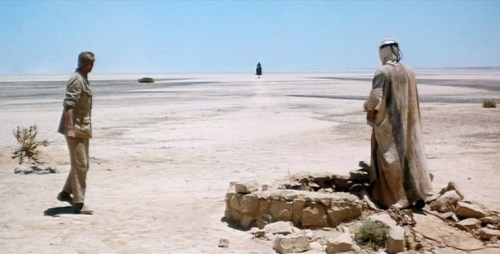
 Lawrence of Arabia aired on local public television last weekend, and I persuaded the household to watch it with me. Even though I’d only seen the film once before on television in the late 70s, it made a lasting impression, and I was very excited to watch it on a larger and more proportional screen. (I still hope to see it in the theater some day.) Just like the first time, I fell hopelessly in love with the desert and was transported by Peter O’Toole’s performance.
My fellow viewers thought the film could have used some editing, that some of the sequences were too long. Though I see their point, I don’t necessarily agree. Some of their response corresponds to a change in cinematic expectations over the years: audiences today want the film to give them a sense of the place and get on with the action. Lawrence of Arabia doesn’t work that way. The desert is not the setting — it is the most important character in the film.
The first half of the film is a love letter to the desert, but even those long, slow pans can only hint at something so vast, complex, inscrutable, and achingly beautiful. I reminded those watching with me that these scenes were filmed on location and not the results of special effects wizardry. The scale is too staggering to be grasped through briefer shots – the eye takes a moment to notice the tiny human figures and the mind still more moments to process the image as a whole.
The desert is the chief antagonist in the film, against whom all the other characters must contend, and against whom they stand in sharp relief. The desert is immense, and in that immensity often seems indifferent and harsh. It is not, however, the villain. That role falls to any number of characters who fail to act on a human scale, where fellow feeling is a human quality and indifference is a choice. Blaming someone else — the desert, the war, the empire — for one’s lack of human sympathy is the worst kind of villainy. Those who own both their actions and the consequences thereof, however unbearable, are the true heroes.
The tension of the film turns on Lawrence’s inner conflicts, and the battles he wins or loses are those within his soul. By the end, it is clear that he is no knight in shining armor, but it’s equally clear that he is no villain.
For those who get Kentucky public television, the film airs again tonight at 9:00 EST/8:00 CST.


 The Daily Compost