Tag Archives: film reviews

Desert thoughts

alis_wellLawrence of Arabia aired on local public television last weekend, and I persuaded the household to watch it with me. Even though I’d only seen the film once before on television in the late 70s, it made a lasting impression, and I was very excited to watch it on a larger and more proportional screen. (I still hope to see it in the theater some day.) Just like the first time, I fell hopelessly in love with the desert and was transported by Peter O’Toole’s performance.

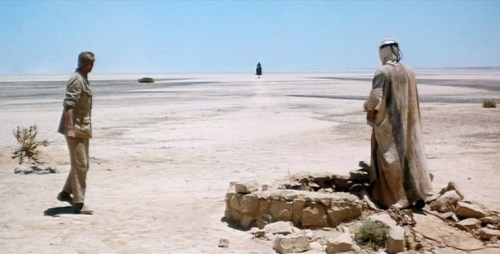
My fellow viewers thought the film could have used some editing, that some of the sequences were too long. Though I see their point, I don’t necessarily agree. Some of their response corresponds to a change in cinematic expectations over the years: audiences today want the film to give them a sense of the place and get on with the action. Lawrence of Arabia doesn’t work that way. The desert is not the setting — it is the most important character in the film.

The first half of the film is a love letter to the desert, but even those long, slow pans can only hint at something so vast, complex, inscrutable, and achingly beautiful. I reminded those watching with me that these scenes were filmed on location and not the results of special effects wizardry. The scale is too staggering to be grasped through briefer shots – the eye takes a moment to notice the tiny human figures and the mind still more moments to process the image as a whole.

The desert is the chief antagonist in the film, against whom all the other characters must contend, and against whom they stand in sharp relief. The desert is immense, and in that immensity often seems indifferent and harsh. It is not, however, the villain. That role falls to any number of characters who fail to act on a human scale, where fellow feeling is a human quality and indifference is a choice. Blaming someone else — the desert, the war, the empire — for one’s lack of human sympathy is the worst kind of villainy. Those who own both their actions and the consequences thereof, however unbearable, are the true heroes.

The tension of the film turns on Lawrence’s inner conflicts, and the battles he wins or loses are those within his soul. By the end, it is clear that he is no knight in shining armor, but it’s equally clear that he is no villain.

For those who get Kentucky public television, the film airs again tonight at 9:00 EST/8:00 CST.

War of the Worlds: a review (with spoilers)

I finally got around to seeing Steven Spielberg’s 2005 War of the Worlds a couple weeks ago. I’d mostly heard that Tom Cruise played an obnoxious jerk (some claimed this was type-casting) and that everyone was rooting for the Martians to get him. I was mostly interested in the special effects; I already knew the story, and it didn’t sound as though the characters would be all that interesting.

The special effects were fantastic, as they should have been, but the characters really caught me by surprise. Ray (Cruise’s character) was indeed a jerk, a thoroughly unlikeable person to the very end. But Spielberg and Cruise pulled off something wonderfully tricky and subtle with Ray: they got me to care about him, even to sympathize with him, despite my distaste for him. They did it by showing his anguish, his terror, his desperation, his impotence – emotions that resonate at the level of instinct. In other words, they made him deeply human, flawed and vulnerable, and I found myself immersed in the nightmare of the Martian invasion through his experience.

The other surprise was Rachel, played by Dakota Fanning. She began as a very sympathetic character, a sensitive child who ended up more or less abandoned, stripped of all sources of comfort and security. As the action unfolded, however, she descended into a kind of monotonous hysteria that rendered her an object of pity when she was quiet and a source of irritation when she wasn’t. I found myself wishing the Martians would get her so I wouldn’t have to listen to any more of her shrieking, a base response that was at once perfectly understandable and horrifying.

I was delighted at the little touches in this movie that paid homage to George Pal’s classic 1953 film adaptation. The church near the opening of Spielberg’s film reminded me of the church at the end of Pal’s, and the eye-stalk and portions of the cellar scene were adopted wholesale from the earlier film. Best of all, though, were the cameo appearances of Gene Barry and Ann Robinson at the end.

I was most intrigued, however, by how closely Spielberg’s movie paralleled H.G. Wells’ original novel. I immediately recognized the opening and closing voice-overs as Wells’ memorable prose, setting the story firmly within the novel’s Darwinian framework. Other little details throughout the film caught at my time-fuzzed recollections of the novel, so that I dug up a copy and reread it within days. From the neat folding of Wells’ curate and artilleryman into the single character of Harlan Olgilvy (played by Timothy Robbins) to the significance of the boot in the cellar scenes of both works, great care was taken to translate Wells’ 19th century horror story into a 21st century horror film.

My only quibbles were with the design of the aliens themselves (Pal’s 1953 aliens were much closer to Wells’ descriptions) and the fact that Robbie (played by Justin Chatwin) turned up alive at the end. I realize this is also consistent with the ending of the novel, but it was artificial and unnecessary to the story as Spielberg told it. The film’s climactic triumph had already been achieved with the destruction of the tripod; Ray’s and Rachel’s reunion with the pregnant Mary Ann was sufficient assurance that life would indeed go on. Robbie’s miraculous appearance struck me as more saccharine than poignant, and somewhat spoiled the ending of a film that I otherwise thoroughly enjoyed.