Tag Archives: loss

The saddest room in the house

In September, our ten-year-old cat, Name-O, was diagnosed with an inoperable tumor, a fast-growing sarcoma between her shoulder blades. This was a terrible shock, as we expected to have her with us for another decade or so.

Name-O came to us when the children were respectively 18 months and 4 years of age; they chose her and named her (“and Name-O was her name-o”). She slept with them when they slept and napped close by when they were awake. She enjoyed their attention, though she let them know when she had reached her limit, always without biting or scratching. When they went off to school, she met them at the door every afternoon. She was a steady comforter of my drama-queen daughter and a boon companion to my cat-crazy son.
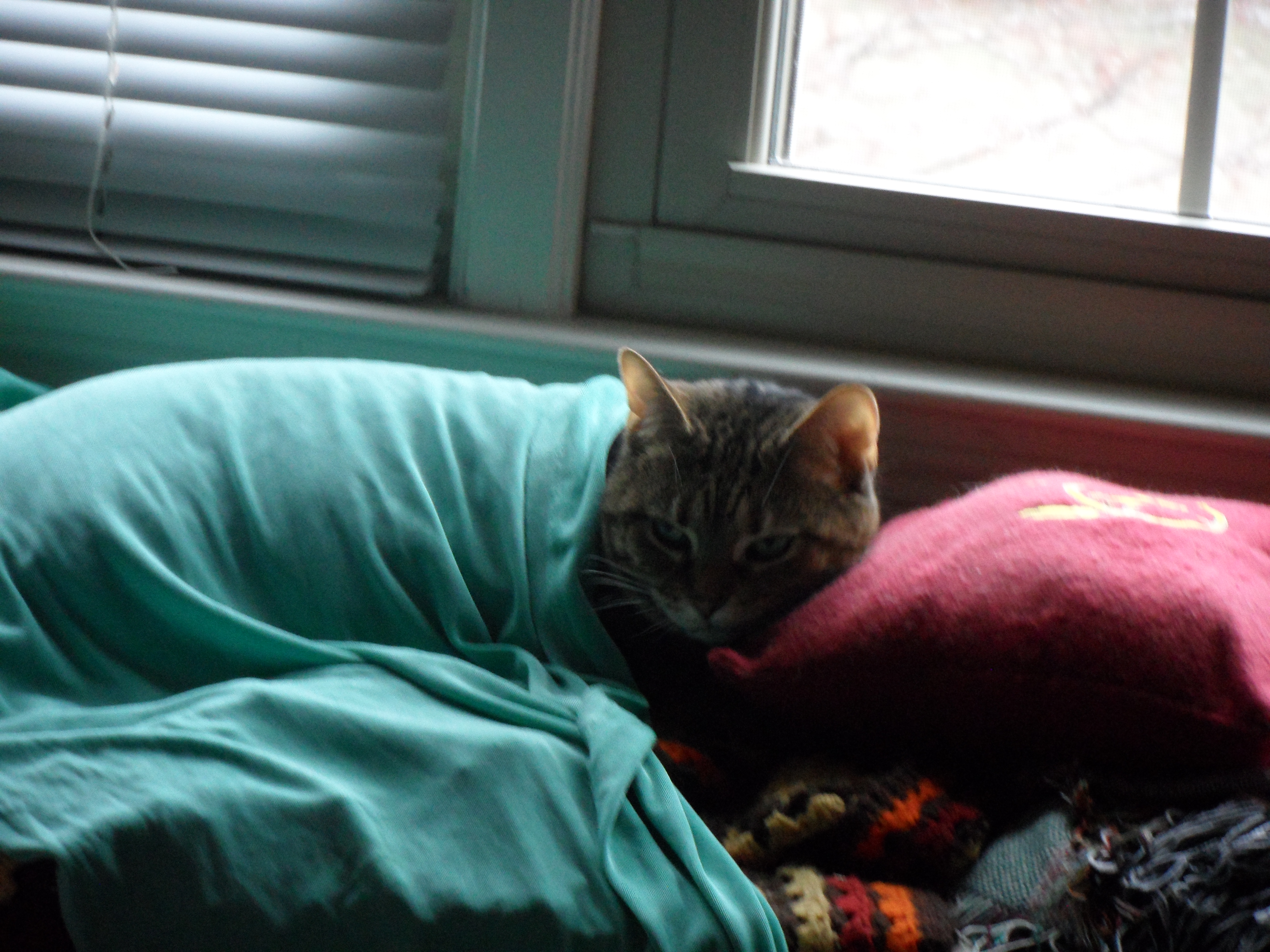
The things I put up with...

Name-O was large for a female cat. Her long, lean frame was easily twice the size of our other cats, and at fit adulthood she weighed 14 lbs. She had big round eyes of green and the longest whiskers I’ve ever seen. Her short fur was beautifully marked with black tabby stripes and swirls on a tawny background. Her underside was creamy with black mackerel spots, and she liked to roll over and invite us to rub her speckled belly. I was intrigued by the distinctive, diamond-shaped patch of light-colored fur that marked her nape. Her tail bore Tigger-like alternating half-stripes; she always carried it vertically, with the black tip crooked like a flag.

Name-O-in-the-box

Like many cats, Name-O enjoyed exploring places that were difficult to access. She was a strong jumper and agile, but not always a good judge of where her large body would fit or how she’d get back out again once she had satisfied her curiosity. I could fill several pages with her hilarious (sometimes exasperating) exploits and mishaps involving shelves, ledges, and furniture both high and low.

Toward the end of her time with us, she spent most of her days in the master bedroom walk-in closet, which serves as a dressing room as well as storage space. We cleared a cubby for her next to the dresser and gave her a fleece blanket to lie on. Drawn by the sound of her loud purring whenever she heard someone enter the bedroom, we detoured into the closet a great deal more often than we might have otherwise, always with a word and a gentle touch for her. If she didn’t come downstairs when it was time to eat, we brought the food to her. Noticing she had difficulty getting up and down, the children set up a series of chairs and footstools so she could reach the cubby without jumping.
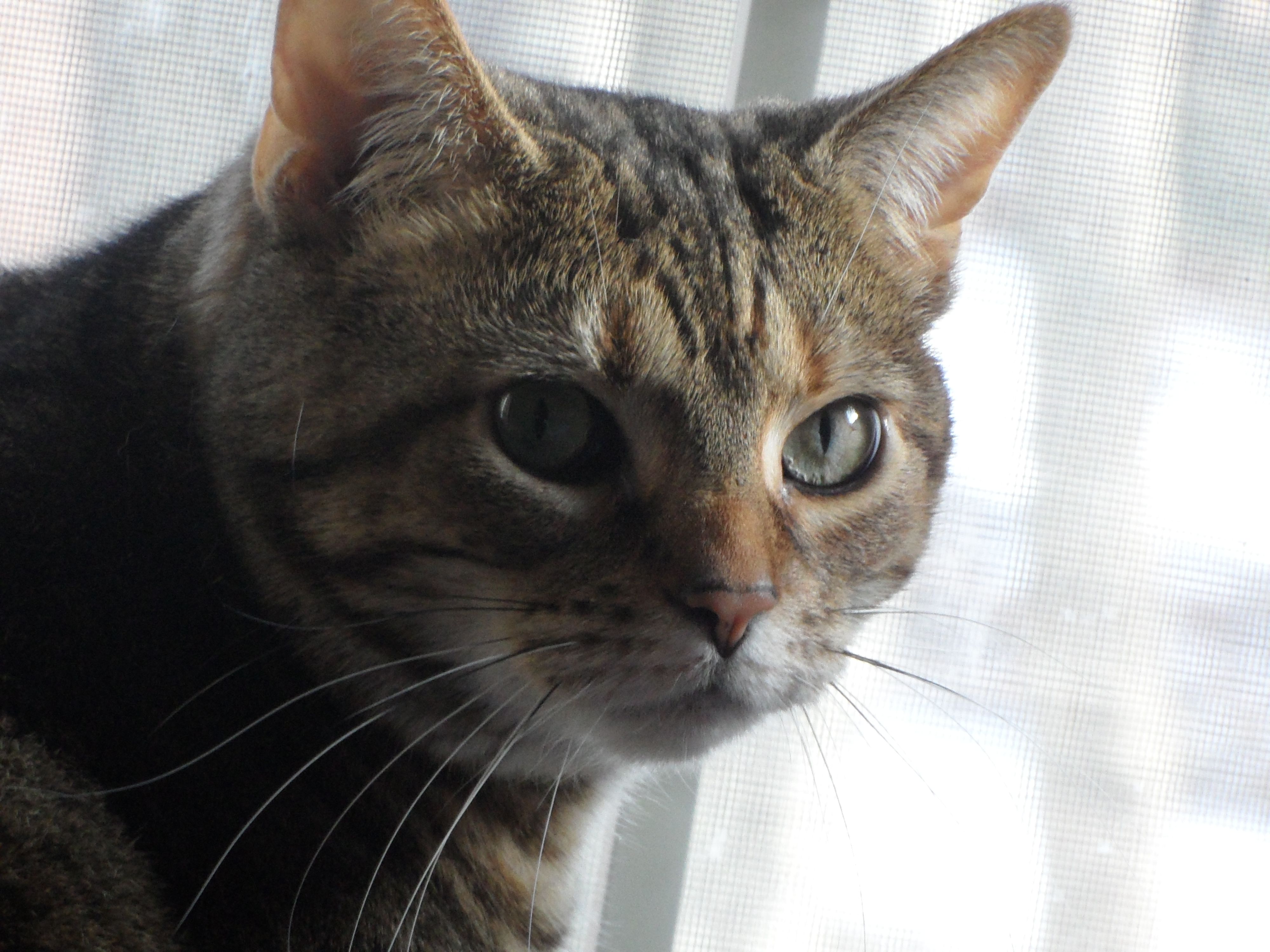
Winter 2010

A friend once observed that one of the most precious gifts our animal companions give us is their mortality, for we enter into relationship with them in the knowledge that we will outlive them. Difficult though her dying was for everyone, none of us would forego the ten years of joy we had together to avoid the pain of those last few months.

She has been gone five weeks now, and I no longer glance at that cubby every time I put away clothes. I’ve finally broken myself of the habit of greeting her whenever I cross the threshold. I don’t cry when I get dressed anymore, but the master closet is still, for me, the saddest room in the house.

Remembering and remembrance

My son had a social studies assignment that could only be completed last Sunday. He was to interview a parent or other adult on September 11 about the effects of the 2001 attacks. He chose to interview me. One of the interview questions was, “How do you think we should remember 9/11?”

This had actually been on my mind in the weeks leading up to the anniversary, because it seemed as though every media outlet I pay attention to had climbed on the 9/11 bandwagon. I found stories and conversations about the topic so distressing that I began avoiding radio, newspaper, and television altogether. But the reason for my distress didn’t come into focus until my son asked me that question.

After a rather long silence, I took a deep breath. “I don’t need anything to remind me,” I told him. “I have no trouble remembering it.” Images flashed unbidden to mind. “Sometimes I’d like to forget the things I saw that day.” As we talked, I realized that the nation’s near-obsession with anniversary observances of 9/11 might have something to do with the fact that most people were much farther removed from it than I had been. For the majority of the country, the events of 9/11 were a singular occurrence; for those living in the shadow of New York City, it was the beginning of a months-long nightmare.

In 2001, we lived in urban coastal Connecticut, along one of the commuter corridors that feed New York City’s white collar labor pool. The smudged and dusty people who limped across Manhattan’s bridges that day weren’t just figures on a television screen – they were our friends and neighbors. For weeks we drove past commuter parking lots with cars whose drivers would not be coming back for them. A column of smoke from lower Manhattan was visible when we went to New Jersey or Long Island, and a smoky pall hung in the air when we went into the city. Once the dust had settled and the smoldering had stopped, the gap in the skyline drew our eyes like the chipped tooth you can’t keep your tongue from probing. For us, 9/11 wasn’t a story that popped up on the news; it was part of the fabric of our daily lives, fabric that had been brutally reshaped by the searing events of that day.

I now live in the Ohio Valley, where the only everyday reminders of 9/11 are images of the New York skyline in old movies and photos and the occasional “NYFD” baseball cap. I don’t really begrudge my neighbors’ need for some significant means of connecting with events that happened many years ago in a far-off place. Their desire to remember is honorable and earnest, even if my own different experience of those events makes it difficult for me to share in it. I just need to remember to cut all of us some slack when the next anniversary rolls around.

The parable of the orchids

There once was a man who had some orchids that he cherished. He placed them near a sunny window because he knew they needed light. After a while they looked a little pale, so he put a bay window in his house to give them more light.

Their condition didn’t really improve, so he built an elaborate greenhouse with automatic temperature control devices and strategically placed shade structures to shield the plants from scorching. The orchids continued to languish, so he called in a plant expert, who told him the plants were too dry.

He installed a humidifier, but the poor orchids withered and eventually died. Devastated, he related his tale of heroic effort and loss to a friend.

“Did you ever water them?” asked the friend.

“I provided the perfect amount of light and humidity,” the man replied.

“What about water?” persisted the friend.

“I carefully controlled the temperature,” the man said.

“Yes,” said his friend gently, “but did you water them?”

The man became irritated. “No, but I built them a greenhouse, for pete’s sake!” he protested.

“That’s all well and good,” answered his friend, “but all they really needed was some water.”

Stealth grief

My first-born turns twelve this week, and I realized today that I’m having a hard time with that. In retrospect, it’s clear now that I’ve been having difficulty with it for several weeks — all sorts of random and dissociated behavior suddenly makes sense.

I found myself weeping this morning, inconsolably wracked with a grief that I didn’t see coming. I recognize it now that it’s swallowed me: something I cherish with every fiber of my being is passing away, and the pain of that loss is immeasurable. Once again the excruciating process of parenting has cracked me open, spilling my soul and leaving a hollow place for something new to grow. I wouldn’t stop it even if I could, but that doesn’t mean it’s a pleasant experience.

Why now, and so suddenly? I don’t know, but I’m quite certain it has far more to do with me than with my son. The changes will continue to find us gradually, as they have from the moment he was conceived. Something within me has shifted, though, and that difference is what grieves me most.

Nothing has ever kindled such fierce joy in me as mothering this boy; what if mothering a young adult, a young man, requires me to let go of that? I will do so without hesitation if needed, but I refuse to dishonor such an amazing experience by pretending that it costs me nothing to relinquish.

It seems as though I’m not giving up much ferocity after all. I suppose I will just have to trust that the joy will take care of itself.

Rhythm and blues

Each community has a different rhythm, created by the movements of its comings and goings, work and play, meetings and partings. The rhythm of the community itself may change over time, depending on how it discerns its own identity in the midst of a changing world. — Jan L. Richardson, Sacred Journeys: A Woman’s Book of Daily Prayer, p. 189

I belong to a community of writers that has various circles of involvement: a large group of people who just pass through, a medium-sized group of people who participate occasionally, a small pool of people who are regulars, a core group of dedicated die-hards, and two facilitators who work in tandem to see to the infrastructure of the community. Change is inherent in such a loose, broad framework, but the high degree of stability in the regular and core groups allows these fluctuations to enliven and energize the community rather than destabilize and dissipate it. Change within those circles of greatest stability, however, may seem like a different matter.

Jan Richardson writes the passage above in her discussion of a community faced with the challenge of continuing to be a community when one of its leaders has suddenly died. She further writes that members have their own individual rhythms within a community, rhythms that also change over time, depending on how they see their roles in the community. When one of the facilitators of my writers group moved out of town a few years ago, she found someone to take her place before she left. This was a major change at a level of deep stability, but members of the community adjusted their roles and adapted quite successfully. The group now faces the loss of a facilitator through an unexpected death. Although this feels far more catastrophic, functionally it isn’t all that different from the previous change in leadership.

I find great comfort in Jan Richardson’s observations about the dynamics of change within a community. The writers group to which I belong is built to incorporate and make good use of change; its flexible structure will accommodate this latest difficulty, even the accompanying pain of sudden loss. Roles will shift, and the rhythms of the community and its members will transform. In a sense, the community will be reborn. I guess that’s not such a bad outcome after all.