Tag Archives: brain

Jennifer-pooh* and some bees

* a Barricklow of Very Little Brain

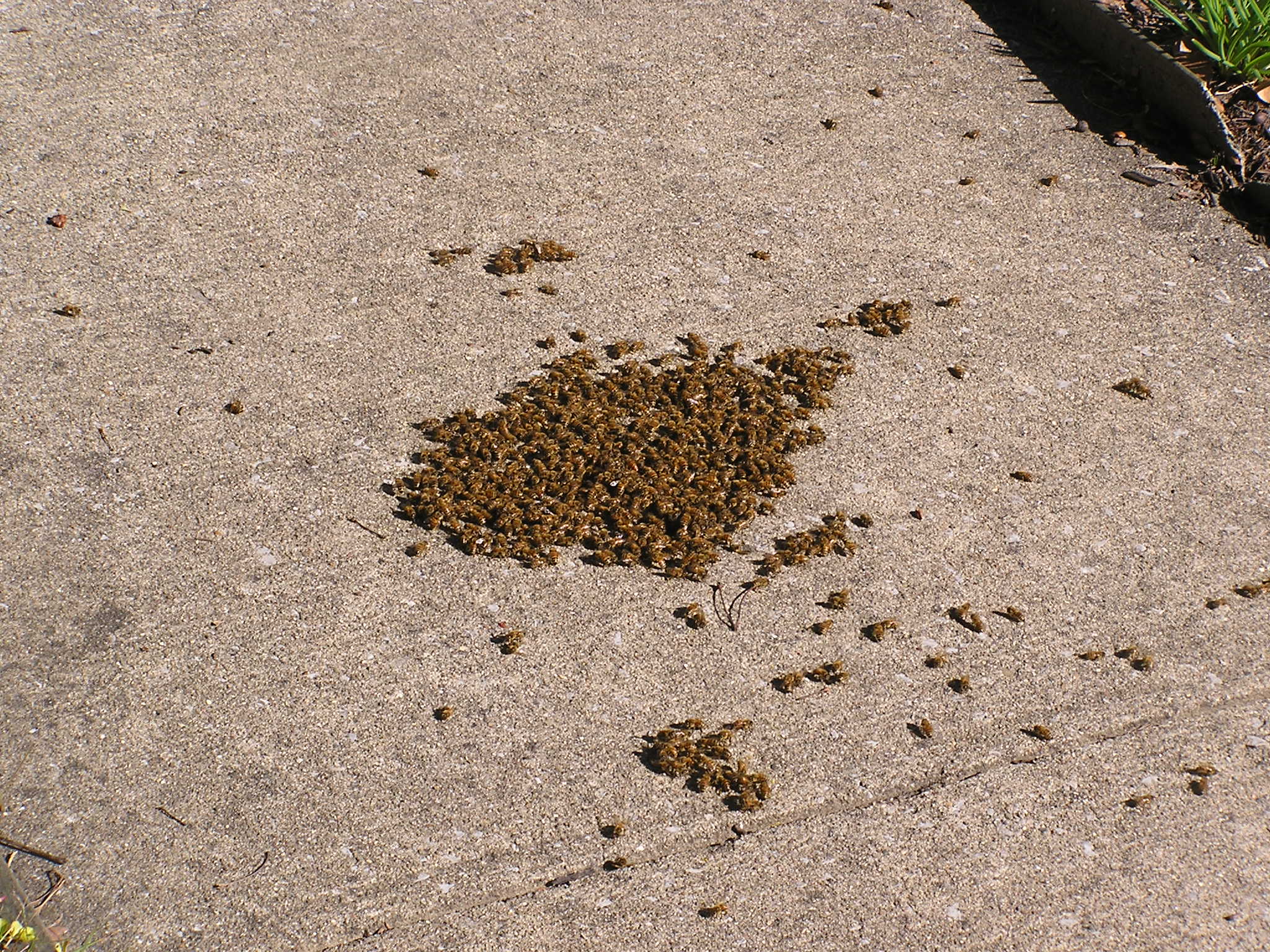
Monday morning, after I left the youngest at the corner on her way to the bus stop, I noticed a strange pile of…something…near the mailbox. It looked as though someone had dumped a very large scoop of pelleted pet food in the middle of the sidewalk. When I got close enough to see the “pellets” more clearly, I realized they were bees. Hundreds and hundreds of honey bees, curled up tight and motionless, clinging to each other in a mass.

A swarm, frozen. (Not literally, but temperatures were in the upper 30s, so they were quite immobilized by the cold.)

The bees weren’t the only ones effectively immobilized. It being early and I not being particularly brainy at that hour, I didn’t do what I should have done, which is scoop the mass into a box and move it off the sidewalk. I did think to drag some lawn chairs and compost buckets out to block the sidewalk, however, so the neighborhood’s avid walkers wouldn’t stumble into the swarm. (I was actually more worried about the welfare of the bees than that of the walkers.) Being also heavily under the influence of cold medication, I went back to bed, resolving to check on the bees once the sun had hit them in a couple hours.

My morning-fogged brain had reasoned that they would warm up, wake up, and fly off on their business. When I checked them around 10:00 a.m., they were moving alright, but mostly moving around rather than moving on. Scout bees would spiral up from the mass every few seconds and take off in various directions, but an awful lot of them remained on the sidewalk. I recognized the tactical error of failing to move them while they were easily moved and realized it was time to involve someone who actually knew what they were doing.

I put the word out on Facebook and soon heard back from a friend who had the phone number of a local beekeeper. By the time he got to my house, it was around noon, and about half of the bees were off scouting for new digs for the colony. The pile of bees was now more of a puddle.
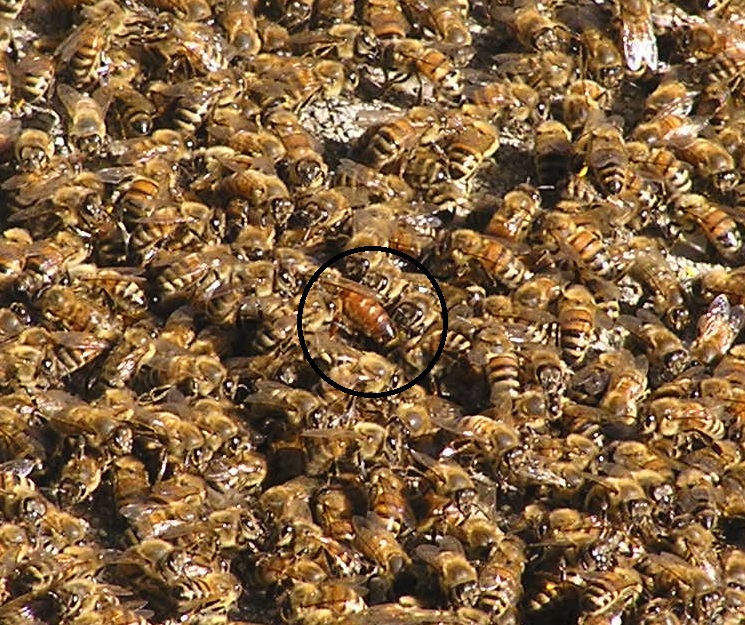
The beekeeper was a little disappointed, but I explained that there had been twice as many bees when I’d started looking for help. He was somewhat molified when he confirmed that there was a queen among them, though she was very young and not very large. (That’s her in the black circle below.)
He placed a lidded hive section, loaded with a few comb frames, over the puddle and tapped on it. (That apparently encourages the bees to climb up; I suppose they want to see what the heck is making that annoying sound.) After a few minutes, he lifted the lid, and sure enough, bees were clambering over the box’s interior. The young queen herself had climbed right to the top, so he carefully put the lid back to prevent her from escaping.

He hung around as long as he could to give returning scouts a chance to join the group, but had to allow himself time to drop the new bees off at home before returning to work. It’s too bad he couldn’t have left the box there for the rest of the day, as several dozen scouts returned throughout the afternoon and seemed lost without their queen and their sisters. A number of them collected on a branch overhanging the sidewalk, which leads me to think that the swarm had settled in the tree for the night but somehow lost their collective grip because of the cold and dropped to the sidewalk.

While waiting for the beekeeper, I spent a delightful half-hour sitting on the sidewalk, watching the bees. The sound of them was soothing, and their furry golden bodies glowed in the sun. It was fascinating to watch them interact, always touching one another with feet or antennae, coming and going on their marvelous and mysterious (to me) business.
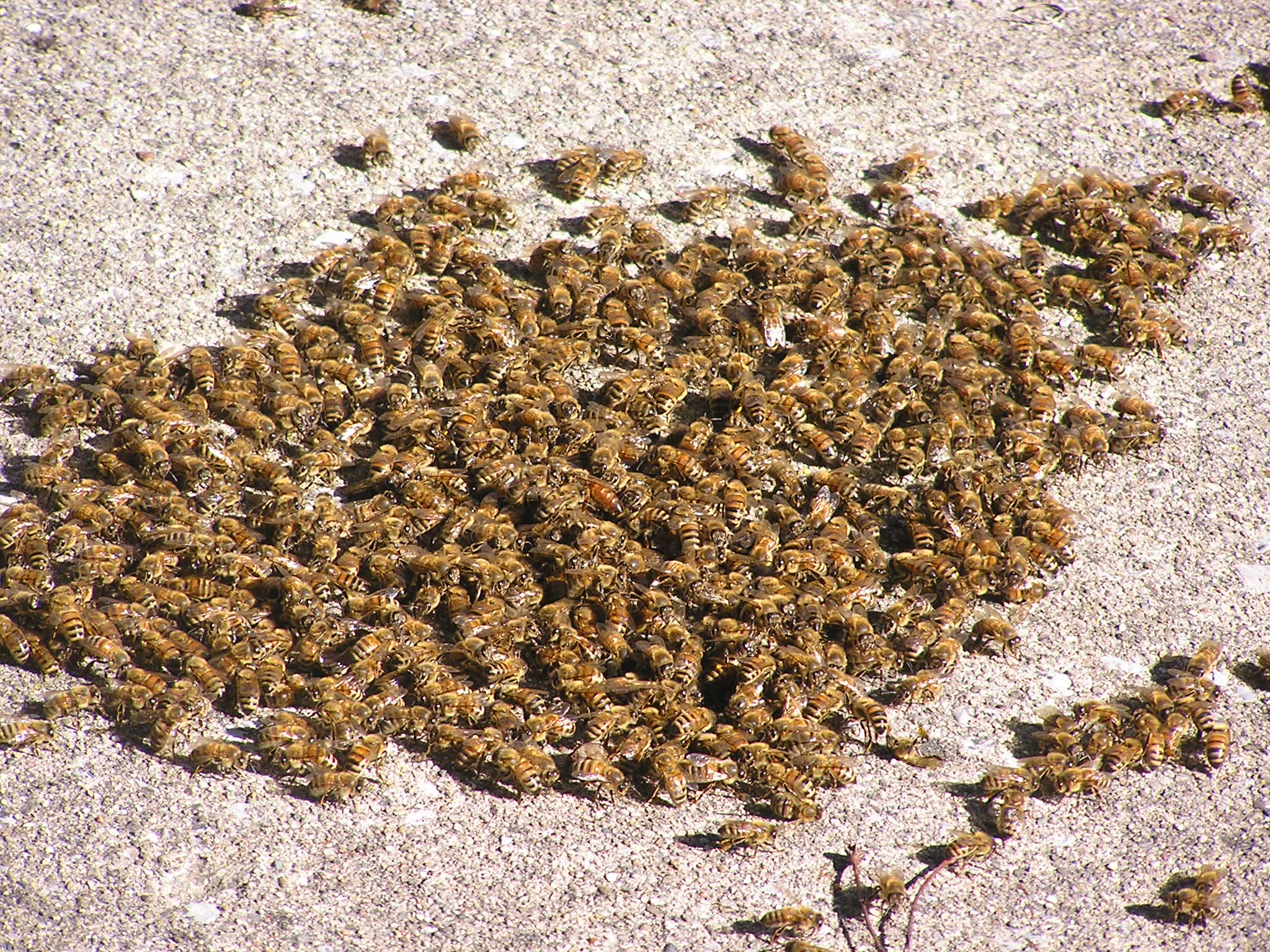
I was so relieved when the beekeeper agreed to take those who would come and to do what he could for them — it’s quite late in the season for such swarms, and they will need a good deal of help to get through the winter. I hope with all my heart that the young queen not only survives but does well for him. As a wild bee, maybe she’ll bring some new traits into his hives that will improve them. May she live long and prosper.

(Bonus points if you can find the queen in the last photo.)
Re-wrinkling my brain

The first time I walked along a busy sidewalk after returning from London, I realized that I had adopted the habit of passing on the left rather than on the right. This made for a number of awkward moments with my fellow North American pedestrians, but it triggered for me a kind of epiphany.

Many years ago, a right-handed co-worker told me that she liked to use the mouse with her left hand because it re-wrinkled her brain. She meant that doing something differently stimulates the brain to form new neural connections and pathways. I tried it myself and found that my brain felt more awake, which made sense since I was using parts of it that didn’t normally see much action.

London had done this for me: it had re-wrinkled my brain. Everything was just different enough to stimulate without overwhelming. The city was filled with patterns to notice, analyze, and assimilate – language, architecture, food, customs, and so on. Awash in this sea of new and intriguing information, I felt more alive than I have in years.

Come on, baby! Momma’s brain needs a new wrinkle!

This explains why I didn’t want to leave, why I felt this nearly desperate urge to return again at the earliest possible opportunity. There are all kinds of contests you can enter to win a trip to this summer’s Olympics in London; I entered several before I caught myself in the midst of applying for a credit card that I really don’t want or need. I’m still entering the ones that have no strings attached. Wish me luck!

Shower power

I always think of great stuff in the shower – ideas for stories, solutions to problems, explanations of intricate concepts, brilliant ways to word things. Ever since I read Frank Herbert’s God Emperor of Dune, I’ve wanted one of those nifty Ixian devices that Leto uses to record his thoughts. That would be so handy in the shower, or while driving, or in any of the other inconvenient places I seem to do my best thinking.

Researchers have been studying why this sort of thing happens and have discovered that we’re most intuitively creative when we aren’t really focused on problem-solving. When our attention is relatively diffuse (as when relaxing) or partially directed elsewhere (as when driving) little bits of our brain that have been working in the background on different aspects of an issue have a chance to compare notes. Et voila! Eureka! A brilliant idea is born.

Now that they better understand the mechanisms behind this phenomenon, I hope that scientists will work on ways for us to capture the amazing insights we have at those awkward moments when pencil and paper or digital recorders aren’t readily available. Until then, I guess I’ll have to get some of those wax pencils we used to write on beakers in high school science and start taking notes on the glass shower doors.

(The research mentioned above is from Jonah Lehrer’s book, Imagine: How Creativity Works, as discussed in the Wall Street Journal article, “How to be Creative.”)

Non compost mentis

A dear man I work with recently notified several people that he would be having minor surgery next week and would be “non compost mentis” for a few days thereafter. I have yet to determine if this was intentional (his British sense of humor is wonderfully wicked) or was merely fabulously Freudian. You see, this man is a gardener. And not a mere putterer with petunias, mind you, but the kind of gardener who passionately espouses (and actively promotes) the use of soil blocks.

(If you just opened a new tab to Google “soil blocks,” do not fret that this means you are not a serious gardener. It just means you are not quite as far gone as some of us.)

This same gardener revealed this spring that he had acquired chickens, which announcement was met with surprise by some (“Is that legal?”) and envy by others (me). Understandably besotted with his new feathered friends, he has attributed all mental lapses since then to a condition he calls “chicken brain.” As a fellow alektorophile (someone who loves chickens) I am both sympathetic and jealous. I wish I could have chicken brain!

As for being non compost mentis, I’m not sure whether that’s a good thing or not. In a strictly biological sense, a brain that is composting might well be decomposing. I believe mine has been doing that for some time now, the neural pathways so infrequently used that the rest of me hasn’t gotten the news that I’m actually brain-dead.

On the other hand, composting is a lively, fecund process by which otherwise-useless matter is broken down into its essential elements, which can then be put to some other use. It’s kind of nice to think that my brain might be re-purposed, that it might actually yield something that some other organism could find useful.