Tag Archives: math

The X factor

It has been a very long time since I studied genetics, and the state of the field is now light-years beyond the things I learned back then. I presume (for no good reason) that some of the rudimentary components remain fairly intact, and the following is based on my recollection of those basics. If I am in error, I welcome gentle correction from the more genetics-savvy.

I spent a lot of time with family this weekend, which got me thinking about how we’re related. X chromosomes popped to mind, partly because it was my mom’s side of the family and partly because you can actually tell, because of their gender and relationship, that certain people have the same X chromosome.

After thinking about it for a bit, though, I realized that the scope of this is fairly limited. It wasn’t possible to tell at all which of us at the gathering this weekend shared an X chromosome from that side of the family. My mother and her brother might have gotten the same X chromosome from their mother, but you can’t tell by looking. It’s possible that my mom in turn passed that same X chromosome to me or one of my two sisters, but there’s no way to tell just by looking.

Because there are three of us, at least two share an X chromosome from Mom, but there’s no outward way of determining who does or doesn’t. In the event that I share that X chromosome with my sister who has a child, it’s also possible that either or both of us passed that same X chromosome along to our children, but again it’s impossible to tell by looking.

Things are a little simpler on the other side of the family, but not by much. It is certain that my sisters and I all share an X chromosome from our father, which he in turn got from his mother. We may or may not share that same chromosome with our aunt or uncles – his siblings – or our only female first cousin. It’s certain we share that X chromosome with other members of our paternal grandmother’s family, but there’s no way to determine that by looking. It is, though, a fact that we don’t share any X chromosomes with members of our paternal grandfather’s family.

I briefly started to calculate the probabilities of these various potential chromosomal overlaps. But then I remembered the two most important things I learned about probability in school: it is always rather more complicated than it first appears, and I wasn’t very good at it. If any math nerds out there would like to tackle these calculations for their amusement, I promise to be inordinately impressed with the results.
Geek holiday overload

March 14 is such an exciting day!

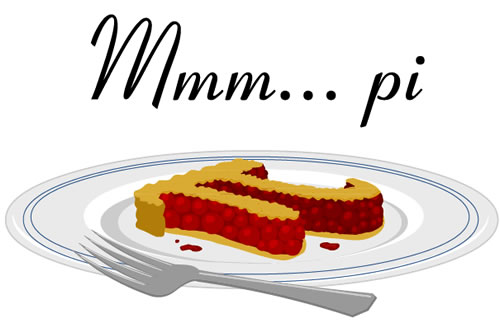
1. Pi Day – Today’s date can be written in month/day format like this: 3.14, which happens to match the first three digits of the mathematical constant, pi. People around the world celebrate this holiday by eating pie, reciting as many digits of pi as they can, and talking about both (pie and pi). Happy Pi Day!

2. Albert Einstein’s birthday – The world’s most respected patent clerk was born on this date in 1879. People around the world commemorate the occasion by discussing physics — or at least reciting the equation E = mc (squared) — and wearing fabulously big hair.

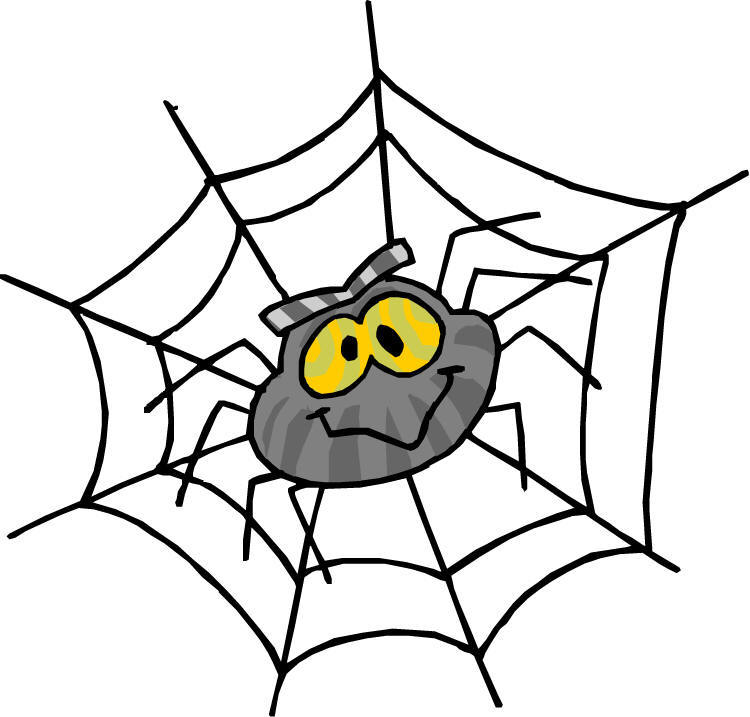
3. Save a Spider Day – This is my favorite thing about today, because I love spiders! (See my other spider-related posts for details.) I haven’t seen any since the large jumping spider my son found hiding in his bath towel last month. (I’m not sure who was more freaked out by the encounter, but I’m happy to report that both survived.) I did walk through a bit of spider web in the yard yesterday, though, which I was pretty excited about (once I stopped ninja dancing to get it off me, of course.)

In the spirit of the day, I invite you to eat some pie, tease your hair, and read this winning contest entry by Brandon J., “Spider Day.” A fellow spider dork salutes you, Brandon!

Weird, true math story

Alas, hunky actors did not likewise appear.

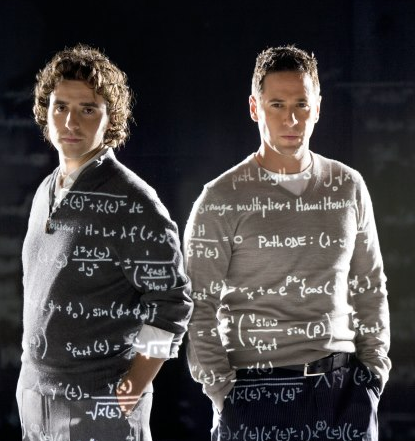
As bedtime approached last night, my son casually mentioned a story problem from his algebra homework that had stumped him. He related the problem to me, and it was like a scene from Numb3rs: I could SEE the variables and their relationships, as if they were floating in the air before me. (Note: this has never happened before. Ever.)

My son wandered off to brush his teeth, and I scrambled for paper and pencil and began frantically writing down mathematical equations, afraid I would somehow lose them. (This also has never happened before.) When he came back, I handed the paper to him and went to deal with some laundry. His father took an interest, and I could hear the two of them puzzling over what I had written. I called down the hall words that I swear have never before crossed my mind, let alone my lips: “You need to set up a binomial equation.”

Where the heck did THAT come from? I can’t remember where I put my keys not five minutes before, but stuff I all but flunked over 30 years ago spontaneously pops into my brain? As dementia closes in and other faculties fade, am I becoming some kind of mathematical idiot savant?

Maybe I should sign up for some math courses at the community college…

(By the way, they were able to solve the problem by following my suggestions, though they resorted to using a calculator. Wimps.)

Calling all math nerds!

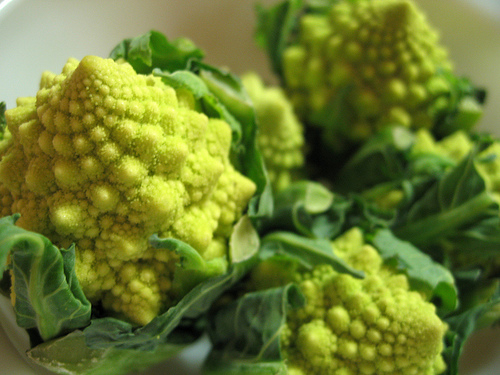
I have discovered a new brain food: Romanesco Broccoli, also known as Roman Cauliflower. The edible flower heads of this incredible brassica grow in chartreuse nested logarithmic spirals. Check it out:

This lovely photo is from The Nutmeg Polymath, whose blog entry on this fabulous fractal food caught my eye and got the wheels turning in my head. If I can figure out how to manage it, you’ll be seeing these babies growing in my yard. How much more ornamental can a vegetable get?

(For more information and amazing photos, visit John Walker’s Fractal Food page.)