Here there be dandelions

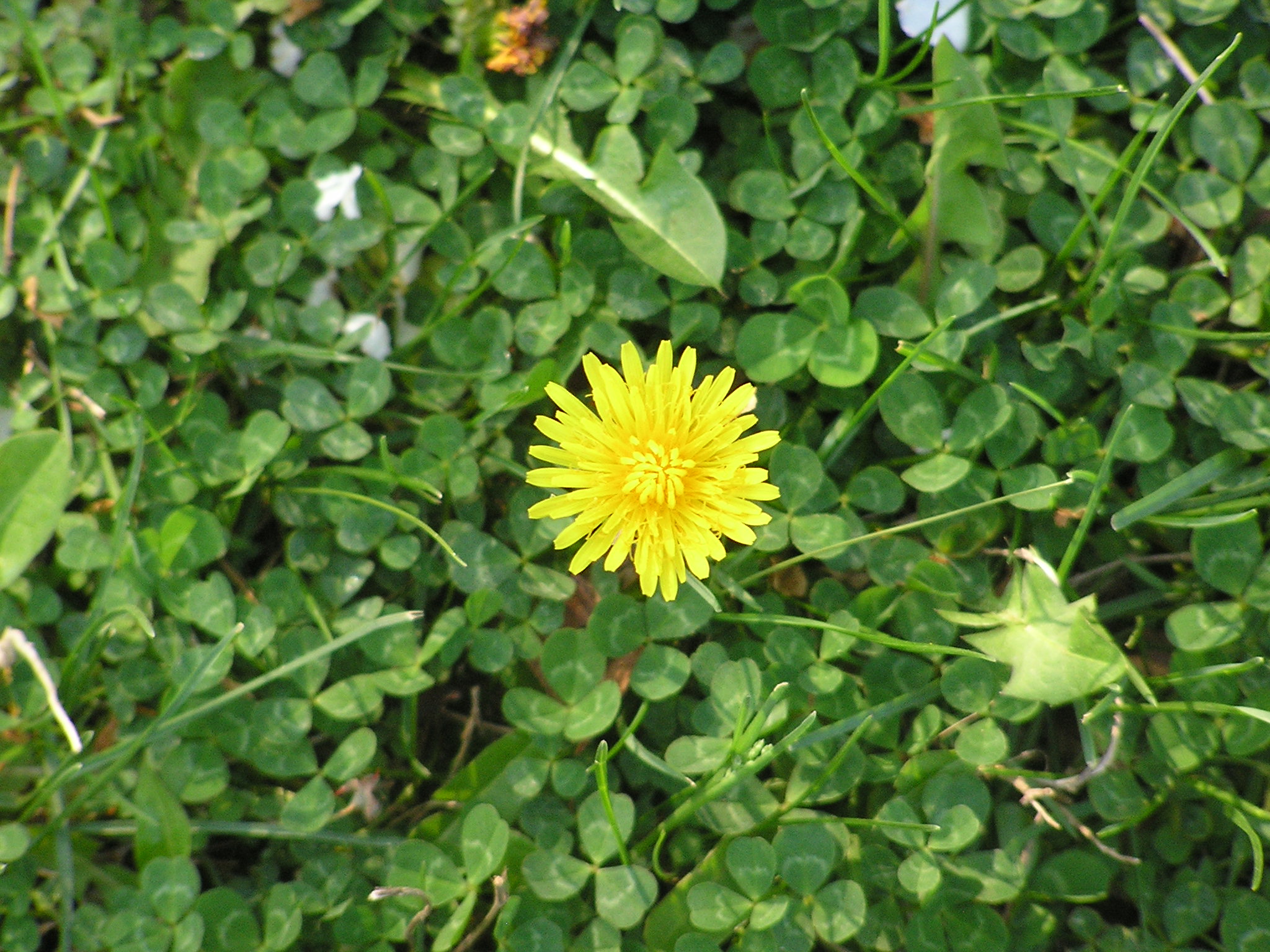
Actual photo of actual dandelion from my actual yard. Note that it is growing in a patch of Dutch white clover. Smart plant!

My yard is full of dandelions!! Whahoo!! Allow me to explain:

Twenty-some years ago, a developer bought a tract of land from a farmer who was retiring and had no one to carry on after him. The land had been used to pasture cattle, being a little too rolling to make easy fields for crops. The developer scraped away the good Kentucky topsoil that had been built up over thousands of years and sold it. Then he graded the rolling hills to make good postage stamp-sized lots and built houses on them, laying sod directly over the compacted clay hardpan that now comprised the soil surface. (I’ll give him credit for one thing, though: he left the existing trees, mostly choke cherry and locust, in the ravines and along the fence rows. I bless him for that.)

The new homeowners dutifully watered and fertilized and pesticided the sod, artificially sustaining it on its tilth-less foundation. They kept this up for fifteen years, maintaining a very respectable-looking lawn of artificial turf. Then some nature-nuts moved in (that’s us) and made the yard quit cold-turkey: no more watering, no more dope.

The first summer was unseasonably cool and rainy, so the yard got a chance to ease into this new, clean life just a bit. The next summer was hotter and drier, and the ill-adapted sod grass fared poorly. We put compost on the yard, but the hardpan had such low absorption capacity that the first good rain washed it away. Crabgrass loves infertile soil with poor drainage, however, and took over the bare patches. We were just glad that SOMETHING was growing.

The next year, we spread Dutch white clover seed. The rains carried much of it away, but enough found a toehold to make a few lush, green patches. Several shallow-rooted species of “weed” began to appear, and we rejoiced: it was a beginning.

Now to the dandelions: last year (year five) was the first year dandelions appeared anywhere other than the raised flower beds. Dandelions have deep taproots; they will not grow where the soil is too compacted to penetrate. Once they do start growing in compacted soil, though, their taproots help to loosen it. Their presence in my yard indicates an improvement in soil quality, both in fertility as well as tilth. There remain places in the yard where they will not yet grow, but this year’s crop is a big step forward.

Another year or two of dandelions and we might be able to grow some grass.

Calling all math nerds!

I have discovered a new brain food: Romanesco Broccoli, also known as Roman Cauliflower. The edible flower heads of this incredible brassica grow in chartreuse nested logarithmic spirals. Check it out:

This lovely photo is from The Nutmeg Polymath, whose blog entry on this fabulous fractal food caught my eye and got the wheels turning in my head. If I can figure out how to manage it, you’ll be seeing these babies growing in my yard. How much more ornamental can a vegetable get?

(For more information and amazing photos, visit John Walker’s Fractal Food page.)

Baseball is upon us

Yes, I am a baseball fanatic–not a mere “fan.” I’m one of those crazy people who understands why Benjamin Sisco keeps a baseball on his desk in Star Trek: DS9. I actually believe all the mystical mumbo-jumbo in every baseball movie ever made. I own not one but TWO decks of baseball-themed tarot cards: The Tarot of Baseball and The Baseball Tarot. (If anyone knows of others, please let me know.) Now that we live near Cincinnati, my Mother’s Day gift is tickets to see my beloved Reds.

Both my kids are in their fourth year of Little League baseball. Last year they fell into the same age division and were thus on the same team. This offers clear and compelling (to me) evidence of the existence of the gods of baseball: having only one team schedule to follow left me time to grapple with some serious health issues I was facing.

This year the older child has moved up into the highest age division, the major league, while the younger child remained in the minor league. This means that, between practices and games for the two teams, I can count on one hand the number of days each month we will NOT be at the ballpark.

Both teams have played their season openers, and both won. Hurray! I have now logged the first four of 75+ hours (not counting the playoffs) I will spend on unforgiving aluminum bleachers, eating hotdogs and giant pretzels, rain or shine. I feel ridiculously and unaccountably euphoric.

It’s baseball season. And I’m in heaven.

Thank the baseball gods.

When life gives you nuts…

I really dislike bumper nuts—you know, those chrome or plastic imitation scrota designed to dangle beneath the rear end of a truck or SUV. If you have never seen these bizarre accessories, consider yourself lucky. (Someone who feels the need to drive an oversized vehicle and give it genitalia is clearly overcompensating for something.) You can look them up on the internet; if they seem appallingly tasteless on a web site, you should see them in traffic.

I do, however, owe a reluctant debt of parental gratitude to these insignia of insecurity, or at least to one in particular. While sitting at a red light, my children and I were admiring a souped-up sedan in the lane next to us. As the light turned and the car pulled away from us, my ten-year-old son spotted something large and shiny swinging below the rear bumper.

“What’s that hanging off the back?” he asked. I laughed to buy some time, took a deep breath, and answered, “Those are supposed to represent testicles.” Silence filled the car.

“You know what testicles are,” I prompted. A glance in the rear view mirror was not reassuring. Their faces wore expressions of mild puzzlement and deep suspicion. Oh, geez, I thought with dismay, I know we’ve talked about this stuff before! Trying not to appear flustered, I launched into what I hoped was a matter-of-fact description of testicles. After a few sentences, my seven-year-old daughter’s face brightened.
“Oh, you mean balls!” she exclaimed.

“Uh, yes,” I sputtered, caught off guard, then added weakly, “I didn’t realize you knew that term.” A chorus of “Duh!” from the back seat dissolved the tension, and I attempted to reclaim the intellectual high ground by emphasizing the correct medical terminology. That brought “weenie,” “boobs,” and “butt” into the conversation as further examples of slang terms for body parts.

Suddenly self-conscious about where his question had led, my ten-year-old slumped in his seat and buried his face in a large book. Never one to shy away from sensitive topics, his sister pressed on with all kinds of questions, and we had our most detailed sexual information talk to date. I swear I looked in the rear view mirror and saw my son’s ears appear around the edges of his book as he strained to hear every word. All my nervous preparation for a “teachable moment” just like this was finally paying off, and by the time we got home I felt like Supermom!

Call me ungrateful, but I still really dislike bumper nuts.

Garden delights (an old-fashioned poem)

Will you meet me in the garden
B’neath the rhubarb’s spreading leaves?
We will make for us a bower
And discuss the birds and bees.

Will you come at daylight’s breaking
To the hawthorn wet with dew,
Find with me a guarded nest there
Perfect sized and shaped for two?

Will you share with me the twilight
Of the arbor’s shaded room,
Suffer sweet intoxication
‘Mid the roses all in bloom?

Will you nill you, I shall have you,
Queen of bees and knave of hearts;
‘Tis the dance that we were born for:
Come together, draw apart.

The crab (a poem of questionable merit)

I’ve molted again
split open and squeezed out
from a life too small
the new carapace hardens
thicker and tougher than before
claws larger, grip stronger
more of a mouthful, not such easy prey
maybe I’ll be bolder
just hope I’ll be lucky enough to live
to molt another day

Monstrosity: a nightmare

A child stands in a room on the ground floor of a grand old house. The room is wood-paneled, with high ceilings, a fireplace, and cases full of books built into the walls. It is furnished with wing-backed chairs in reddish-brown leather and small tables with reading lamps. Over the fireplace hangs a large copy of the painting “The Spirit of ’76.”

In the rooms overhead, the child hears heavy footsteps. She looks at the ceiling fearfully; those are the footfalls of her grandfather, who has been transformed into a monster. She is hiding from him here in the study. The room is still except for the movements of the monster and the quiet crackling of the fire.

Somewhere in the room a frog begins to croak, something between the high trill of a spring peeper and the deep boom of a bullfrog. The child is loathe to move for fear of making some noise that might attract the monster, but she is curious about the frog. She listens carefully; the sound seems to be coming from the area near the fireplace. She creeps toward that part of the room with painful caution, pausing frequently to listen for the monster, which can still be heard roaming upstairs.

The croaking sound is clearly coming from the immediate vicinity of the fireplace, not from the bookshelves on either side. But the hearth is wide and clear, offering no place for the frog to hide. The child ventures into the open area before the fireplace, trying to make sense of what her senses are telling her. She stares at the licking flames and glowing coals, feels their heat scorch her face. In a flash of horror she realizes that the croaking sound is coming from within the firebox.

Overwhelmed by the enormity of this paradox, she shifts uneasily, unconsciously. The ancient wood floor creaks loudly. She freezes, eyes and ears on the ceiling. The monster has also stopped. After a long moment it begins moving deliberately in the direction of the staircase. It has heard her.

Giant spiders: a dream fragment

A woman notices an enormous spider in the house. It is easily as large as her hand, though it has a body type unusual for such a large spider: huge abdomen, small cephalothorax, and long, delicate legs. Its racquetball-sized abdomen is a ghostly grey, the color of certain dusty-hued pearls. Its legs and cephalothorax are dark, either black or brown.

The woman’s children, who have been taught from infancy to admire and respect spiders, are careful of the creature and not in any way afraid of it. There are other people in the house, however, and she is concerned for the spider’s safety. She decides to find it and remove it to the relative security of outdoors.

She searches carefully through the house, finally spies the spider slipping through a door that has been left ajar. She follows and finds a densely foliated shrub with large leaves. On further investigation, she is amazed to discover that the shrub houses a whole colony of enormous spiders of a different type from the one that led her there.

These spiders are built like tarantulas, with short, thick legs and abdomens in proportion to the rest of their bodies. Unlike tarantulas, however, they are not covered with fine hairs but are smooth with small raised bumps like the exterior of a starfish or a cucumber. Each spider is a single, vivid shade of green, orange, pink, yellow, or red. They remind the woman of huge tropical flowers as they crawl about the shrub. Filled with wonder and delight, she calls her children to come see what she has found.

The assassin: a dream

A woman sits in a throne room, on cushions to one side of the throne with the rest of the king’s harem. Like the others, she is wearing beautiful clothing made of costly and exquisite fabrics. Unlike the others, she has concealed on her person a small but deadly weapon. She is a trained assassin, placed in the harem as part of a plot to kill the king. She is the failsafe, the guarantee that the plot will succeed.

She is in place on this day, as on so many days before, wholly unsuspected. A delegation of merchants from a certain city is announced, and she knows that today is the day. The members of the delegation are also assassins; she is to kill the king if their plan does not succeed.

She was raised to think the king a cruel tyrant, but her time in the harem has shown her that he is a just ruler and a wise man. Although her entire life has been dedicated to the fulfillment of this mission, she finds herself questioning the righteousness of her cause. A squabble breaks out among the merchants as they approach the throne. All eyes are drawn to the growing commotion; the moment is at hand. She leaps for the throne, weapon in hand.

“It’s a plot to kill the king!” she cries, assuming a defensive stance between the king and the would-be assassins. Once the guards have neutralized the threat, she turns, drops to one knee, and lays her weapon at the king’s feet. “I know because I was part of it,” she adds with bowed head. She did not expect to survive this day in any case. It is enough to know she has acted with integrity.

Instead of ordering her to be executed, the king asks her to be his personal bodyguard. Amazed and overjoyed, she agrees. She realizes that she has truly found her life’s purpose.

The diver: a dream fragment

A woman stands, poised to run, several strong cords secured about her waist. They trail behind her, each terminating in a stout bar that serves as a handhold for those who will accompany her. In a few moments she will run full tilt toward a large screen and dive headlong into it. In doing so she will plunge into Hell, pulling with her anyone brave or foolish enough to take up the tow ropes. This is not her first foray into Hell; she goes again and again to battle demons. She doesn’t know why the others go with her, only that this peculiar ability is her lot, her gift and burden.