Universal truth

My friend Murphala has posted a lovely photo of a male North American wild turkey at her blog, FlourWaterYeast&Salt. In the comments, someone expressed gratitude at not being a girl turkey, which brought to mind the following:

When he was little, my son and I went to the Beardsley Zoo in Bridgeport one overcast fall weekday. Several of the habitats at the zoo feature native fauna, and many of the animals were active because it was cool and cloudy and there were very few people about. We stood for a long time watching the wild turkeys.

About half of them were on one side of the habitat, foraging and gabbling quietly among themselves. The rest of the turkeys, who had been loosely grouped together on the far side of the habitat, began to approach the others gradually, with a studied casualness that seemed almost stealthy.

As they neared the first group, the feathers on their breasts puffed out dramatically and their gait became a stiff and rather formal kind of strut, complete with head motions. The first group – now it was clear they were females – took one look at the approaching males and trotted off to the other side of the enclosure, gabbling to each other. It took a couple minutes for the males to realize that the females had left – it has to be pretty difficult to see around that puffed up chest.

When they did notice, they lowered their feathers and looked around, no doubt critiquing their performances and wondering where the females had gone. Once they figured out the latter, they began to deliberately stroll toward that part of the enclosure, and the whole drama played itself out again.

As with most courtship rituals, it looked rather absurd from the outside. “Silly turkeys!” we giggled together as we watched.

After a few more iterations, my son asked what they were doing and why. I explained that the boy turkeys (that group there) were trying to get the attention of the girl turkeys (that group there). His mouth opened in wordless astonishment. Really? I nodded. He turned a quizzical eye back on the turkeys, where the females again evaded the attentions of their would-be suitors.

“I don’t think it’s working,” he said with a somber shake of his head.

Some days, it seems there’s not as much difference between us and the turkeys as we’d like to believe.

Happy Halloween!

As an October baby, I love Halloween. It’s my favorite holiday, in fact. I have enough Halloween decorations to adorn two houses, and enough Halloween clothing to wear for the entire month of October.

This year has been strange, though, in that I don’t even have a pumpkin to carve, and I haven’t worn a stitch of holiday-themed clothing until today. I can’t attribute this lack of preparation and celebration to any one cause; rather, it seems to be the cumulative result of a number of small circumstances that have been piling up all fall.

Today is THE day, however, the high festival of The Great Pumpkin himself. I am wearing orange socks adorned with black spiders and white webs, a candy corn-covered turtleneck, and an orange t-shirt with a jack-o-lantern face. I have a huge stash of candy for this evening’s visitors, and I baked pumpkin bread. Some of my daughter’s friends will gather here after school to eat Monster Burgers and Butterscotch Brooms before trick-or-treating; my son plans to canvas the neighborhood as a some form of dead Roman. I think I’ll mull some cider (maybe add a little bourbon?) to take off the chill as I answer the door.

Because Halloween is descended from Samhain, an old new year’s festival, I thought it would be fun to do a new year’s reading with my favorite cards, the Halloween Tarot. I even invented my own spread (with inspiration from Christine Jette’s Tarot for All Seasons and Monica’s Tarot in a Teacup).
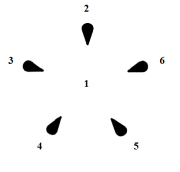
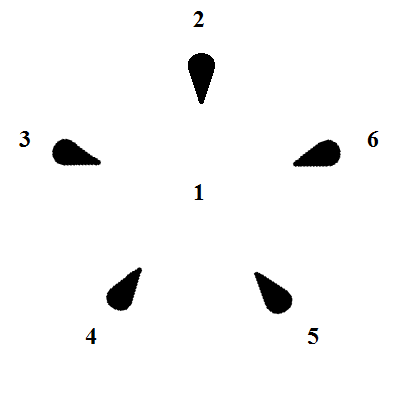
Seeds for a Fruitful New Year (card layout)

Apples are a fall fruit, despite the fact that the global market means we can get them year-round. They belong to the botanical family Rosaceae, which is characterized by flowers with radial symmetry and five parts: sepals, petals, and in the case of apples, ovaries. If you slice an apple in half across the middle, you will see that the ovaries form a five-pointed star around the core, and each ovary contains a seed.  I used this as the basis of my layout, which I call my Apple Spread for the New Year.
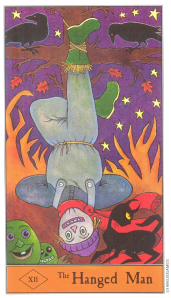
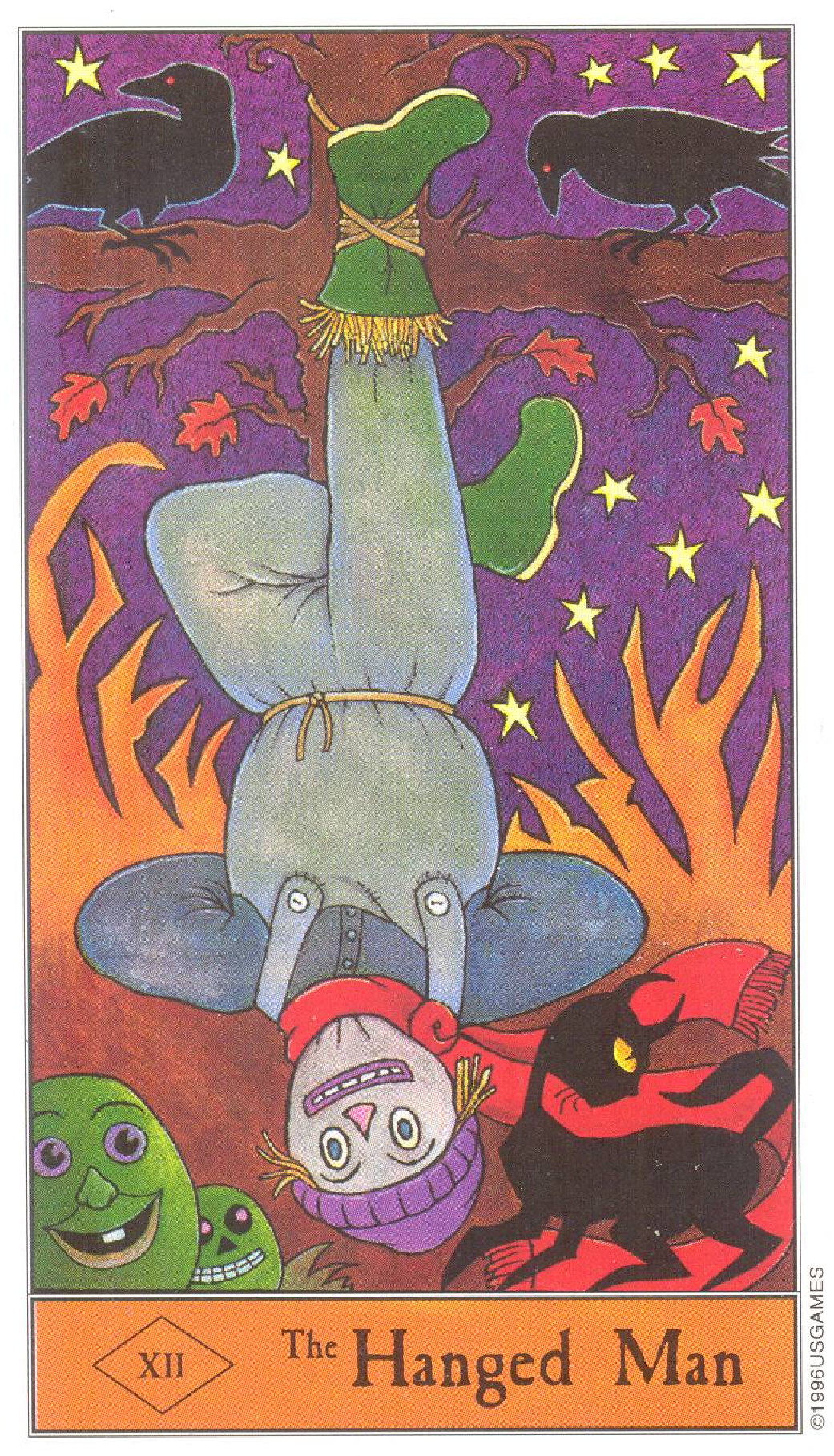
The first card is the core, that which is at the center. I drew the Hanged Man, which the Halloween Tarot pictures as the Scarecrow, that  brave and brilliant thinker from Oz. The two birds also allude to Odin (who was accompanied by two ravens) hanging on the World Tree to gain the wisdom of the runes. This card is about wisdom — not knowledge — won through patience. Being upside-down gives one a different perspective, so this card also speaks of the wisdom to be gained by shifting one’s point of view.
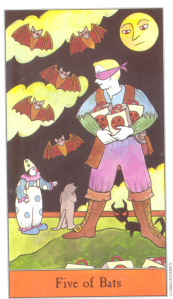
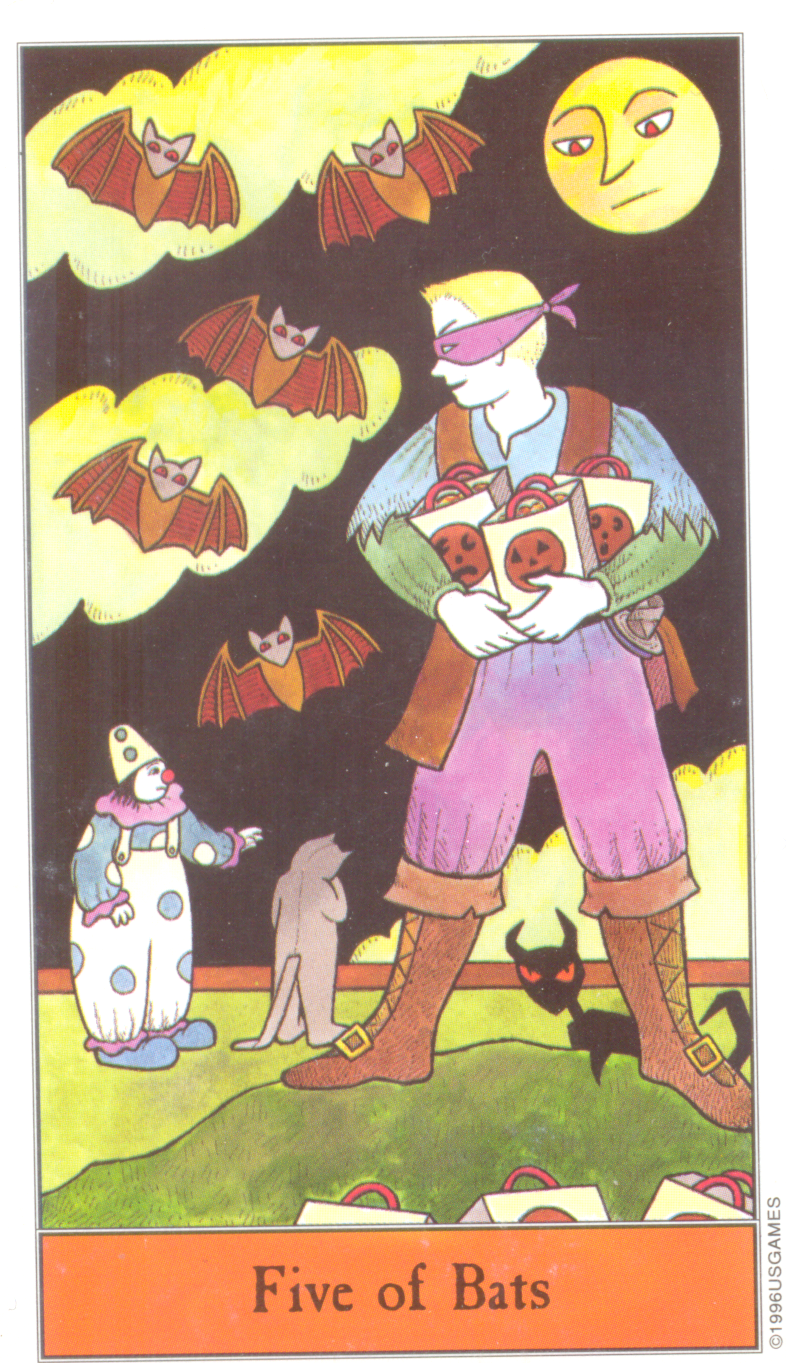
The second card is the seed of what needs to be accepted. I drew the Five of Bats, which depicts a bully stealing and hoarding that which belongs to others. I take this to suggest that greed and avarice will continue to predominate a lot of behavior over the next twelve months. If we recognize that these base motives are behind many of the world’s ills, we may be better prepared to combat them.
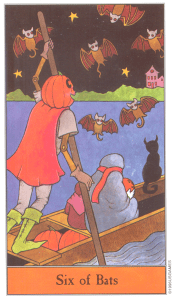
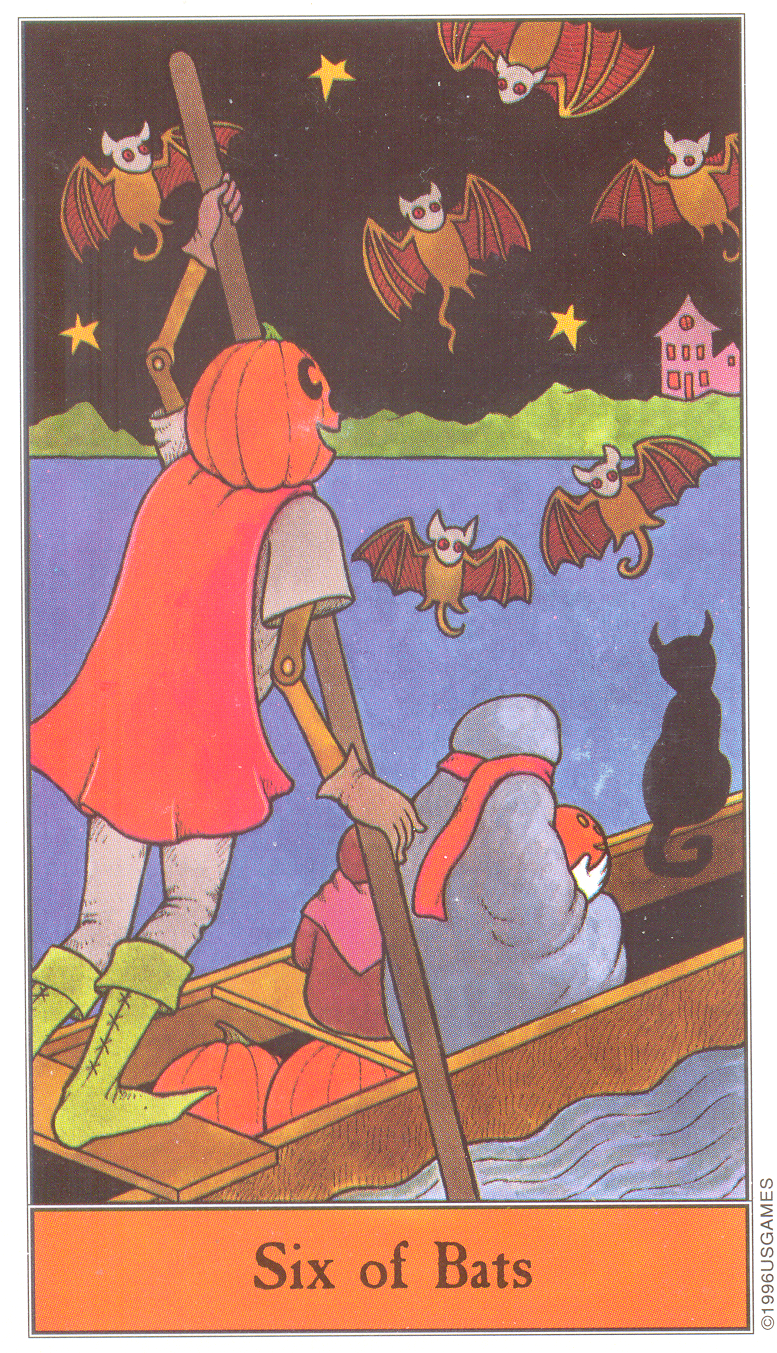
The third card is the seed of what needs to be released. I drew the Six of Bats, which is about moving on. This card always seems a little sad to me; the people in the boat look forlorn, but that might well be a projection of my own reluctance to let things go. We don’t see any faces in this picture — perhaps the passengers are smiling, looking ahead to what lies before them. The buildings on the shore are brightly lit and inviting, and the woman holds a carved jack-o-lantern on her lap — they could be on their way to a Halloween party! Maybe the thing we need to let go of is our fear and pessimism.
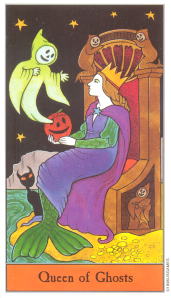
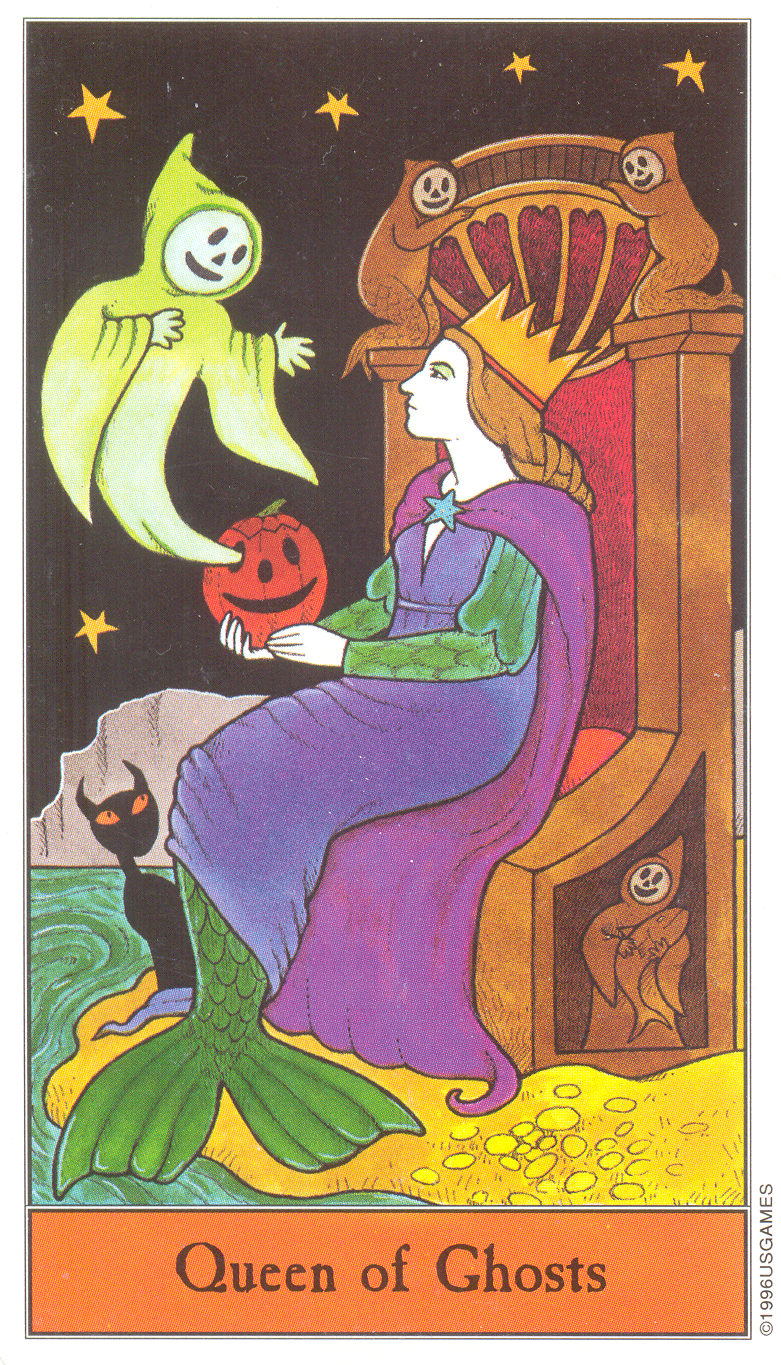
The fourth card is the seed of what needs to be kept. I drew the Queen of Ghosts, whose throne sits on land though she is a mermaid. She represents the capacity to feel deeply and to nurture emotional connection with others. Those seem like good things indeed to hold onto.
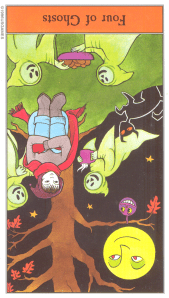
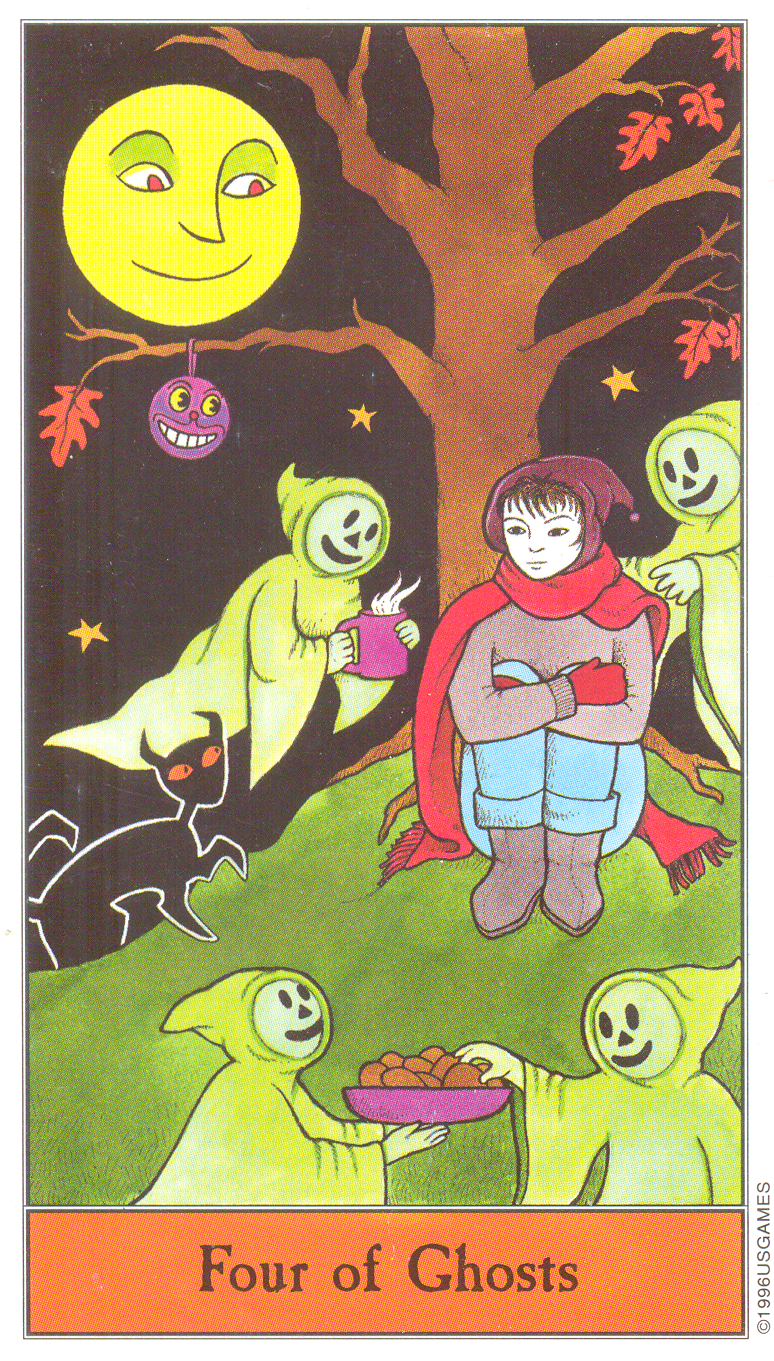
The fifth card is the seed of what needs to be focused on. I drew the Four of Ghosts, reversed. Some people don’t bother with reversals, but I like the additional challenge they bring to a reading. This card is about apathy, particularly the kind that arises from self-imposed isolation. The youth in the picture is literally surrounded by friendly spirits, but seems closed off to them and their ministrations. I read this reversal to suggest that we focus on turning this trend on it’s head — be more attuned to those who are reaching out to us, and be the one who reaches out to break the isolation of others.
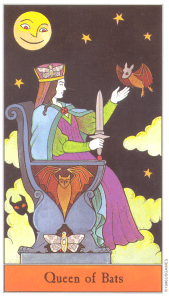
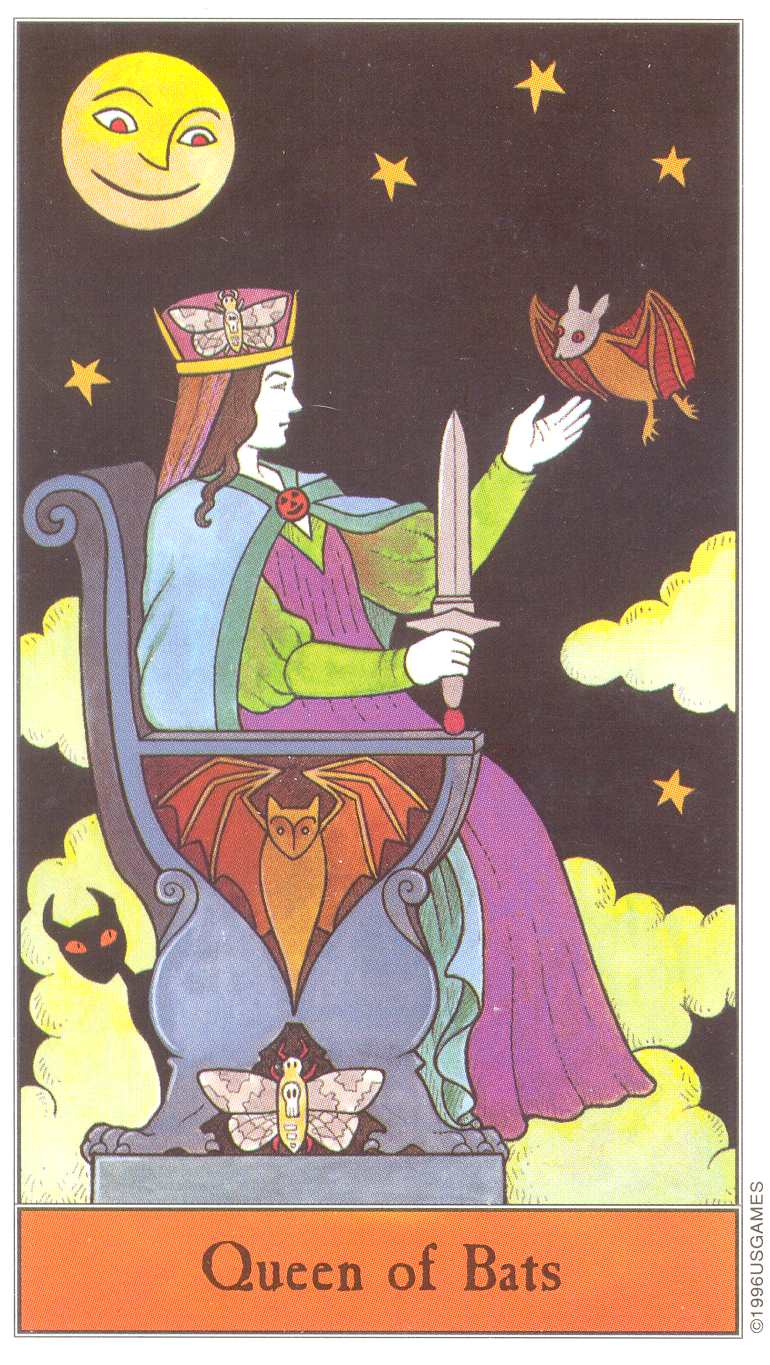
The sixth card is the seed of what needs to be learned. I drew the Queen of Bats, who holds the sword of discernment in one hand and welcomes a bat, image of thought guided by listening, with the other. In the next year, let us learn how to listen with care and intelligence, and learn how to welcome and nurture the role such listening plays in discernment and sound judgement.

Enjoy your Halloween celebrations, whatever form they take, and husband the seeds that have been planted in your life so that they bear good fruit!

(All card images from The Halloween Tarot by Kipling West.)

5 Nov 12 update: I’ve decided to rename this spread Seeds for a Fruitful New Year.

Fragmented poetry, found

I offer the following fragment of found poetry to prove that I have been writing, even though I haven’t been posting. Feel free to comment, make suggestions, or add your own stanza(s)!

inspired by the perilous moon
dying on the waters
your incandescent darkness leaves me
mute with terror/desire/wonder

Happy NERD!

Today has been designated a national Electronic Records Day (NERD) by the Council of State Archivists to raise awareness about digital records resources. In addition to supporting the creation and management of government digital records systems, CoSA offers a tip sheet of survival strategies for personal digital records.

The best of these tips is the reminder to periodically migrate files to newer media. This both allows you to continue reading the files and prevents file loss through media deterioration. I still have a file box of 5.25” floppies with all my undergraduate papers on them, and at least one file box of 3.5” floppies full of graduate school papers, poetry, journal entries, and essays. All are in formats that I’m sure are now unreadable, even if the floppies haven’t suffered any age-related degradation.

Isn’t it funny how we imagined that the digital revolution would allow us to store our personal data in perpetua, with little effort and even less space? It turns out that old-fashioned paper remains the most low-maintenance storage medium, despite the vulnerability of pulp and ink to all kinds of environmental conditions.

So celebrate NERD by checking out your own state’s electronic records resources. Then download the survival strategy sheet, pick one tip that will help you manage and protect your personal records, and DO IT.

Words to live by

“Better to sleep with a sober cannibal than a drunken Christian.”

So says Ishmael, the narrator of Herman Melville’s Moby Dick, shortly after meeting his room/bedmate, the South Seas islander Queequeg. I must say it’s a thought that’s given me pause since I heard it the other day.

If you have not already discovered it, allow me to recommend the Moby Dick Big Read, a fantastic audio project spawned by a 2011 symposium and art exhibition on the whale at Plymouth University. All 135 chapters of Melville’s classic have been read aloud and recorded, to be released for free download, one chapter a day from the middle of September to the middle of January.

I know someone whose father read her Moby Dick as a bedtime story when she was little. She recalls those evenings with warmth and fondness, and believes they instilled in her a life-long love of the sea and all things maritime. Listening to these audio files, I imagine myself a small girl, snuggled beside my friend beneath a billowing comforter in her childhood bedroom. Even the shadows in the corners seem to bend closer to catch the animated cadences of her father’s voice, rising and falling like the sea.

Jennifer-pooh* and some bees

* a Barricklow of Very Little Brain

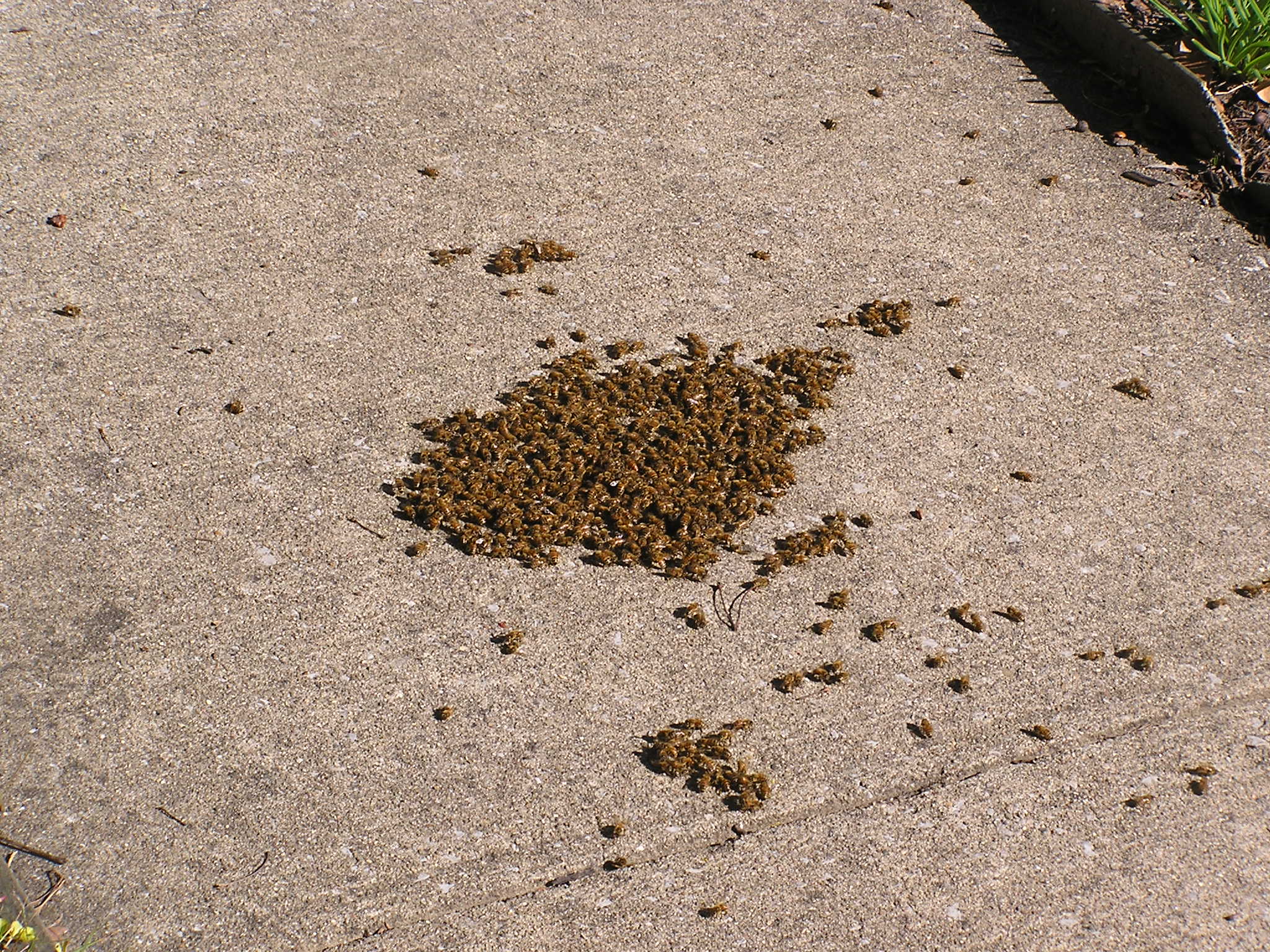
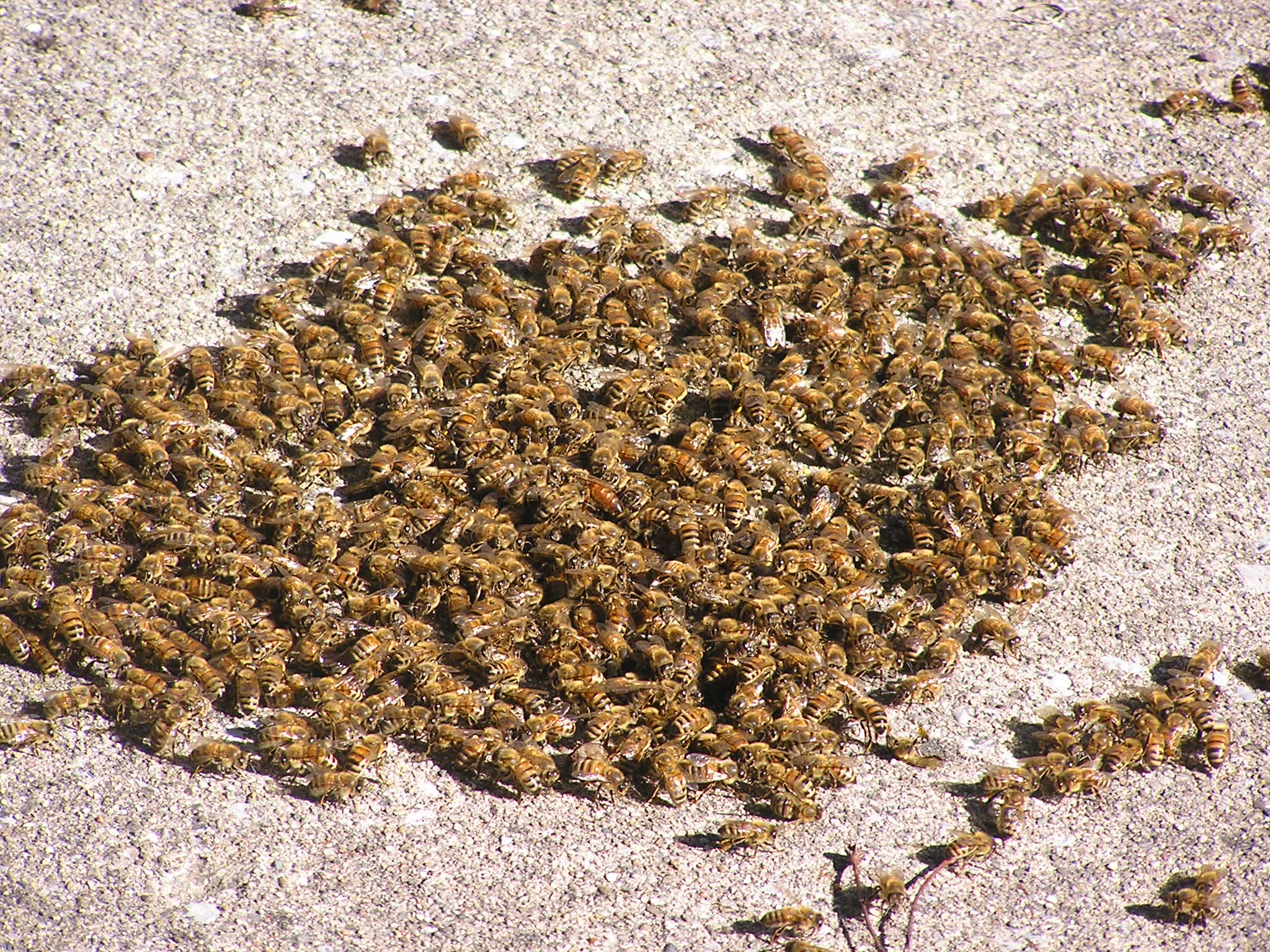
Monday morning, after I left the youngest at the corner on her way to the bus stop, I noticed a strange pile of…something…near the mailbox. It looked as though someone had dumped a very large scoop of pelleted pet food in the middle of the sidewalk. When I got close enough to see the “pellets” more clearly, I realized they were bees. Hundreds and hundreds of honey bees, curled up tight and motionless, clinging to each other in a mass.

A swarm, frozen. (Not literally, but temperatures were in the upper 30s, so they were quite immobilized by the cold.)

The bees weren’t the only ones effectively immobilized. It being early and I not being particularly brainy at that hour, I didn’t do what I should have done, which is scoop the mass into a box and move it off the sidewalk. I did think to drag some lawn chairs and compost buckets out to block the sidewalk, however, so the neighborhood’s avid walkers wouldn’t stumble into the swarm. (I was actually more worried about the welfare of the bees than that of the walkers.) Being also heavily under the influence of cold medication, I went back to bed, resolving to check on the bees once the sun had hit them in a couple hours.

My morning-fogged brain had reasoned that they would warm up, wake up, and fly off on their business. When I checked them around 10:00 a.m., they were moving alright, but mostly moving around rather than moving on. Scout bees would spiral up from the mass every few seconds and take off in various directions, but an awful lot of them remained on the sidewalk. I recognized the tactical error of failing to move them while they were easily moved and realized it was time to involve someone who actually knew what they were doing.

I put the word out on Facebook and soon heard back from a friend who had the phone number of a local beekeeper. By the time he got to my house, it was around noon, and about half of the bees were off scouting for new digs for the colony. The pile of bees was now more of a puddle.

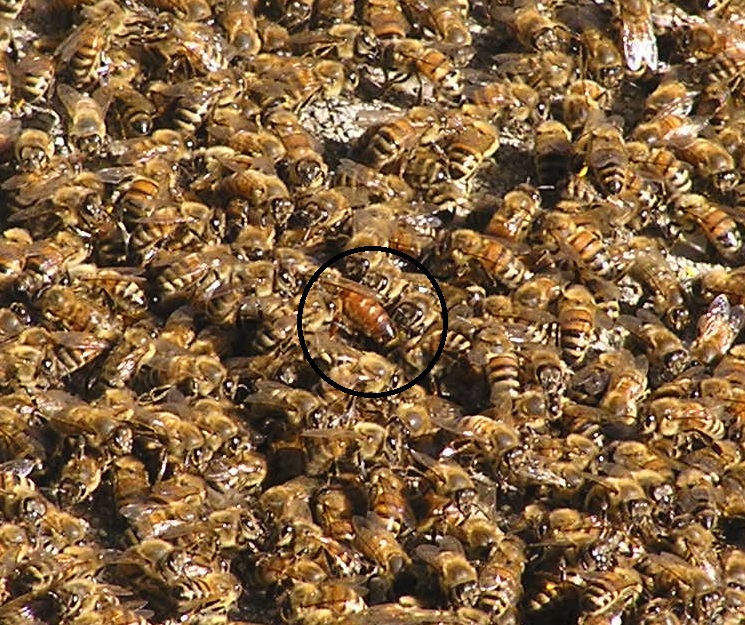
The beekeeper was a little disappointed, but I explained that there had been twice as many bees when I’d started looking for help. He was somewhat molified when he confirmed that there was a queen among them, though she was very young and not very large. (That’s her in the black circle below.)

He placed a lidded hive section, loaded with a few comb frames, over the puddle and tapped on it. (That apparently encourages the bees to climb up; I suppose they want to see what the heck is making that annoying sound.) After a few minutes, he lifted the lid, and sure enough, bees were clambering over the box’s interior. The young queen herself had climbed right to the top, so he carefully put the lid back to prevent her from escaping.

He hung around as long as he could to give returning scouts a chance to join the group, but had to allow himself time to drop the new bees off at home before returning to work. It’s too bad he couldn’t have left the box there for the rest of the day, as several dozen scouts returned throughout the afternoon and seemed lost without their queen and their sisters. A number of them collected on a branch overhanging the sidewalk, which leads me to think that the swarm had settled in the tree for the night but somehow lost their collective grip because of the cold and dropped to the sidewalk.

While waiting for the beekeeper, I spent a delightful half-hour sitting on the sidewalk, watching the bees. The sound of them was soothing, and their furry golden bodies glowed in the sun. It was fascinating to watch them interact, always touching one another with feet or antennae, coming and going on their marvelous and mysterious (to me) business.

I was so relieved when the beekeeper agreed to take those who would come and to do what he could for them — it’s quite late in the season for such swarms, and they will need a good deal of help to get through the winter. I hope with all my heart that the young queen not only survives but does well for him. As a wild bee, maybe she’ll bring some new traits into his hives that will improve them. May she live long and prosper.

(Bonus points if you can find the queen in the last photo.)

The sesame made me do it

It happened again.

Inspired by this recipe at cozywalls, I made sesame sauce to toss with spaghetti squash for lunch and ended up eating the entire squash. At least yesterday it was squash; last time it was a whole package of buckwheat udon.

I made a good faith effort: I divided it into two generous portions, put one in a plastic container in the fridge and the other on my plate. I sat down to eat, and the flavor was fantastic! The texture of the spaghetti squash was unusual, and the way it interacted with the texture of the sesame made me roll my eyes. I’ll just have another taste, I told myself. There’s still plenty for tomorrow, I reasoned. And before long, the plastic container was empty.

I wish I could say, “I can’t believe I ate the whole thing,” but I can and do believe it. It was that yummy.

Thanks to the lower density (and lower caloric content) of the spaghetti squash, I didn’t feel grotesquely bloated as I did after I finished off the sesame-coated udon a couple weeks ago. I don’t think one can actually feel virtuous about having single-handedly eaten an entire squash in one sitting, but it could have been worse. (Is that rationalizing?)

I can’t seem to lay off the sauce – I store plain noodles in the refrigerator all the time without the least temptation to pull them out and eat them. Amy at cozywalls says the stuff tastes even better if left to sit overnight, but I’m beginning to doubt that I will ever find out for myself.

So here is the plan from now on: I will only make half as much sesame sauce, and toss it with just half of the noodles (or medium du jour). If this strategy doesn’t work, I may need an intervention.

And here, so you can develop your own sauce habit, is the recipe:

Quick and Addictive Sesame Sauce

2 tbsp. sesame tahini
2 tbsp. balsamic vinegar
1 tsp. hot sesame oil
1 tsp. minced garlic
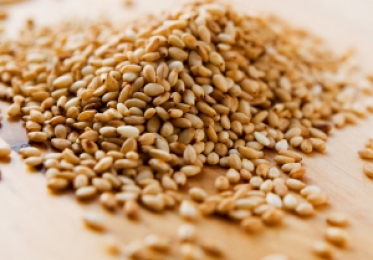
sesame seeds for garnish (toasted or not — your preference)

Stir together first four ingredients and toss with cooked noodles, spaghetti squash, cucumbers, broccoli, snow peas, bean sprouts, shredded cabbage, or anything else that sounds good. Sprinkle with sesame seeds. (Makes enough sauce for 8 oz. package of noodles.)

Paperweights: a poem

Lately I’ve become obsessed with paperweights, she said
Globes of millefiori or lampwork flowers
birds, butterflies, and fish more brilliant
than life
captured mid-swirl
color and light eternally moving in the arrested instant
How can a world, a moment
so fragile and delicate
lie so solid and substantial in my hand?

War of the Worlds: a review (with spoilers)

I finally got around to seeing Steven Spielberg’s 2005 War of the Worlds a couple weeks ago. I’d mostly heard that Tom Cruise played an obnoxious jerk (some claimed this was type-casting) and that everyone was rooting for the Martians to get him. I was mostly interested in the special effects; I already knew the story, and it didn’t sound as though the characters would be all that interesting.

The special effects were fantastic, as they should have been, but the characters really caught me by surprise. Ray (Cruise’s character) was indeed a jerk, a thoroughly unlikeable person to the very end. But Spielberg and Cruise pulled off something wonderfully tricky and subtle with Ray: they got me to care about him, even to sympathize with him, despite my distaste for him. They did it by showing his anguish, his terror, his desperation, his impotence – emotions that resonate at the level of instinct. In other words, they made him deeply human, flawed and vulnerable, and I found myself immersed in the nightmare of the Martian invasion through his experience.

The other surprise was Rachel, played by Dakota Fanning. She began as a very sympathetic character, a sensitive child who ended up more or less abandoned, stripped of all sources of comfort and security. As the action unfolded, however, she descended into a kind of monotonous hysteria that rendered her an object of pity when she was quiet and a source of irritation when she wasn’t. I found myself wishing the Martians would get her so I wouldn’t have to listen to any more of her shrieking, a base response that was at once perfectly understandable and horrifying.

I was delighted at the little touches in this movie that paid homage to George Pal’s classic 1953 film adaptation. The church near the opening of Spielberg’s film reminded me of the church at the end of Pal’s, and the eye-stalk and portions of the cellar scene were adopted wholesale from the earlier film. Best of all, though, were the cameo appearances of Gene Barry and Ann Robinson at the end.

I was most intrigued, however, by how closely Spielberg’s movie paralleled H.G. Wells’ original novel. I immediately recognized the opening and closing voice-overs as Wells’ memorable prose, setting the story firmly within the novel’s Darwinian framework. Other little details throughout the film caught at my time-fuzzed recollections of the novel, so that I dug up a copy and reread it within days. From the neat folding of Wells’ curate and artilleryman into the single character of Harlan Olgilvy (played by Timothy Robbins) to the significance of the boot in the cellar scenes of both works, great care was taken to translate Wells’ 19th century horror story into a 21st century horror film.

My only quibbles were with the design of the aliens themselves (Pal’s 1953 aliens were much closer to Wells’ descriptions) and the fact that Robbie (played by Justin Chatwin) turned up alive at the end. I realize this is also consistent with the ending of the novel, but it was artificial and unnecessary to the story as Spielberg told it. The film’s climactic triumph had already been achieved with the destruction of the tripod; Ray’s and Rachel’s reunion with the pregnant Mary Ann was sufficient assurance that life would indeed go on. Robbie’s miraculous appearance struck me as more saccharine than poignant, and somewhat spoiled the ending of a film that I otherwise thoroughly enjoyed.

Dream of the Black Dog

Dream of the Black Dog

the black dog and I walk
side by side in the road
he likes the silver in my hair
I protest but he flings
his hindquarters in the air and walks
upside down on his forepaws
I laugh and he staggers
but I catch him
together we waltz down the street
wobbly soulmates
in a yin/yang circus act

The black dog can represent many things: faithful companionship, the patient presence of depression, the masculine aspect of the self (animus), instincts and animal urges, even death. In this dream it was my soul mate and it made me laugh. (Which doesn’t rule out the other meanings, incidentally.)