Happy Groundhog’s Day!

Do you know why they have to drag poor old Punxatawny Phil out of his lair every year? It’s because he knows that the beginning of spring isn’t tied at all to whether or not he sees his shadow. Like all intelligent creatures, he realizes that spring begins the day that pitchers and catchers report for spring training.

groundhog-enorme-toute-grosse-253x300Seeing as that event is inevitable and preordained by powers other than himself, he’d just as soon stay tucked up in a cozy ball of rodenty slumber. Who wouldn’t?

But those nasty men in top hats and weird coats nevertheless haul him out by the scruff of his neck to stage their little weather charade. You can tell from their antiquated dress that even they recognize, in their heart of hearts, that the whole thing is a sham: meaningless, outdated, and entirely superseded by the National Pastime.

And don’t fall for any of that vernal equinox nonsense, either. Regardless of where the planet is or what angle the sun is at, spring begins on the day when pitchers and catchers report, which this year falls on February 11. I mean, come on: they don’t call it winter training — it’s SPRING training. Ergo, it must be spring.

So the next time you find yourself wondering when spring will begin, don’t go dragging any large rodents out of their dens. Just check the baseball calendar.

Off-the-cuff poetry

I’ve been taking a poetry writing class, which is in part why I haven’t posted in a while. I’ve been reading and writing and going to class, and that hasn’t left me time to tend the blog. (Sorry!)

One of the class assignments is to respond to daily prompts. Because of my schedule, these tend to be dashed off in half an hour or so, which has been very fun and freeing. It doesn’t necessarily lend itself to great poetry, but it most certainly is great practice.

Here’s what I wrote in response to the prompt “perfect”:

Pitch perfect

the mitt rests against his thigh
throwing arm loose at his side
he lowers his head, blocks the batter
with the bill of his cap
signals flash between the catcher’s knees until
he looks away and brings
the mitt to his chest
his fingers find the seams, wrap
around the ball as he goes
into his motion and delivers
the perfect pitch


(By the way, spring begins in only TEN DAYS with the four most beautiful words in the English language: “Pitchers and catchers report.”)

More bad poetry: not-haiku

This is not haiku

There’s haiku and there’s lowku,
there’s yesku and there’s noku.
There’s inku and there’s outku,
there’s whisperku and shoutku.

There’s upku and there’s downku,
there’s squareku and there’s roundku,
helloku and farewellku,
heavenku and hellku.

There’s leftku and there’s rightku,
there’s darkku and there’s lightku.
But just between us twoku,
this poem’s just plain cuckoo!

The secret’s in the sauce

Inspired by Molly Katzen’s Autumn Vegetable Soup (Still Life with Menu, p. 49), today I made Whatever the Heck You Have on Hand Soup.

I had a quart bag each of chopped turnips, white sweet potatoes, and acorn squash in my freezer. I had some carrots, celery, tomatoes, and red bell peppers left over from holiday party crudite platters. I had a bit of frozen chopped onion and some frozen chopped Red Russian kale.

I chopped up the leftover crudite, then sautéed the carrot, onion, and celery in canola oil until it began to smell yummy. Then I dumped in the turnips, sweet potatoes, and squash, added 3 cups water and one Garden Veggie boullion cube, and cooked it over medium heat until the turnips were soft. I stirred in everything else, plus three cloves minced garlic, salt, pepper, a little soy sauce, a bay leaf, and a dash each of basil, oregano (in place of marjoram), cayenne, curry powder, and Mrs. Dash. I turned it down to simmer and let it fill the house with savory goodness.

Despite the hearty aroma, the broth tasted a little anemic. I rummaged through the fridge and found a small amount of leftover homemade spaghetti sauce. That did the trick: I stirred it in, and the soup went from mezza mezza to bravissimo!

Now to see if the kids will eat it.

OLYMPUS DIGITAL CAMERA(Supper update: The kids liked the flavor but found the texture of the veggies a bit off-putting. A few minutes with the potato masher sufficiently broke down the offending chunks to please the diners’ sensitive palates.)

On the twelfth day of Christmas…

We kicked off our Twelfth Night celebration last night by having pancakes and eggnog for supper. Then we played Bananagrams until about an hour past our usual bedtime, read aloud Chapter 5 of On the Blue Comet (a Christmas gift) and finally turned in.

The festivities continued this morning with the entire household sleeping late. Even the cat refrained from walking on our heads until almost 8:00. Unheard of! Everyone had surfaced by 10:00, at which point we agreed to watch the extended edition of The Two Towers. Breakfast was chocolate- and caramel-covered Boy Scout popcorn and soda. (In our defense, the caramel popcorn did have fancy nuts in it.)

Between discs (yes, this four-hour epic requires more than one DVD) we made pizza – Pillsbury’s whole-wheat pizza dough is a nice alternative to frozen pies. We rounded out our Tolkien overdose with more soda for the kids and hops-based beverages for the adults. It was 4:00 by the time the credits rolled, and we all needed showers.

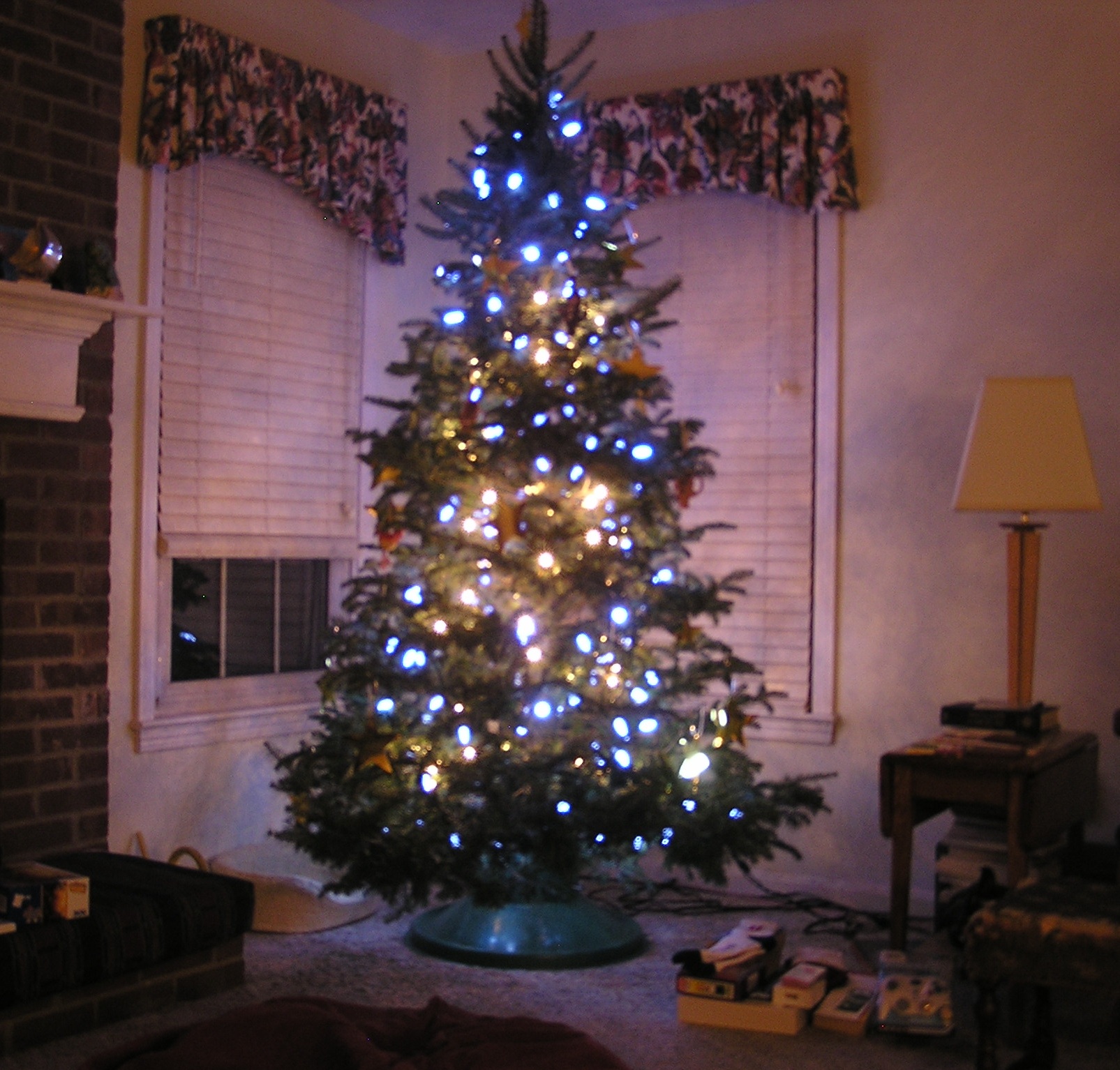
OLYMPUS DIGITAL CAMERASome shoe shopping, some ice skating, then supper at Culver’s. Now we’ve settled in at home again to watch the Vikings and the Pack face off at Lambeau Field. Tomorrow we’ll remove the decorations and put the tree on the deck to provide shelter for birds coming to the feeder, but for one more night it graces our living room with twinkling lights and the delicate scent of fir.

Some star ornaments will linger about the house through Epiphany, reminders of the star that beckoned to wise men of old, the morning star that shines for the peoples of the nations, and the people themselves, more numerous than the stars.

Even twelve drummers drumming is not loud enough to drown out the wonder and mystery of the silent night that began this season.

Some thoughts on fear

Lately I’ve been thinking about fear, particularly fear that divides us even as it holds us in its grip. We are all afraid of homicidal sociopaths with guns. Fear begets fear, and our reactions to that common fear differ widely: some of us are afraid that we won’t be allowed to arm ourselves adequately to defend against homicidal sociopaths with guns; some of us are afraid that anyone we allow to have a gun might turn out to be a homicidal sociopath.

By evolutionary design, fear is not a rational state: it demands a split-second decision to fight or flee. Some years ago, when we as a nation faced great crisis, a leader reminded us that the only thing we have to fear is fear itself. He called it nameless, unreasoning, and unjustified, and accurately noted that it hampers our ability to move forward.

Arguing with someone who is frightened does not make him less afraid. When a child comes into your room in the middle of the night because he has had a nightmare, you cannot reason with him that it wasn’t real. He has experienced that nightmare, and its effects on him are very real: elevated heart rate, adrenaline release, feelings of helplessness, sleep disruption. You can tell him that the nightmare is over and that he is okay, and you can offer something that will comfort and reassure him. Dismissing or belittling his fear will not diminish it in any way, but recognizing it and reconnecting him with normalcy will make it possible to move beyond it.

The tricky thing about fear is that it is based in reality, no matter how tenuously. The things we are afraid of really are out there, which is why reason doesn’t work against fear. But naming those things that frighten us gives us an opportunity to develop strategies for dealing with them. The next time your child wakes with a nightmare, he may remember what you said and did the last time and be able to go back to sleep on his own. If you find out that his nightmare may have been triggered by a TV show he watched in the evening, you can change your family viewing habits.

Fear is not banished by argument, but it can be surmounted when recognized. We need to listen to each other, to acknowledge even those fears we don’t share. Then, with these concerns on the table, we need to craft responses that address them all – not just knee-jerk reactions to the loudest or most alarmed.

Waiting, with lights

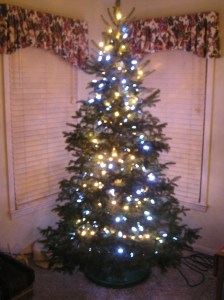
OLYMPUS DIGITAL CAMERAThis is an Advent tree, not yet a Christmas tree. Last Sunday we wove two types of lighted strands through its branches: warm incandescents, whose light reminds us of stars in the sky, and cool LEDs, whose light appears Advent blue and whose bulbs make us think of icicles.

For a week now the tree has cast a soft glow over the living room, the space in our house where we work and play. When I was a child, I would spend hours beneath our tree, staring up through the branches and imagining I was looking at the stars through the canopy of an evergreen wood. The enchantment of tiny lights has never entirely worn off; I suppose it’s one of the reasons I also love fireflies in summer.

Tomorrow we will add another layer of meaning to the tree in the form of ornaments or garland, depending on what box comes out of storage. When the children were small, we made paper chains for garland every year. They drew pictures or wrote on the strips of paper, and I tore off countless small pieces of tape for them to secure the ends of the links. It’s a kind of miracle, you know: simple circlets of paper interlock to form a chain of any length. Sometimes we each made our own chain before joining them together to create a single chain long enough to encompass the whole tree. You wouldn’t have seen it in Better Homes and Gardens, but our garland always seemed more beautiful to me than the most elegant tinsel.

Waiting

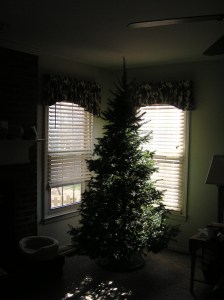
OLYMPUS DIGITAL CAMERAThe tree stands in a corner of the room, majestic in its solitude. It brings with it a wildness: the sharp tang of winter air, the soft contours of evergreen foliage. This tiny piece of northern forest seems doubly incongruous in a home in the Shallow South, its firred limbs a striking contrast against the tangle of leafless branches outside the backdrop of windows.

A horticulture professor has discovered that Fraser fir can be grown even here, at the extreme limits of its climate zone, if the soil conditions are ideal. Six days ago, this tree stood in a field of its fellows, just a couple rolling country miles down the road from here.

For the first week of Advent, it remains unadorned in our house, reminding us that life is always there, waiting, even when the world seems flat and grey. As the tree adjusts to the indoor temperature and humidity, we spend the week admiring the elegant beauty of its shape, getting to know the curve of its branches and the spiky softness of its needles.

This Sunday we will weave lighted strands through those branches, and the tree will sparkle as the night sky above the North Pole itself. But for now it is a shadowy and mysterious presence in darkness, a slim figure of patience in the light, exuding a faint air of balsam that I always associate with wonder.

Technology and miracles

When I dropped my daughter off at school yesterday, I noticed that another parent had pulled her car to the side and was standing in front of it. After a moment, I realized she was taking a picture of the morning sun, just visible through a swirl of heavy mist. It made me smile, and I thought about how many more moments like that are captured nowadays. It used to be that only professional photographers and tourists carried cameras with them at all times, but now just about everyone with a cell phone has a camera in pocket or purse.

Last week, my siblings and helped my mother clean her garage. She has mobility issues and supervised the entire process without leaving the living room. Using an iPad, we consulted with her about where she wanted us to work, what to do with specific items, even how to arrange things to her liking. Someone would snap photos and take the iPad to her so she could see what we were doing and what we had questions about. She was able to see the garage without leaving her armchair and view the contents of containers without us having to drag them into the house. It was brilliantly simple and efficient.

As cool as the technology behind these moments is, I’m reminded that it’s not the gadgets that makes our lives better but the way we use them. At this time of year especially, I’m grateful when something slows me down and focuses my attention on what is useful rather than what is wanted. It’s easy to get caught up in the desire to fulfill every wish, no matter how casual. Gift-giving can be a kind of power trip, and our addictive human response to a head rush of that nature quickly leads to rampant consumerism.

The real miracle of that spontaneous sunrise photo shoot or my family’s garage-cleaning did not lie in the technology employed in either instance. It lay instead in the human responses: wonder at the beauty of the world and a desire to share it; recognition of need and a desire to include another more fully in the solution.

Exercising a little imagination

The last couple weeks have been crazy busy, so I’m behind on a few things. The good folks over at Trifecta noted that November 15 is National Erotica Day. Accordingly, they issued an open prompt writing challenge to write something erotic between 33 and 333 words. Here’s what I came up with:

“I have a confession to make,” she said as she pulled the car door shut.

His hands tightened reflexively on the steering wheel. “Okay.” He drew the word out as though unsure he wanted to hear what might follow.

She fished a small square package out of a pocket and dangled it between her thumb and forefinger. “Just in case our intentions become less than honorable.”

His initial look of surprise slid into a sheepish grin. “You are a wicked woman,” he chuckled, putting the car in gear.

“Not yet,” she replied, tucking the condom away, “but I have aspirations.”