Re-wrinkling my brain

The first time I walked along a busy sidewalk after returning from London, I realized that I had adopted the habit of passing on the left rather than on the right. This made for a number of awkward moments with my fellow North American pedestrians, but it triggered for me a kind of epiphany.

Many years ago, a right-handed co-worker told me that she liked to use the mouse with her left hand because it re-wrinkled her brain. She meant that doing something differently stimulates the brain to form new neural connections and pathways. I tried it myself and found that my brain felt more awake, which made sense since I was using parts of it that didn’t normally see much action.

London had done this for me: it had re-wrinkled my brain. Everything was just different enough to stimulate without overwhelming. The city was filled with patterns to notice, analyze, and assimilate – language, architecture, food, customs, and so on. Awash in this sea of new and intriguing information, I felt more alive than I have in years.
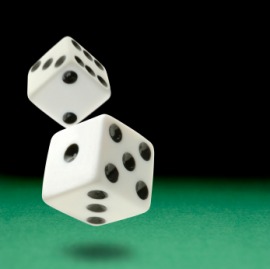
Come on, baby! Momma’s brain needs a new wrinkle!

This explains why I didn’t want to leave, why I felt this nearly desperate urge to return again at the earliest possible opportunity. There are all kinds of contests you can enter to win a trip to this summer’s Olympics in London; I entered several before I caught myself in the midst of applying for a credit card that I really don’t want or need. I’m still entering the ones that have no strings attached. Wish me luck!

Shower power

I always think of great stuff in the shower – ideas for stories, solutions to problems, explanations of intricate concepts, brilliant ways to word things. Ever since I read Frank Herbert’s God Emperor of Dune, I’ve wanted one of those nifty Ixian devices that Leto uses to record his thoughts. That would be so handy in the shower, or while driving, or in any of the other inconvenient places I seem to do my best thinking.

Researchers have been studying why this sort of thing happens and have discovered that we’re most intuitively creative when we aren’t really focused on problem-solving. When our attention is relatively diffuse (as when relaxing) or partially directed elsewhere (as when driving) little bits of our brain that have been working in the background on different aspects of an issue have a chance to compare notes. Et voila! Eureka! A brilliant idea is born.

Now that they better understand the mechanisms behind this phenomenon, I hope that scientists will work on ways for us to capture the amazing insights we have at those awkward moments when pencil and paper or digital recorders aren’t readily available. Until then, I guess I’ll have to get some of those wax pencils we used to write on beakers in high school science and start taking notes on the glass shower doors.

(The research mentioned above is from Jonah Lehrer’s book, Imagine: How Creativity Works, as discussed in the Wall Street Journal article, “How to be Creative.”)

Thinking about tarot

I haven’t always liked tarot. For a time, I viewed it as a terrifying incarnation of evil. My understanding of many things changed as I aged, and I eventually reached a point where I stopped avoiding tarot with superstitious fervor. I was no longer philosophically opposed to it, but I wasn’t much interested in it either.

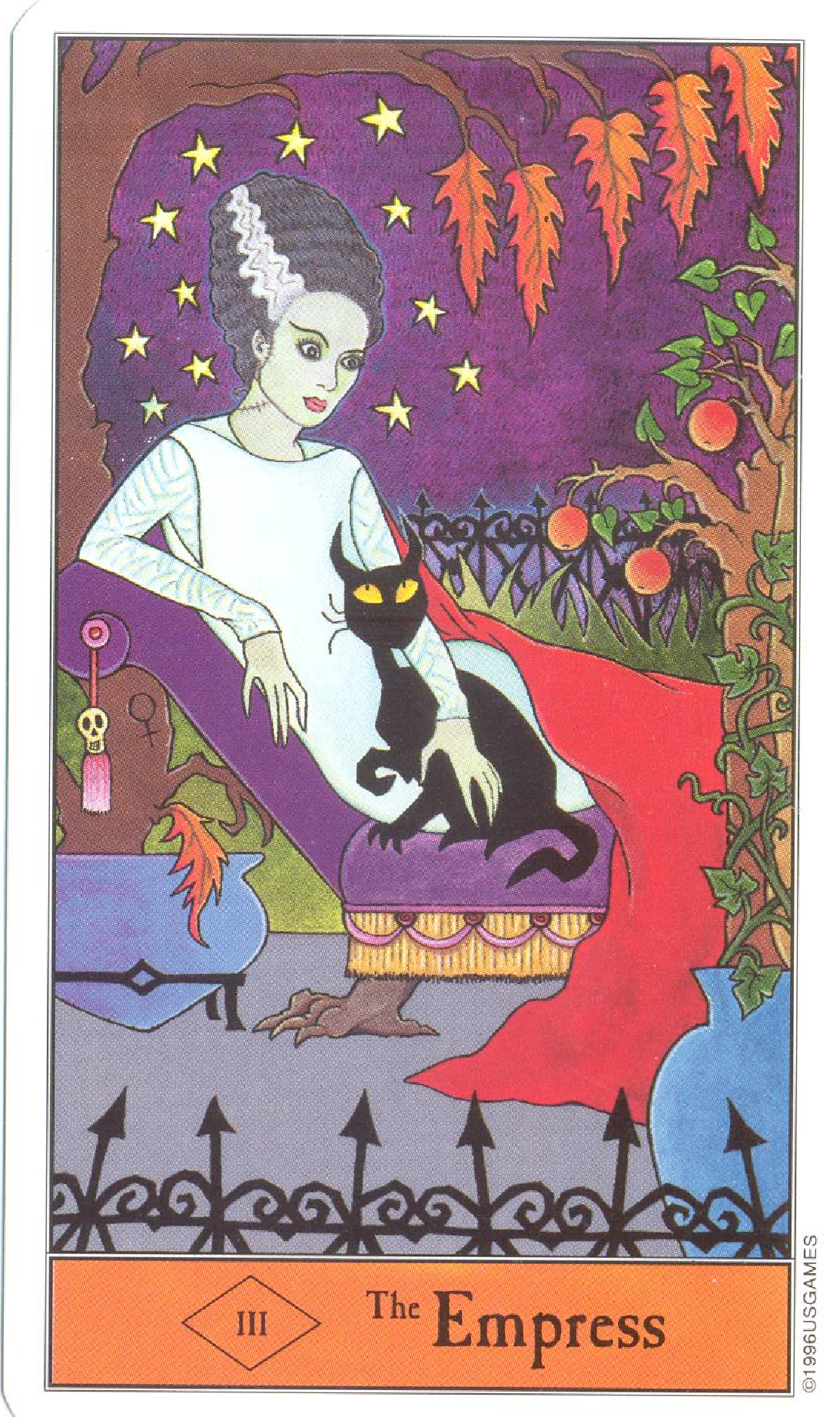
From the Halloween Tarot by Kipling West

I’ve long been a fan of classic monster movies, so when I came across Kipling West’s Halloween Tarot, with its cartoon clarity, bright colors, and iconic monsters, I was smitten. Anything that so lovingly featured my old friends Frankenstein, the Wolfman, Dracula, the Bride, and the Mummy was worth a second look. The images are populated with costumed trick-or-treaters, jack-o-lanterns, friendly ghosts, and black cats. I couldn’t resist! The Halloween Tarot became my first deck and remains one of my favorites.

Now that I realized tarot didn’t have to be mystical or sinister or take itself so seriously, I was intrigued. I found all sorts of fun and fanciful decks, from baseball to Harry Potter to Alice in Wonderland. I found decks whose images could be hanging in a museum and decks whose art could be featured on Saturday morning cartoons. Who knew there was so much beauty and variety in a bunch of cards?

I have come to enjoy tarot like I do art, film, literature, music, dreams. I appreciate the layers of meaning such things have, the way they reflect life back to me, the way my soul sometimes resonates with them. I don’t believe tarot has mystical powers, but I know it sometimes makes me smile or gives me pause. And that, to me, is reason enough to like it.

Mother’s Day truth

What does every mother want? She wants her child to be safe and happy. This is not a constant desire, every moment of every day, seven days a week, but at least once, between the hour she first knows she’s pregnant and the moment of her last breath, that is what she wants.

A poem inspired by the letter U

Underlord

the surface distrusts the dark judge
Lord of wealth and all who fancy themselves
master of the riches they hold, disregarding
its weight, the way it presses
into his service

treasure is drawn to its master and takes with it
all whose grasp does not loosen
glitter-blind, they do not recognize the hungry shades
they have become even while their hearts beat
still in sunlight

Dis scarcely notices: beside the pale, eternal denizens of his realm
daylit lives are vague and spurious
mis-remembered dreams of pain and pleasure

dragged by greed, borne by death
he is the earth into which they sink
he is the dust to which they return

(Apologies to those who were expecting underwear to the be topic of this post.)

On voice

Voice is an unavoidable component of all forms of writing. To slightly paraphrase Janice Hardy, voice is the sense that there is a person behind the words. That sense of person is how the reader connects with what the writer says. If there is a problem with voice, the connection will be faulty or won’t be made at all.

How can there be a problem with voice? Isn’t the writer always the person behind the words? Well, yes and no. Yes, the writer is always somewhere behind the words, but often the writer wants to communicate or connect through a particular perspective or persona, even in non-fiction. Any time the words don’t clearly convey that perspective or persona, the connection shorts out.

Although this can happen in several ways, inconsistency is the most common problem with voice. It’s like someone changing channels during a broadcast without warning: inconsistent voice makes it hard to follow what’s going on, whether that’s a line of reasoning or a plot line. The simplest way to be consistent is to maintain the same perspective throughout a written piece (much harder than it sounds). This is not to say, however, that shifts in perspective make for poor writing or need to be avoided. When executed properly, they bring a delightful complexity and nuance to writing.

How can changes in perspective, by their very definition, be consistent? They happen in a manner that makes sense, that arises naturally from the plot or argument and advances it. They follow a structural pattern, usually visible, occurring at section or chapter breaks. They take place when a scene changes or when new source material is introduced.  Here’s the real kicker: when shifts in perspective add to the plot or line of reasoning without disruption or distraction, they weave together to form a single, rich, complex voice.

The writer’s voice.

Weeding

It may sound strange, but I love to weed. As a young person, I spent countless hours pulling weeds in the humongous kitchen garden we planted every year. That kind of experience would traumatize most people and put them off weeding for life, but it instilled in me a profound love.

In part, I love to weed because it takes me back to the cool, dew-drenched mornings and hazy, sun-drenched afternoons of my childhood. It reminds me of long hours spent in companionable silence or lively chatter, working beside a number of family members in various times and places.

But there’s something else about weeding that appeals to me on a deeper level, something in it that soothes my soul. It’s a form of moving meditation: active enough to keep my monkey mind occupied, repetitious and methodical enough to allow me to slip into a sort of trance.

I also find weeding very satisfying, in more than one way. It offers the cathartic effects of physical labor coupled with the psychological pleasure of tangible progress. I feel as ridiculously edified by aching muscles as I do by neat planting beds. And I feel peaceful, on top of the exhaustion and pride. What’s not to like?

Up until this last week, I haven’t been able to weed because it’s been so dry. Where I live, there used to be a foot or so of rich topsoil, an accumulation of thousands of years of decayed plant and animal matter. A couple decades ago, a developer scraped it off, sold it, and built houses and laid sod on the remaining clay subsoil. So my garden beds are built on and out of clay.

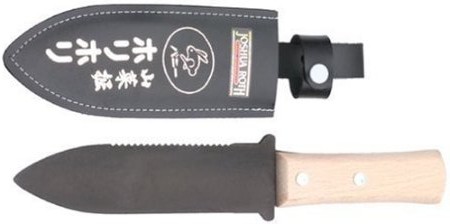
When clay gets dry, it becomes the kind of material that people have been building houses out of for millennia. Roots sunk into dry clay cannot be removed by pulling; it is impervious to most hand tools in that state, even my trusty hori-hori.

I feel like a black ops garden commando when I strap this puppy on.


So I am woefully behind on the weeding, and I don’t think the neighbors are happy about it.

I wrote the above paragraphs last week, before we got some much-needed rain. I’m happy to say that I’ve been able to get in a little weeding since, though we were away for three days of prime yard working time over the weekend. I’m still behind, but most of the really big weeds have been removed. Now the yard merely looks unkempt instead of overgrown.

The X factor

It has been a very long time since I studied genetics, and the state of the field is now light-years beyond the things I learned back then. I presume (for no good reason) that some of the rudimentary components remain fairly intact, and the following is based on my recollection of those basics. If I am in error, I welcome gentle correction from the more genetics-savvy.

I spent a lot of time with family this weekend, which got me thinking about how we’re related. X chromosomes popped to mind, partly because it was my mom’s side of the family and partly because you can actually tell, because of their gender and relationship, that certain people have the same X chromosome.

After thinking about it for a bit, though, I realized that the scope of this is fairly limited. It wasn’t possible to tell at all which of us at the gathering this weekend shared an X chromosome from that side of the family. My mother and her brother might have gotten the same X chromosome from their mother, but you can’t tell by looking. It’s possible that my mom in turn passed that same X chromosome to me or one of my two sisters, but there’s no way to tell just by looking.

Because there are three of us, at least two share an X chromosome from Mom, but there’s no outward way of determining who does or doesn’t. In the event that I share that X chromosome with my sister who has a child, it’s also possible that either or both of us passed that same X chromosome along to our children, but again it’s impossible to tell by looking.

Things are a little simpler on the other side of the family, but not by much. It is certain that my sisters and I all share an X chromosome from our father, which he in turn got from his mother. We may or may not share that same chromosome with our aunt or uncles – his siblings – or our only female first cousin. It’s certain we share that X chromosome with other members of our paternal grandmother’s family, but there’s no way to determine that by looking. It is, though, a fact that we don’t share any X chromosomes with members of our paternal grandfather’s family.

I briefly started to calculate the probabilities of these various potential chromosomal overlaps. But then I remembered the two most important things I learned about probability in school: it is always rather more complicated than it first appears, and I wasn’t very good at it. If any math nerds out there would like to tackle these calculations for their amusement, I promise to be inordinately impressed with the results.

Years

It’s kind of strange the way we count years. A birthday or anniversary marks the completion of the year we identify, yet we tend to think of it as marking the beginning of that year. The fifth anniversary marks the completion of five years and the beginning of the sixth, for example, yet if someone asks how long you’ve been married during that sixth year, the standard answer would be, “Five years.”

Children have a sense of this inaccuracy. Introduce a child as being nine, and you’re likely to be corrected: “Nine and a half, actually.” No kid wants to be thought of as nine when she’s really not.

(If you’re having trouble understanding this, think about the way we number centuries vs. the way we number years. The 1900s were the 20th century; we are now in the 21st century, even though the current year begins with 20.)

Today is the last day of my mother’s 7th decade on this planet. Tomorrow she will turn 70 — complete her 70th year and begin her 71st. It’s cool to think that she’s reached the milestone identified in the last major birthday party I threw for myself, my “Halfway to 70” party. (A lot of people were very confused by the theme, but thankfully they came anyway.) This gives me hope that I might actually make it that far.

(That isn’t just foolish posturing, by the way; I’ve now surpassed my father’s age by more than a year. Realizing this has helped me understand the incredibly weird dynamic my midlife crisis assumed over the last couple years – it was a sort of endlife crisis at the same time. Talk about heavy!)

In honor of my mother’s birthday, I offer a poem I wrote 20 years ago:

Amazing Discovery

Mother, you look
so beautiful and
I look like you!

I saw you
in the mirror this morning
and smiled
“she’s beautiful” before
I realized she’s me.

Z to A Even Day Challenge

The April A to Z Challenge was a great way to jump-start my writing again, though I found the daily aspect an unwelcome source of added stress. If I had participated from the beginning rather than hopping on near the end as I did, I think I would have been thoroughly burnt out with the whole thing by now.

The upshot is that I’ve decided to attempt a variation on this writing/blogging challenge for the next several weeks. The idea is to post on every even-numbered calendar day, which allows a little more time to think and polish. My hope is to raise the quality of the published writing and reduce the amount of stress associated therewith.

I’ve also decided to work my way backwards through the alphabet, as I found the letter prompts arbitrary enough to inspire creativity but predictable enough get me thinking ahead. I plan to be more subtle with this challenge and abandon the “X is for Y” approach, which becomes tedious after a bit.

If you decide to follow along in your own writing, I’d love to hear about it. Your company on this journey is most welcome, either as a reader or a fellow writer.