Category Archives: Uncategorized

Flaky

No, I’m not talking pastry; I’m talking about myself.

I spent the better part of the day searching through photo disks and thumb drives for a picture of a frog. A particular frog (actually, a series of frogs) known as Pond Frog. I was going to write a lovely post about Pond Frog (all of them), but first I just had to find that picture I remembered seeing. Sometime.

Since Pond Frog lived at our previous house, I had to look through pictures taken over eight years ago, because that’s how long we’ve been in this house. Things that far back aren’t quite as well organized as more recent things, and recent things aren’t all that well organized, so you see my problem.

I know I’ve seen that picture, but I can’t remember where, or for that matter, when. And now it’s time to head for bed, and I have neither a picture of Pond Frog or a post about it to show for my trouble.

I did get to relive a lot of great memories, though.

Grace, today

This is a day of grace. Waking in a comfortable bed, in a climate-controlled house. Opening a cupboard to find food to prepare. Turning on a faucet for clean water to drink, cook, and bathe. Having transportation to church, library, store. Worshiping in the midst of the beloved community. Watching a movie with family and talking with friends. Praying for those I love, for those I dislike, and for those I don’t know. Searching for a way through apathy and anger, fear and regret.

And through, in, and around it all, there is sunshine and rain, birds and trees, tears and laughter. There are songs to sing and books to read, hands to hold and gifts to receive. There is work to do and blessed rest. This is a day of grace.

Every day.

Linden love (with locust)

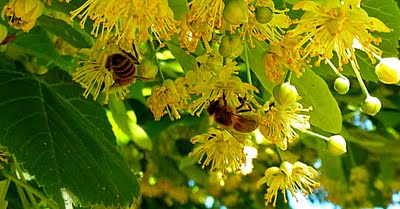
Sunday I stopped at a branch library on the other side of town, one I don’t usually frequent. The outside temperature was in the 90s; as I opened the car door, the air was almost a living presence: thick with humidity and heavy with perfume. I was expecting the heat, but the perfume caught me by surprise. It was sweet and sticky, and I recognized it immediately: linden flowers. The library parking lot was surrounded by linden trees, all of them in full bloom.

I closed my eyes and breathed deeply, the sweltering heat forgotten. The air vibrated with the inebriated buzzing of hundreds of bees as they staggered from flower to flower. I closed the door, rolled down the windows, and just sat there, adrift in scent and sound. A light breeze rustled the leaves and actually felt cool as it fanned past me.

Bees and linden flowers (photo by Ken Broadhurst)


Eventually, the slamming of a car door reminded me where I was and my purpose for being there. Unhurried, I checked the time and was surprised to realize I had to leave, my errand undone. I didn’t mind in the slightest, though.

Twenty-five years ago, I lived in downtown Indianapolis and walked to work. At that time, many of the streets were planted with linden trees, and I remember the dizzy sensation of walking to and from work when they were in bloom. So distracted and transported was I by the heady fragrance of those blossoms that it’s a miracle I didn’t walk into traffic and get myself killed.

Certain flowers and their fragrances have always had that effect on me. When the black locust trees are in bloom around here, I am truly a navigational menace on foot. I keep my car windows up because I fear I’ll go off the road following my nose if the breeze carries that powerful perfume my way. Black locust are very tall, so their sweet aroma carries for quite a distance, with or without a breeze.

Linden and black locust trees are both native to the region where I grew up and where several generations of my people lived and died. Maybe the scent of those blossoms stirs some deep, ancestral memory. Or maybe, as some have suggested, I was actually a bee in a previous life.

Bzzzzzzzz.

Special thanks to Ken Broadhurst of Living the Life in Saint-Aignan, who let me use his wonderful photo of bees and linden blossoms. He wrote a lovely post about the linden behind his house, with lots more photos. His blog is full of beautiful photography and stories that make you want to move to France — and don’t forget to check out his post about making dolmas using leaves from his own backyard vines!

Mulch and order

A few Saturdays ago, I had to work at the library for several hours. When I came home, one of the flower beds in the front yard had been transformed: weeds and chaos had given way to mulch and order.

It was like magic! I left a seedy looking yard and several bags of mulch and returned to a beautifully mulched flower bed. I felt like I had stepped into the Grimm fairy tale about the elves and the shoemaker.

I don’t have elves, but I do have Mulch Man.

In the presence of mulch and favorable weather, this mild-mannered traffic engineer transforms into a fearless defender of beds and borders. Dandelions, poison ivy, even creeping euonymus are no match for his mad mulching skills. He weeds! He edges! He carefully protects the crowns of perennials!

Thank you, Mulch Man! Without your vigilance, we would be in violation of several homeowners’ association regulations and in danger of being ridden out of the neighborhood on a rail. You have saved us from much humiliation and a number of fines. How can we ever repay you?

What’s that? No problem. One ice-cold beer, coming right up!

Some reasons why I am not a novelist

When I tell people I am a writer, they tend to presume that I write novels. Novels are the most visible and popular form of literature, and best-selling novelists enjoy both fame and wealth. I impute the kindest of motives to these presumptions, choosing to see in them a tacit wish for me to be both famous and wealthy. Because folks tend to be disappointed and lose interest if I disabuse them of their presumption, out of kindness I sometimes don’t bother. What follows is the beginning of an explanation for this outwardly irrational choice on my part, which won’t probably be of interest to anyone who isn’t also a writer.

  • I don’t like being in charge of people – I want people to be in charge of themselves. As a teacher, I gravitated to decentralized models of pedagogy and strove to create environments wherein learning was student-driven. I prefer the role of facilitator. This sometimes works with real people, under the right circumstances, but it doesn’t work very well with imaginary people. As a writer, I have to make all the choices for my characters, and that really goes against my nature.
  • I see too many possibilities; my view of the big picture contains a lot of detail. I can detect and analyze patterns more easily where I don’t have anything at stake – in the past, for example. Future projections bring out excessive caution in me, as the undetermined factors increase exponentially at every step. This makes it very difficult to create a story arc of novel length and complexity.
  • I can only be involved in so many long-term projects at one time. I am currently parenting two children and partnering with another adult. I manage a household, help maintain the yard, and take care of a cat. I just don’t have the energy or the desire to take on another epic project at this point in my life. I feel insanely gratified that I manage to write at all.

This is by no means a complete analysis, but it is devilishly difficult to analyze something when one is smack in the middle of it. Additional posts on this and related subjects are in the works, so stay tuned!

Overloaded

Today is the last day of school for my kids this year, and I feel more than a bit frazzled. I never thought I’d say this, but I miss being kept informed of things the way I was when the kids were in elementary school. If you get yourself on the right e-mailing lists, you can find out most of what’s going on in middle school, but high school is a bit more spotty in this regard.

The directors really do communicate quite a lot with band parents, but there’s just so doggone much going on that they can only keep so far ahead of it all. The online calendar lists most planned activities, but extra rehearsals and spontaneous pancake parties (like this morning) don’t make it onto the calendar.

Then there are the associated social events. Groups of students walk somewhere to grab a bite before practice or after a concert; they decide to attend the school play together or have a picnic. That stuff is always last-minute and poorly organized, and it wreaks havoc on the intricate transportation schedule we work out every morning.

The last couple weeks have been a whirlwind of exams, rehearsals, performances, track practices and meets, award banquets, and cookouts. Almost all of it has been fun, but I’m bushed. I guess it’s a good thing I’m not in high school anymore; I simply wouldn’t have the stamina.

I have two weeks to recover before summer school starts, then two weeks after summer school ends before band camp begins. Wish me luck.

Word of the day: pickelhaube

I was going to post something about poetry today, but last night my son told me a funny story in which the word pickelhaube played a role. (I kid you not—he amazes me sometimes.) I was so struck by the word that I decided to write about it.

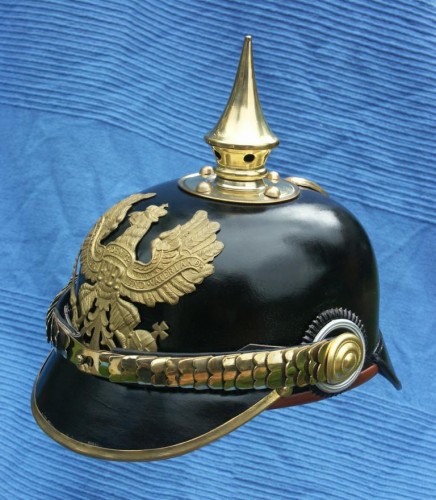
I correctly guessed the word is German in origin. It refers to a type of military headgear made famous during WWI and now almost universally associated with Kaiser Wilhelm and company.
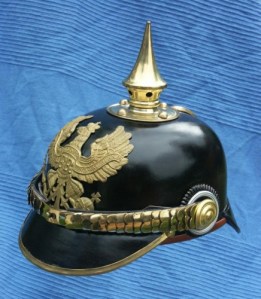
The helmet was originally made of leather, lacquered and burnished until it shone, with polished metal fittings. The most recognizable of these are the large helmet plate, which typically covers the entire front of the crown, and the spike, which sometimes holds a cascading plume.

I always thought the entire thing was made of metal, because of the crown’s high sheen. (This proved to be a serious liability in combat and led to the design of cloth covers.) I was amazed to learn that pickelhauben were also made of felt and other heavy fabrics when wartime demand outstripped leather supplies.

Not surprisingly, even leather helmets offer little protection from bullets and shrapnel, and the medical branch of the German military eventually demanded that troops be supplied with better headgear. The pickelhaube is still used by military and police units around the world, but chiefly in an ornamental or non-combat capacity.

A little research into the etymology of the word revealed the limitations of my resources, but yielded some interesting fodder for thought. According to Wikipedia, which offered the only etymology I could readily find, “pickel” derives from an old German word for a spike or pick-axe and “haube” indicates a bonnet. No source was cited for this information, but it did seem to be supported in part by my pocket Langenscheidt dictionary. In modern German usage, pickel most often designates a pimple or boil, but it can also be used to describe a pointed hand tool like a pick-axe. Haube means “bonnet,” either in the sense of a close-fitting head covering (like a cap), or in the British sense of a covering for the engine compartment of a car (“hood” in American English).

While it is most likely that “pickel” was used because of its spiky meaning, I can’t help but think there’s something appropriate in the pimply/bumpy meaning. After all, the shape of the pickelhaube is rounded, and the lack of a brim makes it look rather like a bump, especially when it’s not on someone’s head. I suppose that’s the way that folk etymologies are born.

(I want to acknowledge my sources for this post, Trenches on the Web [http://www.worldwar1.com/sfgph.htm] and Colonel J.’s amazing web site [http://www.pickelhauben.net/]. If anyone has more definitive or authoritative information on the etymology of pickelhaube, please share it.)

The Queen (sadly, not)

I had a great post planned for today: I was going to reblog this wonderful pair of pictures of Queen Elizabeth and Prince Philip, one very recent and one from several decades ago. Both are casual shots, and the poses in each are virtually identical. But I can’t remember where I saw this post; it doesn’t appear on the blog where I thought I saw it. I seemed to recall that I had commented on the photos, but when I tracked back through comments I’ve made, it turns out that I didn’t after all. (Deep sigh.) My having to explain all this takes the magic out of it.

So what started out in my mind to be a (mostly) wordless blog post (because when you see the pictures, no words are needed) has turned into a rather long-winded explanation with a lame description. For this I apologize, and I promise to reblog the post properly when I find it (if I find it).

Re-wrinkling my brain

The first time I walked along a busy sidewalk after returning from London, I realized that I had adopted the habit of passing on the left rather than on the right. This made for a number of awkward moments with my fellow North American pedestrians, but it triggered for me a kind of epiphany.

Many years ago, a right-handed co-worker told me that she liked to use the mouse with her left hand because it re-wrinkled her brain. She meant that doing something differently stimulates the brain to form new neural connections and pathways. I tried it myself and found that my brain felt more awake, which made sense since I was using parts of it that didn’t normally see much action.

London had done this for me: it had re-wrinkled my brain. Everything was just different enough to stimulate without overwhelming. The city was filled with patterns to notice, analyze, and assimilate – language, architecture, food, customs, and so on. Awash in this sea of new and intriguing information, I felt more alive than I have in years.

Come on, baby! Momma’s brain needs a new wrinkle!

This explains why I didn’t want to leave, why I felt this nearly desperate urge to return again at the earliest possible opportunity. There are all kinds of contests you can enter to win a trip to this summer’s Olympics in London; I entered several before I caught myself in the midst of applying for a credit card that I really don’t want or need. I’m still entering the ones that have no strings attached. Wish me luck!

Shower power

I always think of great stuff in the shower – ideas for stories, solutions to problems, explanations of intricate concepts, brilliant ways to word things. Ever since I read Frank Herbert’s God Emperor of Dune, I’ve wanted one of those nifty Ixian devices that Leto uses to record his thoughts. That would be so handy in the shower, or while driving, or in any of the other inconvenient places I seem to do my best thinking.

Researchers have been studying why this sort of thing happens and have discovered that we’re most intuitively creative when we aren’t really focused on problem-solving. When our attention is relatively diffuse (as when relaxing) or partially directed elsewhere (as when driving) little bits of our brain that have been working in the background on different aspects of an issue have a chance to compare notes. Et voila! Eureka! A brilliant idea is born.

Now that they better understand the mechanisms behind this phenomenon, I hope that scientists will work on ways for us to capture the amazing insights we have at those awkward moments when pencil and paper or digital recorders aren’t readily available. Until then, I guess I’ll have to get some of those wax pencils we used to write on beakers in high school science and start taking notes on the glass shower doors.

(The research mentioned above is from Jonah Lehrer’s book, Imagine: How Creativity Works, as discussed in the Wall Street Journal article, “How to be Creative.”)