I was going to post something about poetry today, but last night my son told me a funny story in which the word pickelhaube played a role. (I kid you not—he amazes me sometimes.) I was so struck by the word that I decided to write about it.
I correctly guessed the word is German in origin. It refers to a type of military headgear made famous during WWI and now almost universally associated with Kaiser Wilhelm and company.
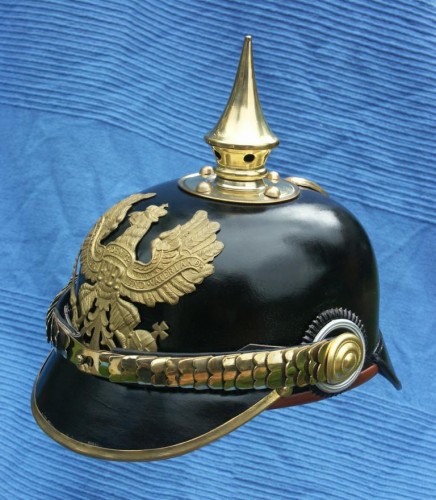 The helmet was originally made of leather, lacquered and burnished until it shone, with polished metal fittings. The most recognizable of these are the large helmet plate, which typically covers the entire front of the crown, and the spike, which sometimes holds a cascading plume.
I always thought the entire thing was made of metal, because of the crown’s high sheen. (This proved to be a serious liability in combat and led to the design of cloth covers.) I was amazed to learn that pickelhauben were also made of felt and other heavy fabrics when wartime demand outstripped leather supplies.
Not surprisingly, even leather helmets offer little protection from bullets and shrapnel, and the medical branch of the German military eventually demanded that troops be supplied with better headgear. The pickelhaube is still used by military and police units around the world, but chiefly in an ornamental or non-combat capacity.
A little research into the etymology of the word revealed the limitations of my resources, but yielded some interesting fodder for thought. According to Wikipedia, which offered the only etymology I could readily find, “pickel” derives from an old German word for a spike or pick-axe and “haube” indicates a bonnet. No source was cited for this information, but it did seem to be supported in part by my pocket Langenscheidt dictionary. In modern German usage, pickel most often designates a pimple or boil, but it can also be used to describe a pointed hand tool like a pick-axe. Haube means “bonnet,” either in the sense of a close-fitting head covering (like a cap), or in the British sense of a covering for the engine compartment of a car (“hood” in American English).
While it is most likely that “pickel” was used because of its spiky meaning, I can’t help but think there’s something appropriate in the pimply/bumpy meaning. After all, the shape of the pickelhaube is rounded, and the lack of a brim makes it look rather like a bump, especially when it’s not on someone’s head. I suppose that’s the way that folk etymologies are born.
(I want to acknowledge my sources for this post, Trenches on the Web [http://www.worldwar1.com/sfgph.htm] and Colonel J.’s amazing web site [http://www.pickelhauben.net/]. If anyone has more definitive or authoritative information on the etymology of pickelhaube, please share it.)