Tag Archives: language

Word of the day: pickelhaube

I was going to post something about poetry today, but last night my son told me a funny story in which the word pickelhaube played a role. (I kid you not—he amazes me sometimes.) I was so struck by the word that I decided to write about it.

I correctly guessed the word is German in origin. It refers to a type of military headgear made famous during WWI and now almost universally associated with Kaiser Wilhelm and company.
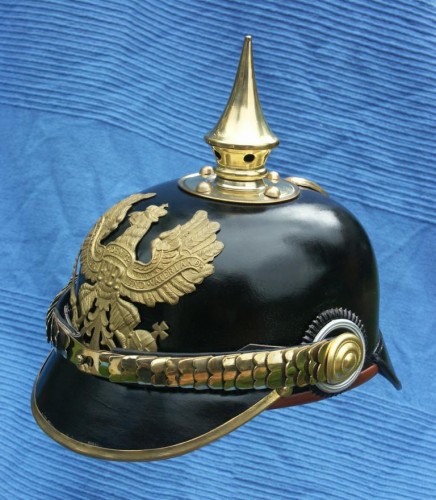
The helmet was originally made of leather, lacquered and burnished until it shone, with polished metal fittings. The most recognizable of these are the large helmet plate, which typically covers the entire front of the crown, and the spike, which sometimes holds a cascading plume.

I always thought the entire thing was made of metal, because of the crown’s high sheen. (This proved to be a serious liability in combat and led to the design of cloth covers.) I was amazed to learn that pickelhauben were also made of felt and other heavy fabrics when wartime demand outstripped leather supplies.

Not surprisingly, even leather helmets offer little protection from bullets and shrapnel, and the medical branch of the German military eventually demanded that troops be supplied with better headgear. The pickelhaube is still used by military and police units around the world, but chiefly in an ornamental or non-combat capacity.

A little research into the etymology of the word revealed the limitations of my resources, but yielded some interesting fodder for thought. According to Wikipedia, which offered the only etymology I could readily find, “pickel” derives from an old German word for a spike or pick-axe and “haube” indicates a bonnet. No source was cited for this information, but it did seem to be supported in part by my pocket Langenscheidt dictionary. In modern German usage, pickel most often designates a pimple or boil, but it can also be used to describe a pointed hand tool like a pick-axe. Haube means “bonnet,” either in the sense of a close-fitting head covering (like a cap), or in the British sense of a covering for the engine compartment of a car (“hood” in American English).

While it is most likely that “pickel” was used because of its spiky meaning, I can’t help but think there’s something appropriate in the pimply/bumpy meaning. After all, the shape of the pickelhaube is rounded, and the lack of a brim makes it look rather like a bump, especially when it’s not on someone’s head. I suppose that’s the way that folk etymologies are born.

(I want to acknowledge my sources for this post, Trenches on the Web [http://www.worldwar1.com/sfgph.htm] and Colonel J.’s amazing web site [http://www.pickelhauben.net/]. If anyone has more definitive or authoritative information on the etymology of pickelhaube, please share it.)

U is for undecided

I couldn’t decide whether to write about Underdog, one of my favorite childhood cartoon heroes, or underwear. So I’ll write about both.

We owned a couple of Underdog glass tumblers (tall drinking glasses) when I was a kid: one had Sweet Polly Purebred, Underdog’s lady love on it; the other featured the humble superdog himself. The theme song to that show was so thrilling, and I loved the fact that Underdog always spoke in rhymed verse. In fact, if asked as a child what kind of superpower I would like to be given, I’m pretty sure I would have asked for the ability to always speak in rhymed verse. (Even then I was a language geek.)

Since the theme of the day is undecided, I’ve changed my mind about writing about underwear. (I hear some of you sighing in relief and others moaning in disappointment. Maybe next “U is for…” day.)

Yesterday, a friend and I were discussing how the both of us are understaffed and underfunded. I mentioned that I had taken one of those personality-type quizzes that helps you figure out how best to get organized. I fall into the category of person who should hire someone. It turns out that I’m not really disorganized; I’m understaffed. My friend has been tirelessly looking for a job since well before she was awarded her PhD last spring. Her research fellowship is running out, and she’s trying not to panic. I pointed out that she’s been working harder at finding a job than she would work if she actually had a job. She put it this way: “I’m not unemployed — because heaven knows I have more than enough to do — I’m underfunded.”

There’s a good chance you’ve found this post uninteresting. While that is unfortunate, it also seems unavoidable.

He, she, or it?

Yesterday, NPR’s Morning Edition carried a science story on language, specifically about evidence that gendered language influences the ways in which its speakers view the world. Lera Boroditsky, a psychologist at Stanford, has conducted a couple of studies that demonstrate the ways in which linguistic associations with gender affect our perceptions.

This isn’t exactly a newsflash for feminists, who have been saying this for years. Boroditsky’s research, however, finally lends the weight of science to the common sense arguments that progressive women and men have made against sexist language since long before anyone now living was born.

In light of this research, then, how might a language without gendered nouns, such as English, open up possibilities in the minds of its speakers? The NPR report cites an example from one of Boroditsky’s studies in which speakers of German and Spanish were asked to characterize the word “bridge,” which is feminine in German and masculine in Spanish. The bridge pictured on the NPR web page is the Golden Gate Bridge. The key words I came up with upon first seeing the picture were a combination of the respectively “feminine” and “masculine” words provided by the German and Spanish speakers: long, elegant, strong, beautiful. Had I seen a picture of the Pont-Neuf in Paris instead, I would have immediately thought of more “masculine” descriptors, such as sturdy or solid, because of the bridge’s construction. Does my being a native English speaker dispose me more readily to think flexibly about the characteristics of objects?

Sounds like an interesting topic for a follow-up study. Any psycholinguists or cognitive psychologists in the house?