Category Archives: Uncategorized

Technology and miracles

When I dropped my daughter off at school yesterday, I noticed that another parent had pulled her car to the side and was standing in front of it. After a moment, I realized she was taking a picture of the morning sun, just visible through a swirl of heavy mist. It made me smile, and I thought about how many more moments like that are captured nowadays. It used to be that only professional photographers and tourists carried cameras with them at all times, but now just about everyone with a cell phone has a camera in pocket or purse.

Last week, my siblings and helped my mother clean her garage. She has mobility issues and supervised the entire process without leaving the living room. Using an iPad, we consulted with her about where she wanted us to work, what to do with specific items, even how to arrange things to her liking. Someone would snap photos and take the iPad to her so she could see what we were doing and what we had questions about. She was able to see the garage without leaving her armchair and view the contents of containers without us having to drag them into the house. It was brilliantly simple and efficient.

As cool as the technology behind these moments is, I’m reminded that it’s not the gadgets that makes our lives better but the way we use them. At this time of year especially, I’m grateful when something slows me down and focuses my attention on what is useful rather than what is wanted. It’s easy to get caught up in the desire to fulfill every wish, no matter how casual. Gift-giving can be a kind of power trip, and our addictive human response to a head rush of that nature quickly leads to rampant consumerism.

The real miracle of that spontaneous sunrise photo shoot or my family’s garage-cleaning did not lie in the technology employed in either instance. It lay instead in the human responses: wonder at the beauty of the world and a desire to share it; recognition of need and a desire to include another more fully in the solution.

Exercising a little imagination

The last couple weeks have been crazy busy, so I’m behind on a few things. The good folks over at Trifecta noted that November 15 is National Erotica Day. Accordingly, they issued an open prompt writing challenge to write something erotic between 33 and 333 words. Here’s what I came up with:

“I have a confession to make,” she said as she pulled the car door shut.

His hands tightened reflexively on the steering wheel. “Okay.” He drew the word out as though unsure he wanted to hear what might follow.

She fished a small square package out of a pocket and dangled it between her thumb and forefinger. “Just in case our intentions become less than honorable.”

His initial look of surprise slid into a sheepish grin. “You are a wicked woman,” he chuckled, putting the car in gear.

“Not yet,” she replied, tucking the condom away, “but I have aspirations.”

Universal truth

My friend Murphala has posted a lovely photo of a male North American wild turkey at her blog, FlourWaterYeast&Salt. In the comments, someone expressed gratitude at not being a girl turkey, which brought to mind the following:

When he was little, my son and I went to the Beardsley Zoo in Bridgeport one overcast fall weekday. Several of the habitats at the zoo feature native fauna, and many of the animals were active because it was cool and cloudy and there were very few people about. We stood for a long time watching the wild turkeys.

About half of them were on one side of the habitat, foraging and gabbling quietly among themselves. The rest of the turkeys, who had been loosely grouped together on the far side of the habitat, began to approach the others gradually, with a studied casualness that seemed almost stealthy.

As they neared the first group, the feathers on their breasts puffed out dramatically and their gait became a stiff and rather formal kind of strut, complete with head motions. The first group – now it was clear they were females – took one look at the approaching males and trotted off to the other side of the enclosure, gabbling to each other. It took a couple minutes for the males to realize that the females had left – it has to be pretty difficult to see around that puffed up chest.

When they did notice, they lowered their feathers and looked around, no doubt critiquing their performances and wondering where the females had gone. Once they figured out the latter, they began to deliberately stroll toward that part of the enclosure, and the whole drama played itself out again.

As with most courtship rituals, it looked rather absurd from the outside. “Silly turkeys!” we giggled together as we watched.

After a few more iterations, my son asked what they were doing and why. I explained that the boy turkeys (that group there) were trying to get the attention of the girl turkeys (that group there). His mouth opened in wordless astonishment. Really? I nodded. He turned a quizzical eye back on the turkeys, where the females again evaded the attentions of their would-be suitors.

“I don’t think it’s working,” he said with a somber shake of his head.

Some days, it seems there’s not as much difference between us and the turkeys as we’d like to believe.

Happy NERD!

Today has been designated a national Electronic Records Day (NERD) by the Council of State Archivists to raise awareness about digital records resources. In addition to supporting the creation and management of government digital records systems, CoSA offers a tip sheet of survival strategies for personal digital records.

The best of these tips is the reminder to periodically migrate files to newer media. This both allows you to continue reading the files and prevents file loss through media deterioration. I still have a file box of 5.25” floppies with all my undergraduate papers on them, and at least one file box of 3.5” floppies full of graduate school papers, poetry, journal entries, and essays. All are in formats that I’m sure are now unreadable, even if the floppies haven’t suffered any age-related degradation.

Isn’t it funny how we imagined that the digital revolution would allow us to store our personal data in perpetua, with little effort and even less space? It turns out that old-fashioned paper remains the most low-maintenance storage medium, despite the vulnerability of pulp and ink to all kinds of environmental conditions.

So celebrate NERD by checking out your own state’s electronic records resources. Then download the survival strategy sheet, pick one tip that will help you manage and protect your personal records, and DO IT.

Words to live by

“Better to sleep with a sober cannibal than a drunken Christian.”

So says Ishmael, the narrator of Herman Melville’s Moby Dick, shortly after meeting his room/bedmate, the South Seas islander Queequeg. I must say it’s a thought that’s given me pause since I heard it the other day.

If you have not already discovered it, allow me to recommend the Moby Dick Big Read, a fantastic audio project spawned by a 2011 symposium and art exhibition on the whale at Plymouth University. All 135 chapters of Melville’s classic have been read aloud and recorded, to be released for free download, one chapter a day from the middle of September to the middle of January.

I know someone whose father read her Moby Dick as a bedtime story when she was little. She recalls those evenings with warmth and fondness, and believes they instilled in her a life-long love of the sea and all things maritime. Listening to these audio files, I imagine myself a small girl, snuggled beside my friend beneath a billowing comforter in her childhood bedroom. Even the shadows in the corners seem to bend closer to catch the animated cadences of her father’s voice, rising and falling like the sea.

Jennifer-pooh* and some bees

* a Barricklow of Very Little Brain

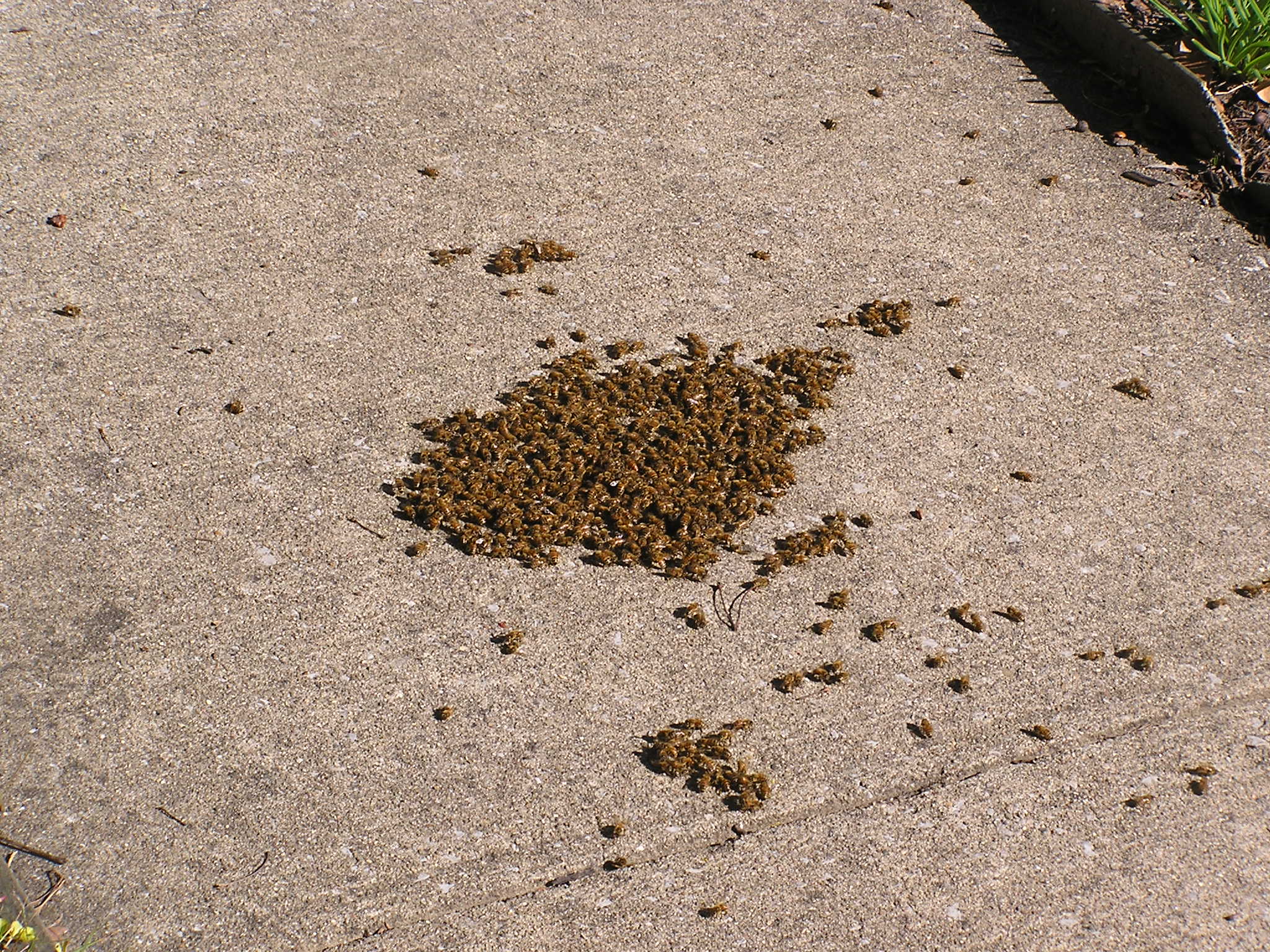
Monday morning, after I left the youngest at the corner on her way to the bus stop, I noticed a strange pile of…something…near the mailbox. It looked as though someone had dumped a very large scoop of pelleted pet food in the middle of the sidewalk. When I got close enough to see the “pellets” more clearly, I realized they were bees. Hundreds and hundreds of honey bees, curled up tight and motionless, clinging to each other in a mass.

A swarm, frozen. (Not literally, but temperatures were in the upper 30s, so they were quite immobilized by the cold.)

The bees weren’t the only ones effectively immobilized. It being early and I not being particularly brainy at that hour, I didn’t do what I should have done, which is scoop the mass into a box and move it off the sidewalk. I did think to drag some lawn chairs and compost buckets out to block the sidewalk, however, so the neighborhood’s avid walkers wouldn’t stumble into the swarm. (I was actually more worried about the welfare of the bees than that of the walkers.) Being also heavily under the influence of cold medication, I went back to bed, resolving to check on the bees once the sun had hit them in a couple hours.

My morning-fogged brain had reasoned that they would warm up, wake up, and fly off on their business. When I checked them around 10:00 a.m., they were moving alright, but mostly moving around rather than moving on. Scout bees would spiral up from the mass every few seconds and take off in various directions, but an awful lot of them remained on the sidewalk. I recognized the tactical error of failing to move them while they were easily moved and realized it was time to involve someone who actually knew what they were doing.

I put the word out on Facebook and soon heard back from a friend who had the phone number of a local beekeeper. By the time he got to my house, it was around noon, and about half of the bees were off scouting for new digs for the colony. The pile of bees was now more of a puddle.
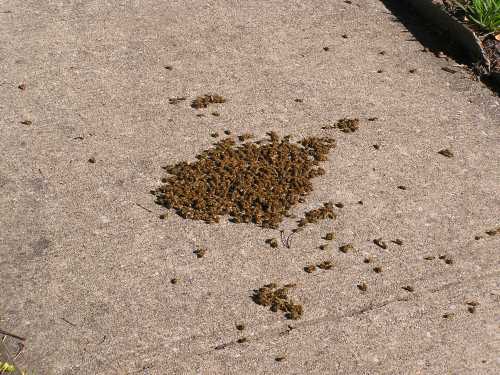
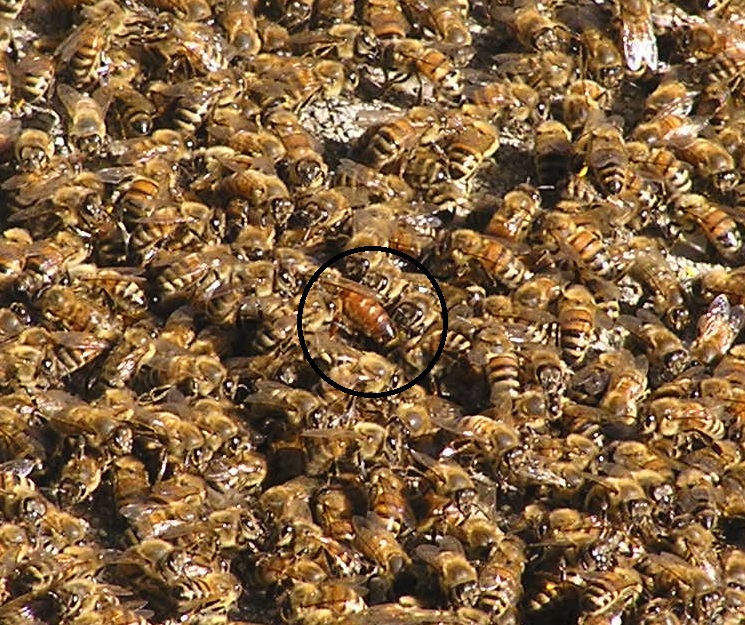
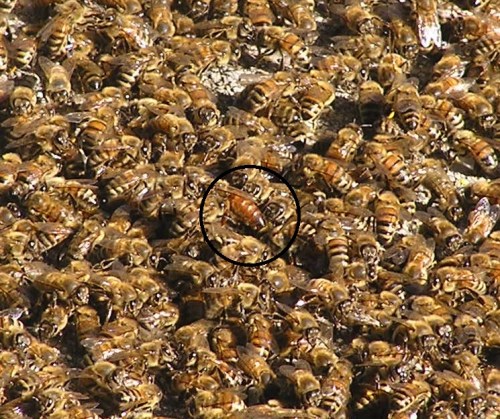
The beekeeper was a little disappointed, but I explained that there had been twice as many bees when I’d started looking for help. He was somewhat molified when he confirmed that there was a queen among them, though she was very young and not very large. (That’s her in the black circle below.)
He placed a lidded hive section, loaded with a few comb frames, over the puddle and tapped on it. (That apparently encourages the bees to climb up; I suppose they want to see what the heck is making that annoying sound.) After a few minutes, he lifted the lid, and sure enough, bees were clambering over the box’s interior. The young queen herself had climbed right to the top, so he carefully put the lid back to prevent her from escaping.

He hung around as long as he could to give returning scouts a chance to join the group, but had to allow himself time to drop the new bees off at home before returning to work. It’s too bad he couldn’t have left the box there for the rest of the day, as several dozen scouts returned throughout the afternoon and seemed lost without their queen and their sisters. A number of them collected on a branch overhanging the sidewalk, which leads me to think that the swarm had settled in the tree for the night but somehow lost their collective grip because of the cold and dropped to the sidewalk.

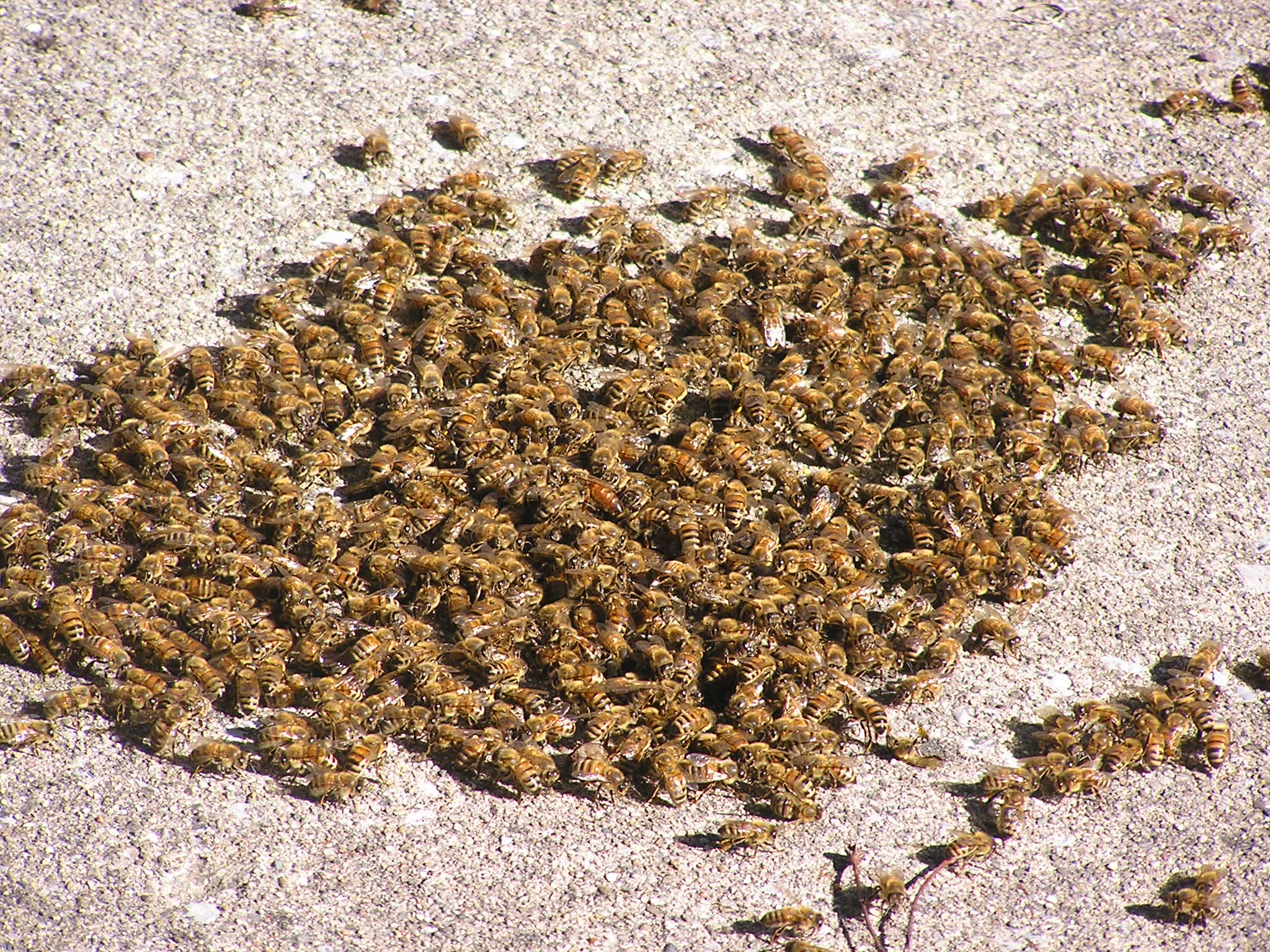
While waiting for the beekeeper, I spent a delightful half-hour sitting on the sidewalk, watching the bees. The sound of them was soothing, and their furry golden bodies glowed in the sun. It was fascinating to watch them interact, always touching one another with feet or antennae, coming and going on their marvelous and mysterious (to me) business.
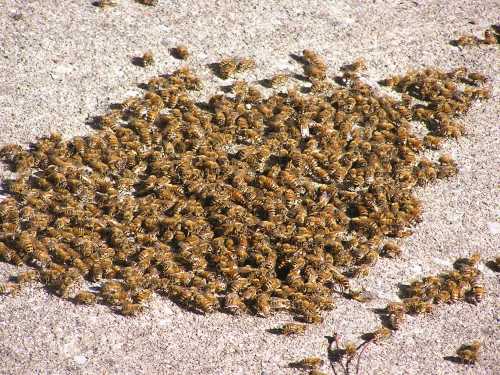
I was so relieved when the beekeeper agreed to take those who would come and to do what he could for them — it’s quite late in the season for such swarms, and they will need a good deal of help to get through the winter. I hope with all my heart that the young queen not only survives but does well for him. As a wild bee, maybe she’ll bring some new traits into his hives that will improve them. May she live long and prosper.

(Bonus points if you can find the queen in the last photo.)

The sesame made me do it

It happened again.

Inspired by this recipe at cozywalls, I made sesame sauce to toss with spaghetti squash for lunch and ended up eating the entire squash. At least yesterday it was squash; last time it was a whole package of buckwheat udon.

I made a good faith effort: I divided it into two generous portions, put one in a plastic container in the fridge and the other on my plate. I sat down to eat, and the flavor was fantastic! The texture of the spaghetti squash was unusual, and the way it interacted with the texture of the sesame made me roll my eyes. I’ll just have another taste, I told myself. There’s still plenty for tomorrow, I reasoned. And before long, the plastic container was empty.

I wish I could say, “I can’t believe I ate the whole thing,” but I can and do believe it. It was that yummy.

Thanks to the lower density (and lower caloric content) of the spaghetti squash, I didn’t feel grotesquely bloated as I did after I finished off the sesame-coated udon a couple weeks ago. I don’t think one can actually feel virtuous about having single-handedly eaten an entire squash in one sitting, but it could have been worse. (Is that rationalizing?)

I can’t seem to lay off the sauce – I store plain noodles in the refrigerator all the time without the least temptation to pull them out and eat them. Amy at cozywalls says the stuff tastes even better if left to sit overnight, but I’m beginning to doubt that I will ever find out for myself.

So here is the plan from now on: I will only make half as much sesame sauce, and toss it with just half of the noodles (or medium du jour). If this strategy doesn’t work, I may need an intervention.

And here, so you can develop your own sauce habit, is the recipe:

Quick and Addictive Sesame Sauce

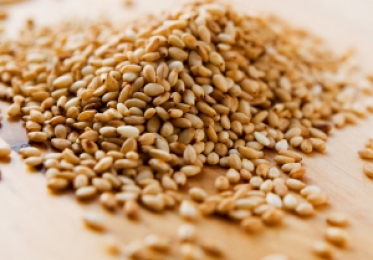
2 tbsp. sesame tahini
2 tbsp. balsamic vinegar
1 tsp. hot sesame oil
1 tsp. minced garlic
sesame seeds for garnish (toasted or not — your preference)

Stir together first four ingredients and toss with cooked noodles, spaghetti squash, cucumbers, broccoli, snow peas, bean sprouts, shredded cabbage, or anything else that sounds good. Sprinkle with sesame seeds. (Makes enough sauce for 8 oz. package of noodles.)

Random acts

As I took my daily walk in the neighborhood this morning, a car pulled up beside me and a woman offered me a bottle of water. She had a cooler and a boy (who looked to 7 or so) with her, and she told me they were driving around handing out water bottles.

By the time I thought to ask her why, she had driven off. I encountered others on my route — runners, walkers, people working in their yards — who had also been on the receiving end of her beneficence. We raised our bottles to one another cheerfully as we passed, big, goofy smiles of recognition on our faces.

I have no idea what lay behind this woman’s actions this morning, but some intriguing possibilities come to mind. It might have been a project for school, or something inspired by a church program. Maybe the idea came from a movie or television show — perhaps even a radio show. Or it might have been prompted by something in a book or magazine.

My chances of finding out are pretty slim. I didn’t recognize the woman or the child, and I doubt I would if I saw them again, unless they were handing out water. I don’t even know if they live in our neighborhood.

What impressed me most is the warmth I felt when I accepted that bottle, from the smile and wave we exchanged as she drove off. That warmth stayed with me, the bottle in my hand a continuing reminder. The feeling was renewed every time I saw someone else holding a similar bottle, with the smiles and nods that passed between us. We all had more in common than usual, thanks to that woman.

Not only did her gift make each of us feel good individually, it disposed us to share that good feeling with others. It also created a kind of affinity group among those who had been recipients of her kindness, and we recognized each other with a simple joy that reinforced the original gift experience we shared.

Such a small and uncomplicated thing to do, handing out bottles of water. None of us were parched or dehydrated, but accepting that gift of water changed each of our days. Water is a humble yet universal symbol of shared embodiment, but I think the real power was in the act itself, in the giving and in the receiving.

In the words of my favorite rabbi, “Go and do likewise.”

Monday the umpteenth

My friend Murphala over at FWY&S is having a bad day, and she suspects it may be because today is Monday the 13th. I say she’s half-right: she’s having a bad day because it’s a Monday.

For decades (if not centuries), Monday has been viewed with trepidation and despair. After all, it’s the day we return to work (or school) after our weekly respite (the weekend). It’s often the day we go back to the grind after vacation, though I’ve noticed in recent years that school corporations (in the U.S., at least) seem to take great pains not to begin the new school year on a Monday. Could it be that they’ve observed some truth in the old Russian adage that one should never begin anything important on a Monday?

You may be tempted to dismiss this as random coincidence or blind superstition, but consider the following:

  • Have you noticed how much better the week is after a three-day weekend that includes a Monday holiday? This can’t simply be due to the shorter (four-day) week, because weeks preceding a three-day weekend that begins with a Friday holiday are downright hellish.
  • In everyone’s mind, summer really begins the day after Memorial Day, school calendars and summer solstice notwithstanding. (The same can be said for Labor Day and fall.)
  • In sensible places like Canada and Great Britain, the day after Easter (a Monday) is a national holiday.
  • Songwriters have little good to say about Monday: “Monday, Monday” by The Mamas & the Papas, “Rainy Days and Mondays” by The Carpenters, “I Don’t Like Mondays” by The Boomtown Rats, and “Manic Monday” by The Bangles, for example.
  • According to the Urban Dictionary, that hip barometer of society, Monday is bad news all around — the word can even be used as a very nasty (though somewhat cryptic) insult.

So here’s to the end of another Monday and hoping that the rest of the week is better. After all, there’s nowhere to go from here but up!

Writing that inspires: Seven Pillars of Wisdom

I’ve been reading T.E. Lawrence’s Seven Pillars of Wisdom, and at times his prose is breathtaking. Here’s what he says about his journey down the Red Sea by boat from Suez to Jidda:

By day we lay in shadow; and for great part of the glorious nights we would tramp up and down the wet decks under the stars in the steaming breath of the southern wind. But when at last we anchored in the outer harbor, off the white town hung between the blazing sky and its reflection in the mirage which swept and rolled over the wide lagoon, then the heat of Arabia came out like a drawn sword and struck us speechless. (p. 49)

I feel like I’m there, standing on the ship’s deck beneath a noonday sun so bright that all color seems muted, trying to hold firm against the assault of that intense heat.

Lawrence describes dozens of different types of sand and stone throughout the book, the way they lie together in valleys or tower over the landscape in layered escarpments.  I can see them in my mind’s eye, and I find myself longing to see them with the eyes of my face as well, to feel them beneath my camel’s feet and hear the sounds they make when traversed by wind and body.

The swept ground was so flat and clean, the pebbles so variegated, their colors so joyously blended that they gave a sense of design to the landscape; and this feeling was strengthened by the straight lines and sharpness of the hills. They rose on each hand regularly, precipices a thousand feet in height of granite-brown and dark porphyry-coloured rock, with pink stains; and by a strange fortune these glowing hills rested on hundred-foot bases of the cross-grained stone, whose unusual colour suggested a thin growth of moss. (p. 72)

His language often evokes images of water, reflecting both the incongruent influence of water on the terrain and the necessary preoccupation with water that underlies the thoughts and actions of desert dwellers.

The hills got lower, with the sand banked up against them in greater drifts, till even the crests were sand-spattered, and at last drowned beyond sight. So as the sun became high and painfully fierce, we led out upon a waste of dunes, rolling southward for miles down hill to the misty sea, where it lay grey-blue in the false distance of the heat. (p. 93)

Such descriptions remind me of the incredible cinematography in Lawrence of Arabia (one of my favorite films of all time), and I realize that the movie’s vast panoramas and sweeping score attempt to express the ineffable qualities of Lawrence’s evocative words. This is what he writes about the great interior expanse of the Arabian peninsula:

We, ourselves, felt tiny in it, and our urgent progress across its immensity was a stillness or immobility of futile effort. (p. 238)

Alas, thus does my own writing seem some days!

(All quotations from the 1997 Wordsworth Edition.)