Tag Archives: children

It’s snowing!

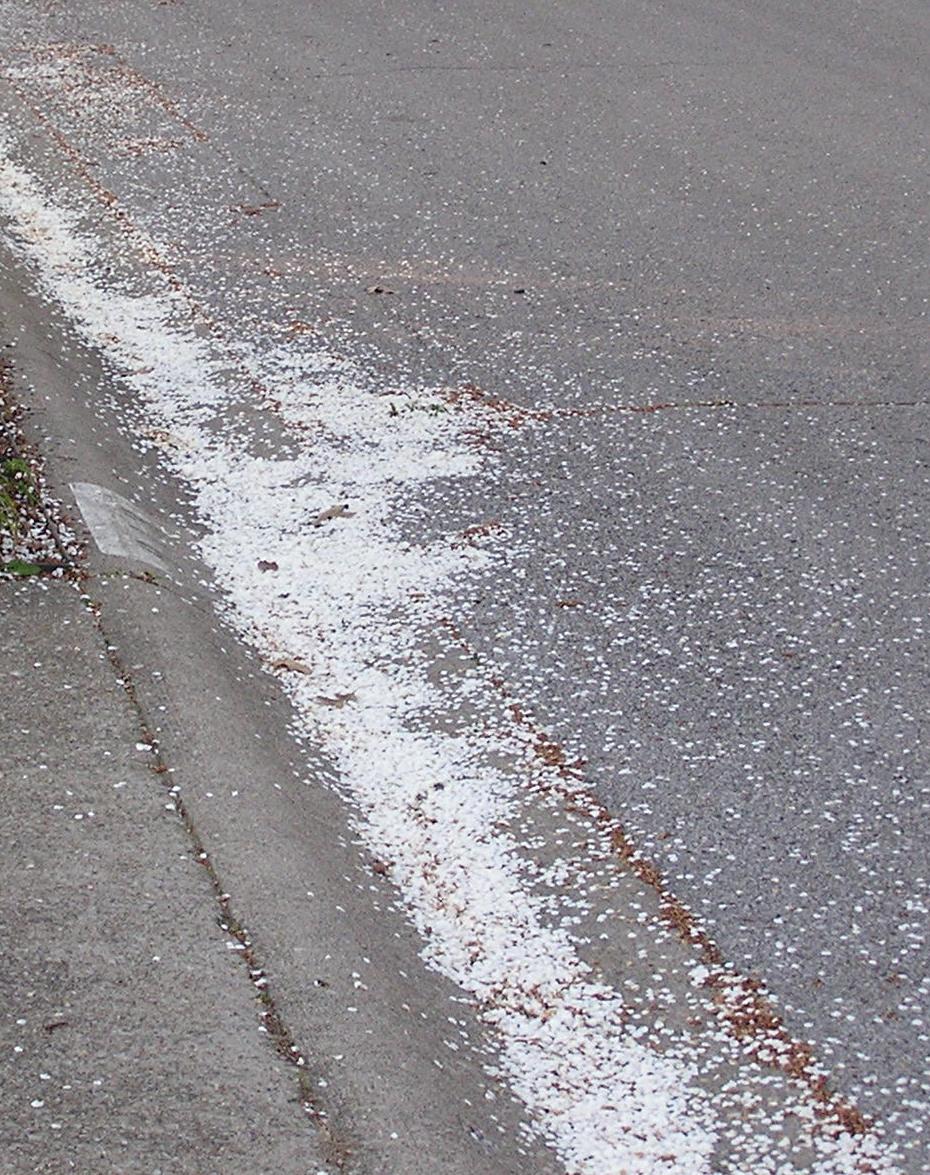
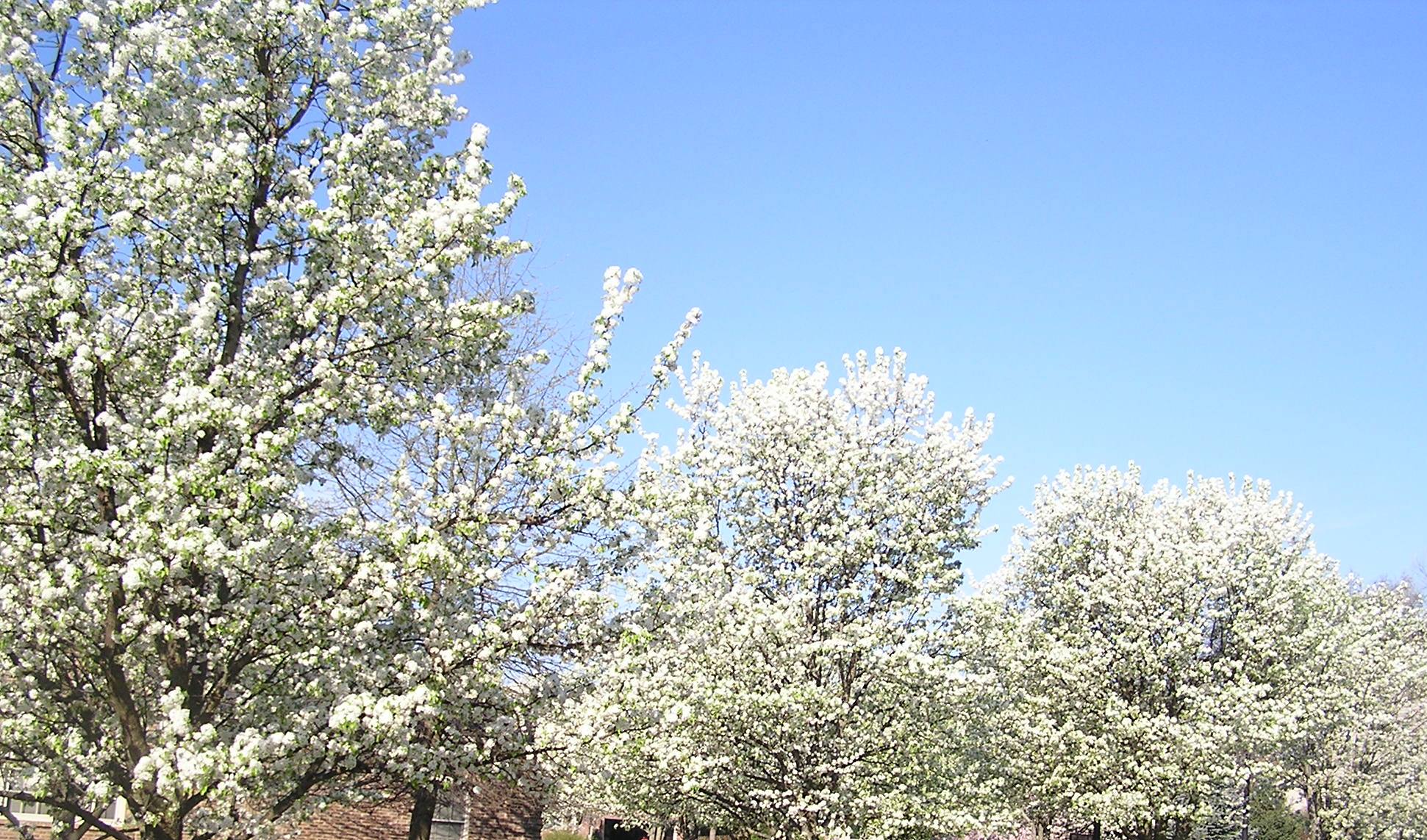
Not really; it’s been in the upper 80’s (F) all week. But the ornamental pear trees that line the street  look a lot like they did a couple weeks ago (minus the tiny green leaves), when each branch was weighed down with a tiny mound of snow.

Each time a bird alights in or takes off from a tree, there’s a little shower of white petals. Last evening I heard small voices giggling and shrieking, “It’s snowing!” Down the street, two children were tossing twigs into the trees and dancing around in the resulting cascade.

For a few magical days, snowy white petals will swirl on the breezes and form car-blown drifts in the street. Despite the ridiculous heat, it really is only spring.

Internal clocks

(This post was inspired by my friend Murphala at FlourWaterYeast&Salt.)

When I was growing up, we kept all the clocks in the house set 15 minutes fast, because that’s about how much we always ran late. It actually worked pretty well. It takes my rational brain a few minutes to shift gears and say, “Whoa there, the clock is fast, remember?” In the meantime, my reactional brain has seen the time, yelped “Holy pancakes!” and sent a jolt of adrenaline through my system. By the time the rational brain kicks in, I’m already in gear and halfway out the door.

My S.O. is the sort of person who could have coined the expression, “To be early is to be on time; to be on time is to be late.” Living together all these years, I’ve come to appreciate that running a few minutes early means I don’t have to feel rushed, and he’s come to appreciate that the world really doesn’t end if he’s not fifteen minutes early to everything.

Unfortunately for the harmonious balance we have managed to strike, we have children.

One is reasonably well-organized and quite capable of punctuality. He frequently fails to live up to his potential in that area, however, largely because he is a teenager. He loves the thrill of pulling things off without a moment to spare, timing everything down to the last second so he can crow in triumph at the killjoy parents who have been anxiously clucking and fluttering him out the door. At least half the time, though, he leaves something out of his meticulous calculations, and, as his plan includes no margin for error, the whole scheme crashes and burns, accompanied by parental hair-pulling and scolding.

The other child has always been temporally challenged, a condition that has only intensified as she’s moved into her pre-teen years. She can stretch the briefest of tasks into an agonizing effort of Sysiphean proportions. When asked if she’s ready to leave, she’ll answer yes, only to begin rushing around at the moment of departure doing 37 things that have to be done so she can go. I can only guess that she understands “ready to leave” to actually mean “ready to think about getting ready to leave.”

The one good thing about this situation is that it has driven my S.O. and I to greater solidarity in the departure department. Of course, we’re also more unified in terms of elevated blood pressure. Assuming we both survive until the offspring are on their own, I’m pretty sure we’ll never again fuss at each other over being on time.

Of God and glitter: Why no self-respecting church would ever ordain me

I was writing in a coffee shop the other day and overheard some women sitting at a nearby table. Their conversation must have been about faith and parenting, because one woman said she found it difficult to talk with her children about God the Father when their own father had walked out on all of them. Another woman chimed in, wondering how she could convince her children that their heavenly Father loves them when their earthly father, who also supposedly loved them, had been so abusive.

I heard the struggle in these mothers’ stories, the anguish in their voices, and I wondered why they needed to teach their children that God is a loving heavenly father. Why try to stuff God into a metaphor that has no resonance in their lives? Why not talk about God as a loving heavenly mother who was willing to sacrifice everything, to an even greater extent than the mother whose living example is before her children daily?

Jesus didn’t randomly choose to refer to God as father; he had specific reasons for doing so, both personal and political. They were his reasons, a natural outgrowth of his life experience and the life experiences of those around him. And his doing so was considered quite scandalous at the time – how dare he cast the God of Israel, the Lord of Hosts, in such an intimate, human role! How dare he describe the one, true God in language so similar to that used by the hated, idolatrous Romans (paterfamilias)? I cannot imagine that Jesus would in any way fault us for doing the same scandalous thing in our time, out of our life experiences.

Christians have spoken of God in feminine and maternal terms throughout the ages, though these expressions have been largely overshadowed by the loud shouting of masculine and paternal images that became fossilized in the creeds. Jesus described himself as a mother hen who longed to shelter her chicks beneath her wings; why are we so reluctant to use this imagery ourselves?

I feel sad that those mothers found themselves struggling in the one place they and their children should have been able to find peace and comfort: their faith. I believe that Jesus, who was notorious for meeting people on their own terms, would have sat down at their table and told them marvelous stories of a God who is like a woman that asks a neighbor to watch the rest of her children while she goes out looking for the one who didn’t come home at curfew; a God whose kingdom is like the glitter you keep finding all over the house months after the art project has been turned in; a God who always makes room in bed for the child who has a bad dream, even if it means She has to spend the rest of the night clinging to the edge of the mattress.

The saddest room in the house

In September, our ten-year-old cat, Name-O, was diagnosed with an inoperable tumor, a fast-growing sarcoma between her shoulder blades. This was a terrible shock, as we expected to have her with us for another decade or so.

Name-O came to us when the children were respectively 18 months and 4 years of age; they chose her and named her (“and Name-O was her name-o”). She slept with them when they slept and napped close by when they were awake. She enjoyed their attention, though she let them know when she had reached her limit, always without biting or scratching. When they went off to school, she met them at the door every afternoon. She was a steady comforter of my drama-queen daughter and a boon companion to my cat-crazy son.

The things I put up with...

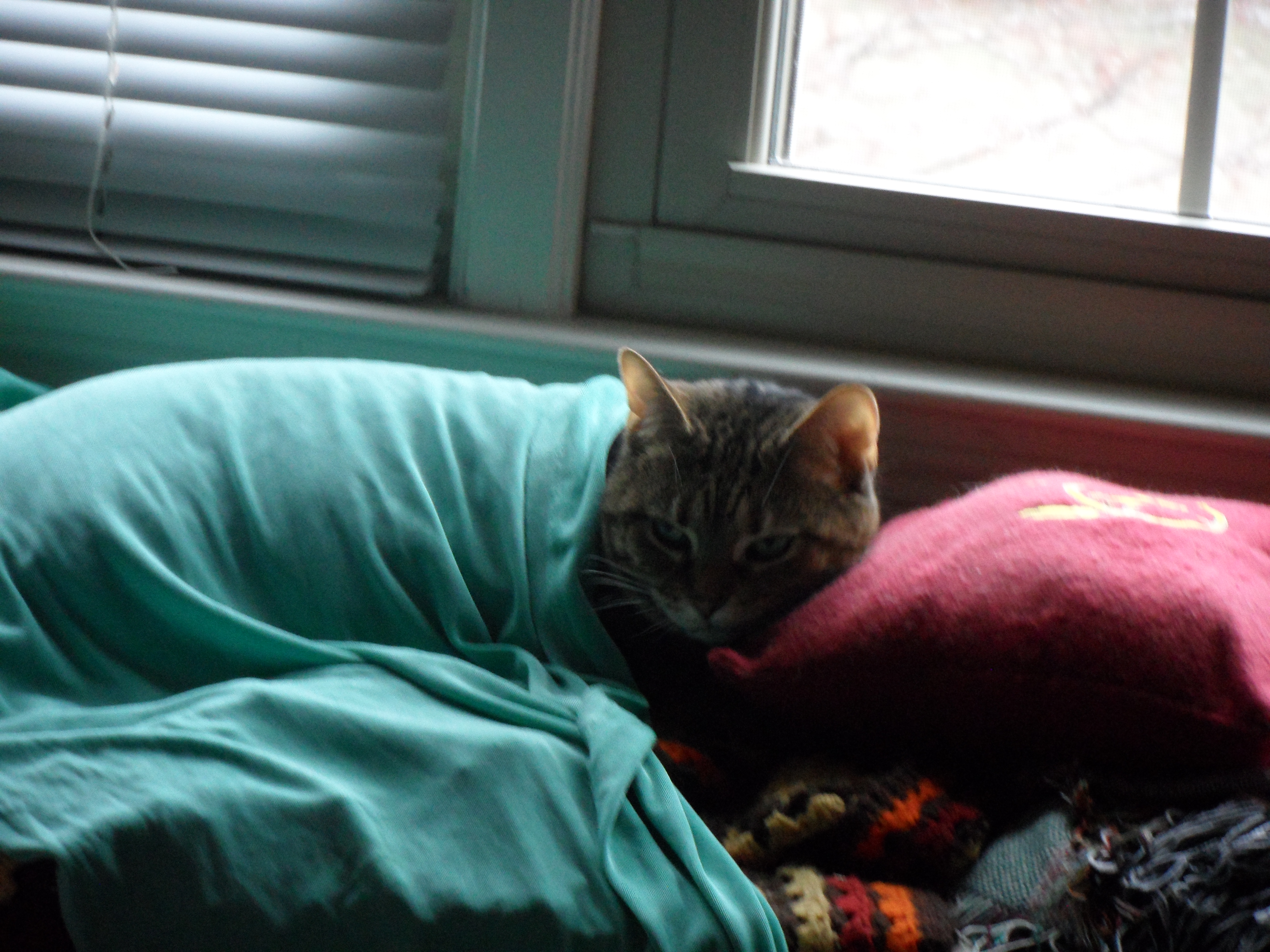
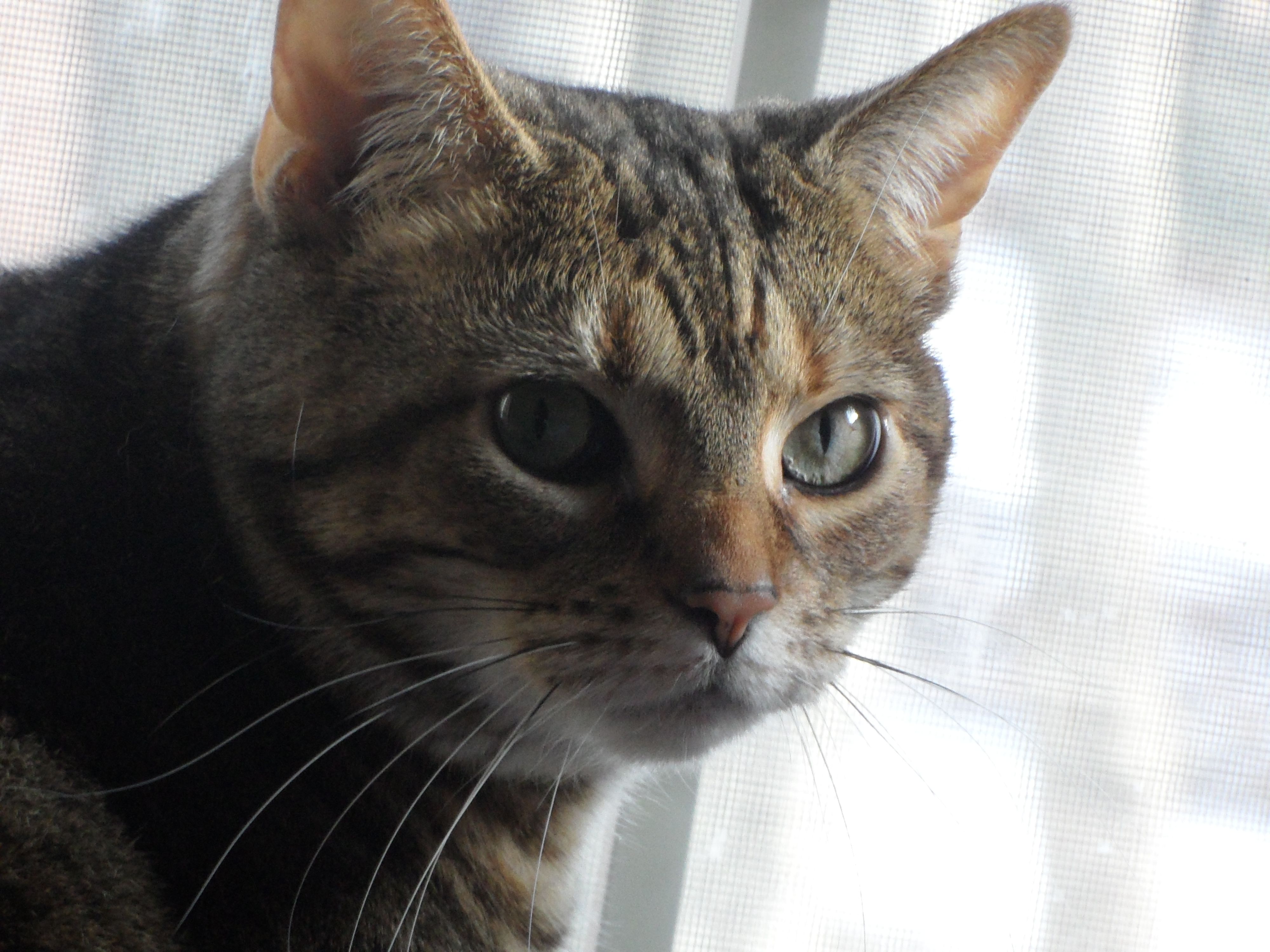
Name-O was large for a female cat. Her long, lean frame was easily twice the size of our other cats, and at fit adulthood she weighed 14 lbs. She had big round eyes of green and the longest whiskers I’ve ever seen. Her short fur was beautifully marked with black tabby stripes and swirls on a tawny background. Her underside was creamy with black mackerel spots, and she liked to roll over and invite us to rub her speckled belly. I was intrigued by the distinctive, diamond-shaped patch of light-colored fur that marked her nape. Her tail bore Tigger-like alternating half-stripes; she always carried it vertically, with the black tip crooked like a flag.

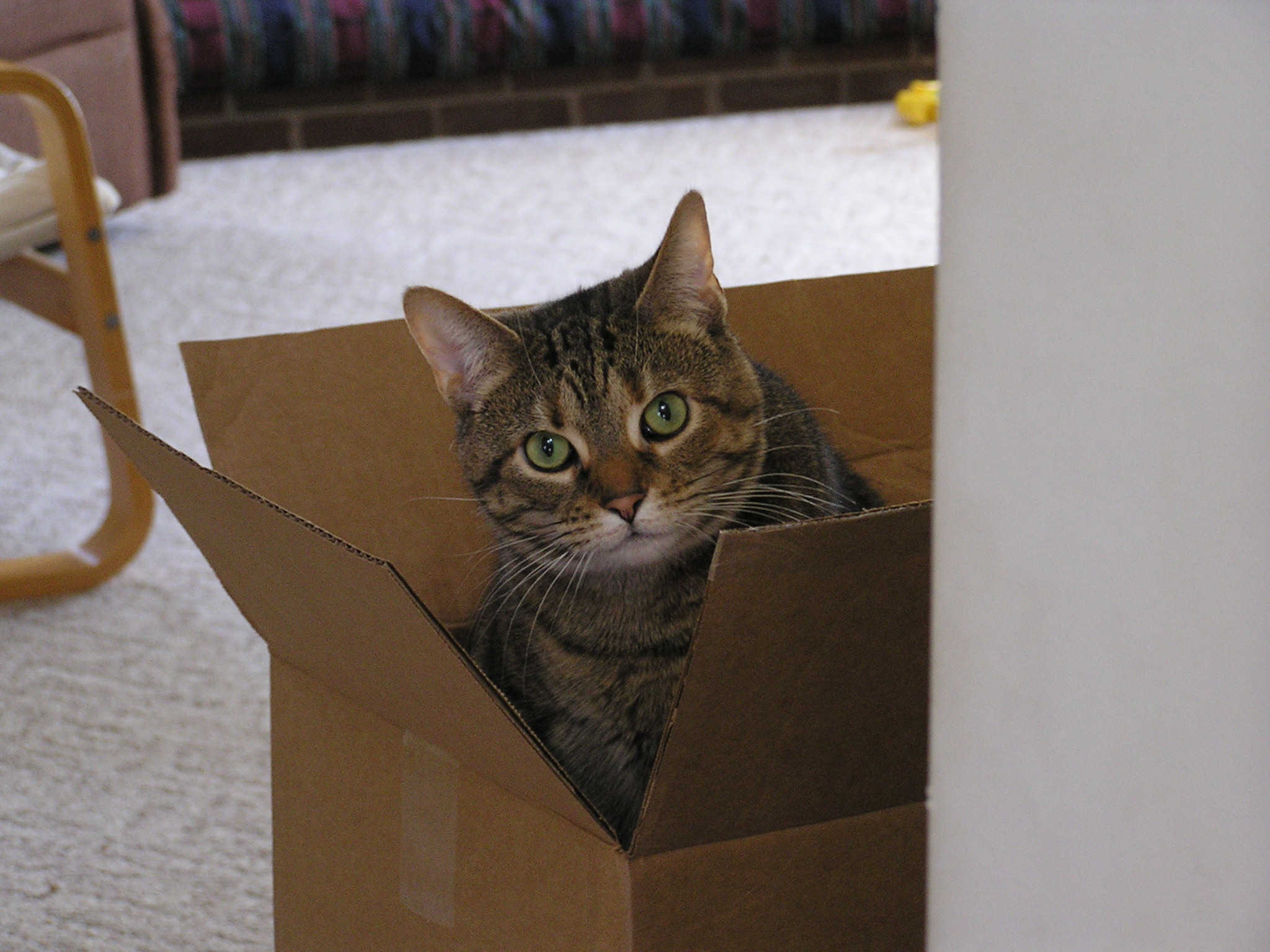
Name-O-in-the-box

Like many cats, Name-O enjoyed exploring places that were difficult to access. She was a strong jumper and agile, but not always a good judge of where her large body would fit or how she’d get back out again once she had satisfied her curiosity. I could fill several pages with her hilarious (sometimes exasperating) exploits and mishaps involving shelves, ledges, and furniture both high and low.

Toward the end of her time with us, she spent most of her days in the master bedroom walk-in closet, which serves as a dressing room as well as storage space. We cleared a cubby for her next to the dresser and gave her a fleece blanket to lie on. Drawn by the sound of her loud purring whenever she heard someone enter the bedroom, we detoured into the closet a great deal more often than we might have otherwise, always with a word and a gentle touch for her. If she didn’t come downstairs when it was time to eat, we brought the food to her. Noticing she had difficulty getting up and down, the children set up a series of chairs and footstools so she could reach the cubby without jumping.

Winter 2010

A friend once observed that one of the most precious gifts our animal companions give us is their mortality, for we enter into relationship with them in the knowledge that we will outlive them. Difficult though her dying was for everyone, none of us would forego the ten years of joy we had together to avoid the pain of those last few months.

She has been gone five weeks now, and I no longer glance at that cubby every time I put away clothes. I’ve finally broken myself of the habit of greeting her whenever I cross the threshold. I don’t cry when I get dressed anymore, but the master closet is still, for me, the saddest room in the house.

Weird, true math story

Alas, hunky actors did not likewise appear.

As bedtime approached last night, my son casually mentioned a story problem from his algebra homework that had stumped him. He related the problem to me, and it was like a scene from Numb3rs: I could SEE the variables and their relationships, as if they were floating in the air before me. (Note: this has never happened before. Ever.)

My son wandered off to brush his teeth, and I scrambled for paper and pencil and began frantically writing down mathematical equations, afraid I would somehow lose them. (This also has never happened before.) When he came back, I handed the paper to him and went to deal with some laundry. His father took an interest, and I could hear the two of them puzzling over what I had written. I called down the hall words that I swear have never before crossed my mind, let alone my lips: “You need to set up a binomial equation.”

Where the heck did THAT come from? I can’t remember where I put my keys not five minutes before, but stuff I all but flunked over 30 years ago spontaneously pops into my brain? As dementia closes in and other faculties fade, am I becoming some kind of mathematical idiot savant?

Maybe I should sign up for some math courses at the community college…

(By the way, they were able to solve the problem by following my suggestions, though they resorted to using a calculator. Wimps.)

My favorite tantrum

At this remote point in history, I haven’t the faintest idea what triggered it, but there was our toddler son, throwing a classic tantrum on the kitchen floor. We had tears, a beet-red face, continuous screaming, pounding feet, and flailing arms. His father and I exchanged looks high above the rampage, eyebrows arched: this was a most impressive display. After a few more seconds, one of us shrugged and cocked a head toward the door. The other nodded, and we left the room.

We resumed our interrupted conversation on the living room couch, two rooms removed from the din.  Suddenly the noise from the kitchen ceased. We heard small feet pound through the dining room. Having located his stray audience, the indignant little performer flung himself at our feet and began the tantrum anew. After a brief, amazed silence, we burst into laughter, unable to help ourselves.

This was not at all the intended effect, and the offended actor stopped mid-fit and sat up to fix us with such a look of annoyance that we were further reduced to tears of hilarity. Summoning the autocratic dignity with which all children are born, he picked himself up, surveyed us with disgust, and walked out of the room.

A long moment later, we had recovered sufficiently to go in search of our budding Machiavelli. We found him in his room, busy at some new thing, the entire affair apparently blown over. Its lessons were not forgotten, however, for he’s a cagey little creature, possessed of a shrewdness that his sweet disposition both belies and (fortunately) moderates. He’s also a quick study: this was his one and only tantrum.

Good thing it was so memorable.

(I want to thank Marie of 1000 Reasons I’m a Bad Mom for inspiring this post, via Mamapedia: http://www.mamapedia.com/voices/barbarism-begins-at-home.)

Remembering and remembrance

My son had a social studies assignment that could only be completed last Sunday. He was to interview a parent or other adult on September 11 about the effects of the 2001 attacks. He chose to interview me. One of the interview questions was, “How do you think we should remember 9/11?”

This had actually been on my mind in the weeks leading up to the anniversary, because it seemed as though every media outlet I pay attention to had climbed on the 9/11 bandwagon. I found stories and conversations about the topic so distressing that I began avoiding radio, newspaper, and television altogether. But the reason for my distress didn’t come into focus until my son asked me that question.

After a rather long silence, I took a deep breath. “I don’t need anything to remind me,” I told him. “I have no trouble remembering it.” Images flashed unbidden to mind. “Sometimes I’d like to forget the things I saw that day.” As we talked, I realized that the nation’s near-obsession with anniversary observances of 9/11 might have something to do with the fact that most people were much farther removed from it than I had been. For the majority of the country, the events of 9/11 were a singular occurrence; for those living in the shadow of New York City, it was the beginning of a months-long nightmare.

In 2001, we lived in urban coastal Connecticut, along one of the commuter corridors that feed New York City’s white collar labor pool. The smudged and dusty people who limped across Manhattan’s bridges that day weren’t just figures on a television screen – they were our friends and neighbors. For weeks we drove past commuter parking lots with cars whose drivers would not be coming back for them. A column of smoke from lower Manhattan was visible when we went to New Jersey or Long Island, and a smoky pall hung in the air when we went into the city. Once the dust had settled and the smoldering had stopped, the gap in the skyline drew our eyes like the chipped tooth you can’t keep your tongue from probing. For us, 9/11 wasn’t a story that popped up on the news; it was part of the fabric of our daily lives, fabric that had been brutally reshaped by the searing events of that day.

I now live in the Ohio Valley, where the only everyday reminders of 9/11 are images of the New York skyline in old movies and photos and the occasional “NYFD” baseball cap. I don’t really begrudge my neighbors’ need for some significant means of connecting with events that happened many years ago in a far-off place. Their desire to remember is honorable and earnest, even if my own different experience of those events makes it difficult for me to share in it. I just need to remember to cut all of us some slack when the next anniversary rolls around.

Thoughts unbecoming a parent (or maybe not)

In college, I fell in with a crowd of card players. While other students were out learning about jello shots and frat parties, I was learning about bowers and meld and trump. We mostly played euchre (if four were playing) or pinochle (if more than four were playing). In fact, I met my SO playing cards with this bunch and eventually married into a serious card-playing family.

The family game is pinochle – the more players and decks, the better – though the oldest generation favored setback, which used to be played out of deference when they were around. (Sadly, none of them are anymore. Around, that is.) It has long been a milestone rite of passage to be allowed to play cards with the adults.

After dinner at the in-laws’ last night, someone made the inevitable suggestion that we play cards. My older child, whose friends play snap and Egyptian rat slap at school during lunch, jumped at the idea. The younger one wasn’t at all enthusiastic, but we persuaded her to play with us for one deal around the table – six hands. By the second hand, I was thinking about how much fun it would be to play five-handed.

She took FOREVER to pick up, sort, and look at her cards. She took FOREVER to bid. She took FOREVER to meld. She took FOREVER to play each and every card. (There were sixteen tricks per hand; you do the math.) And she demanded complete silence while she deliberated, getting irate if the rest of us so much as talked among ourselves.

Oh, and did I mention that she outbid everyone for four of the six hands?

To her credit, she’s a gutsy and creative player, seeing possibilities (and strands of luck) where more experienced players would see nothing at all. She takes outrageous chances and leads with a breathtaking disregard for orthodoxy that pays off surprisingly well. But she’s also very expressive, and when one of her unconventional stratagems falls through, she becomes visibly and audibly upset. This makes for a less-than-pleasant playing environment, and quickly had me thinking less-than-charitable thoughts.

Her father was remarkably patient, especially considering he was one of her partners. His forbearance gave me pause; I, too, am a more deliberate player than most, and I owe much of my present confidence and velocity (such as it is) in playing to the kindness and tolerance of players who nurtured me through my most awkward stages of learning. Then the Good Parent voice chimed in, “How will she ever learn to play with confidence and reasonable speed if she doesn’t get to practice in a supportive environment?”

A martyred sigh was poised on my lips; I modulated it into a long, meditative breath: slow exhalation, slow inhalation. With a much firmer grip on my composure, I closed my eyes and awaited the bidder’s next move, resolved not to be quite so persistent the next time she said she didn’t want to play. After all, it might be our own fault for pushing her to join us. Maybe we should let her come to us in her own time.

Water

Yesterday, my SO took the day off from work and we put the kids on the bus and spent the day together, just running errands and hanging out. It was our anniversary.

That may not sound very romantic, but we fall more along the lines of practical than romantic. For one of our first Valentine’s Days together, he gave me a slow cooker, followed a year later by an electric wok. For our 20th anniversary, I bought him a load of creek stone.

For the first time in years (almost 14 since our first-born arrived) we just…did stuff…together. For an entire day. It was refreshingly simple, and refreshingly…refreshing.

Like a long, deep drink of cool, clear water.

(A huge “thank you!” to Mom and Dad for taking care of the kids after school — you two are the best!)

These are a few of my favorite ornaments…

…today.

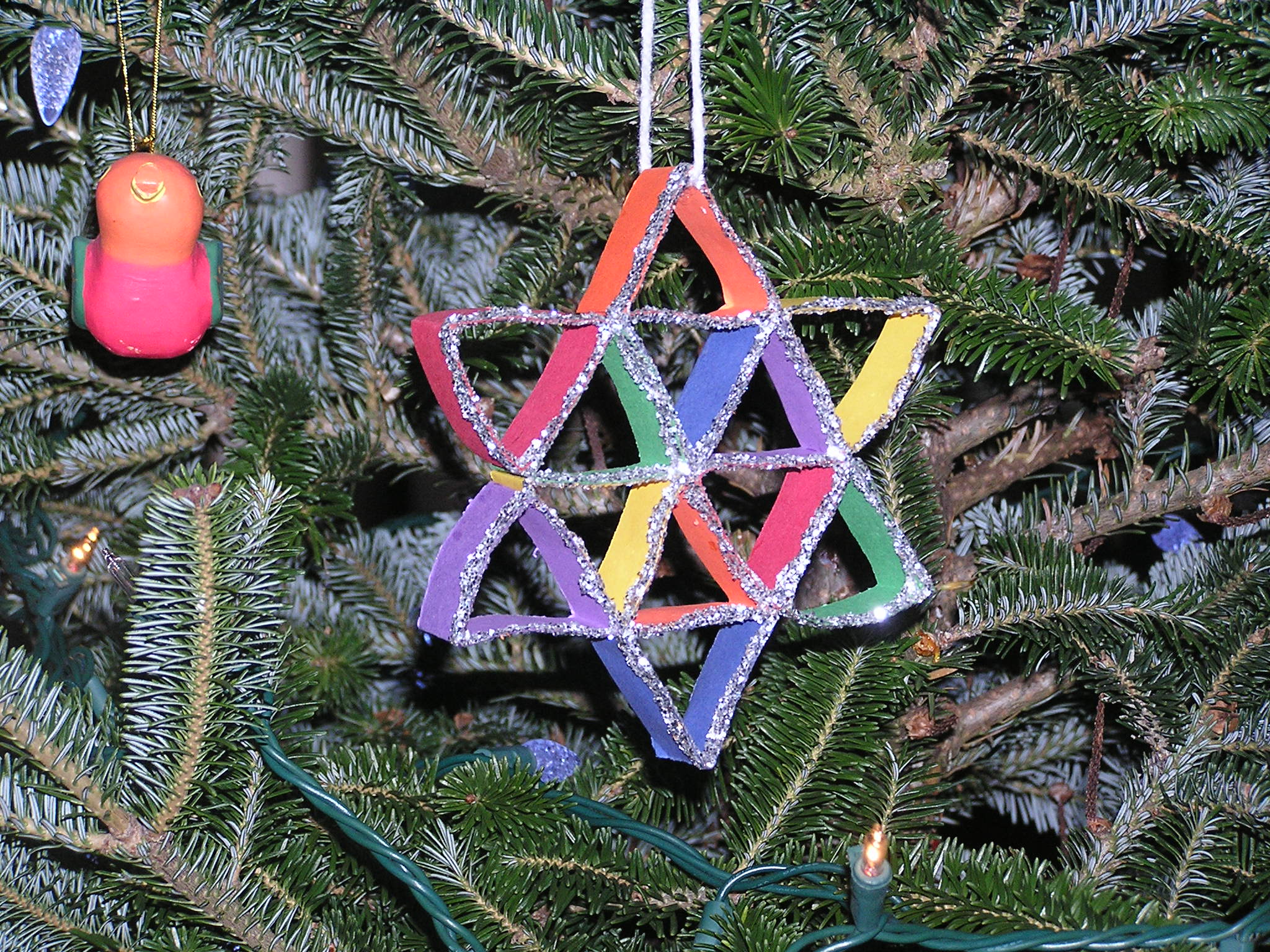
Many years ago, one of the kids brought home a lovely ornament made of simple construction paper triangles. Inspired by the clever but easy fabrication technique, we made a bunch of triangles and came up with some fun designs of our own.

This is the original ornament: twelve triangles glued together, one side of the finished snowflake/Star of David dipped in glue and then in glitter. Elegant and beautiful in its simplicity.

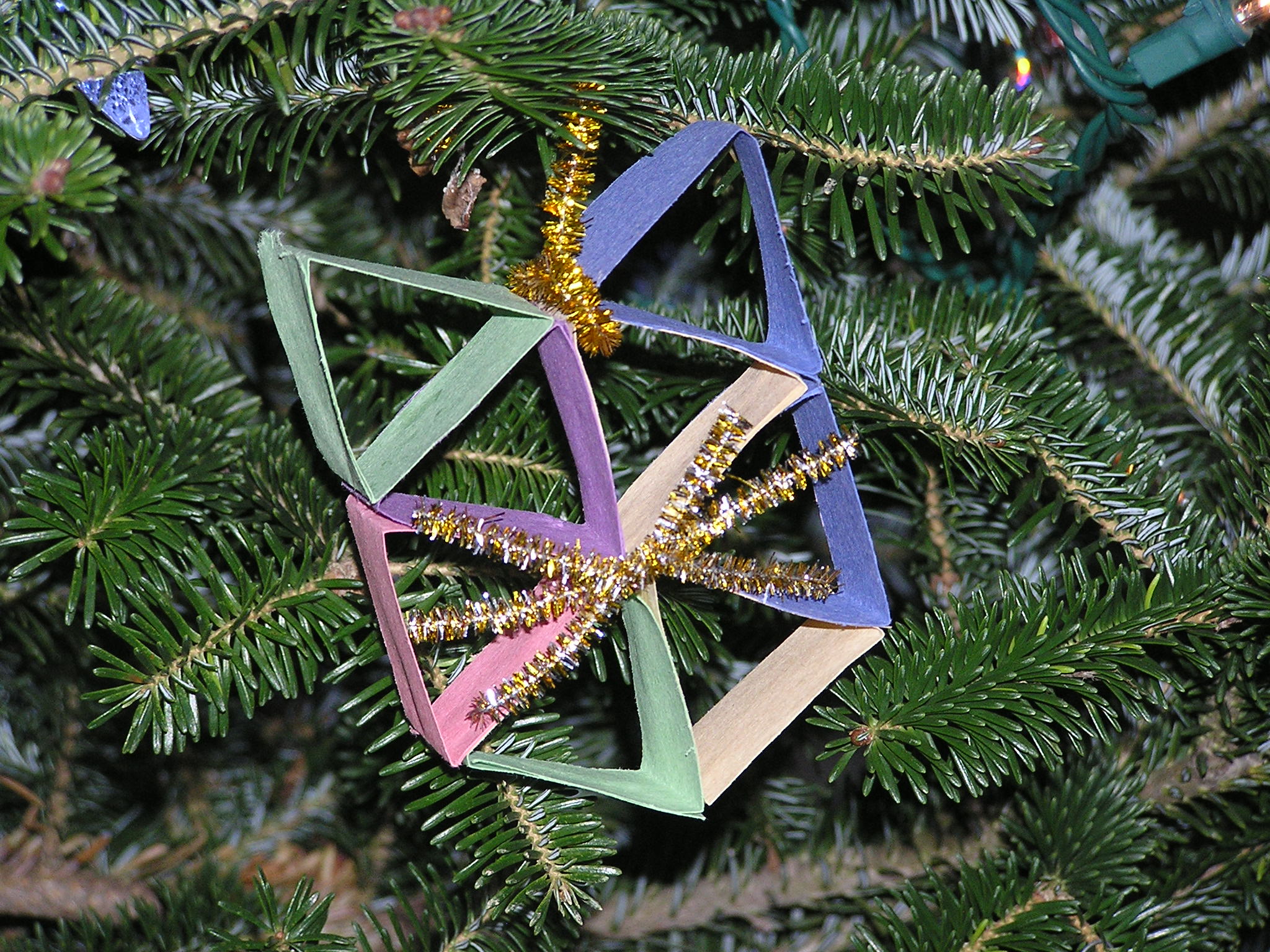
The Kitty-Cat variation: pipe cleaner whiskers instead of glitter.

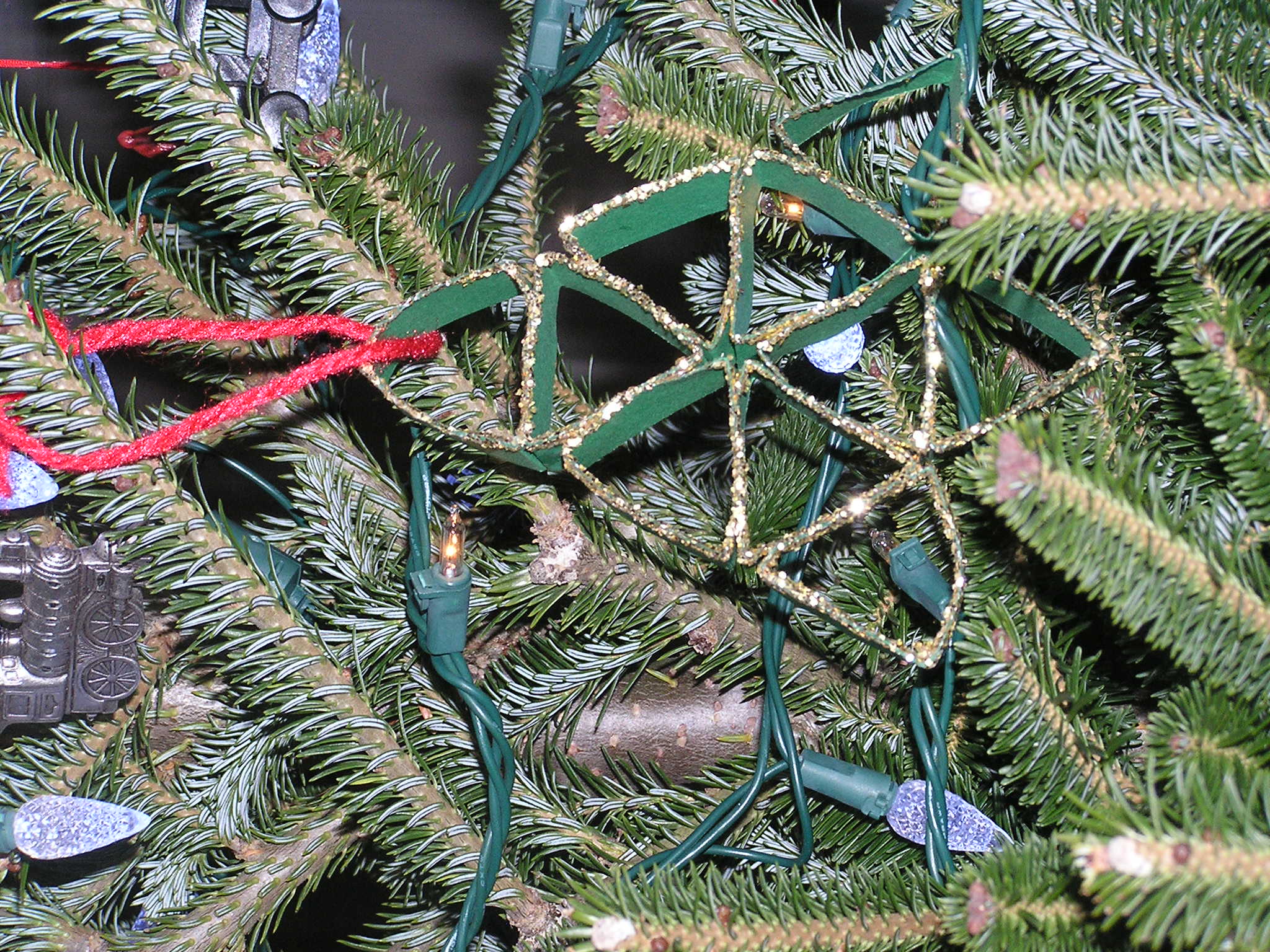
The Christmas Tree variation, in dark green; it shows up much better when NOT on the tree.

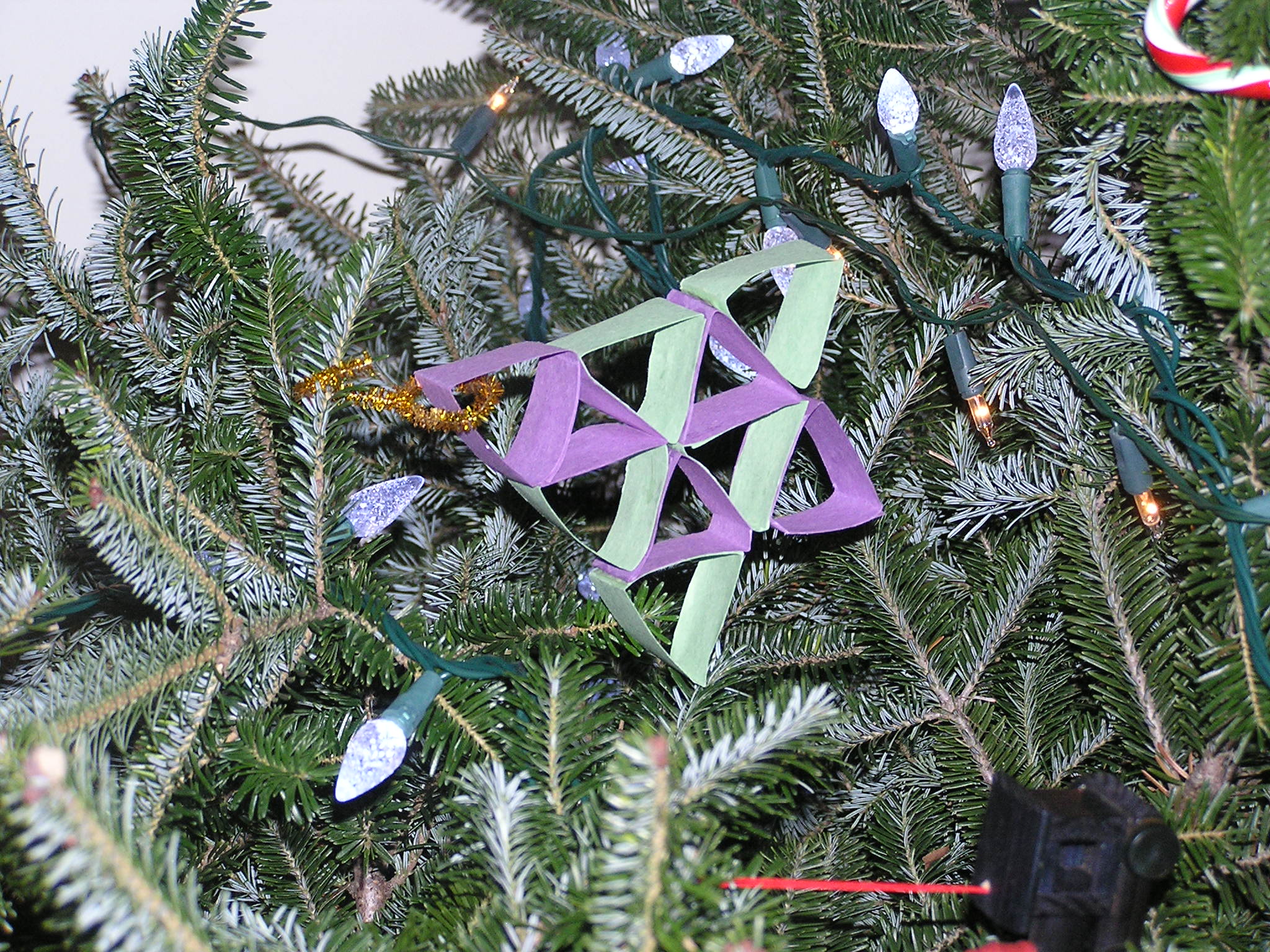
The Christmas Tree variation in colors that work better on the tree. Probably could use some glitter.

If I get industrious, I may post a how-to, with photos.