
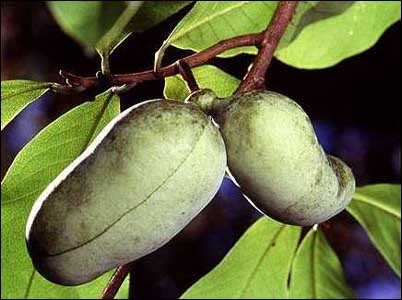
green paw-paw
You know it’s fall when the paw-paws show up in the produce section.
Yes, you read that right: paw-paws, as in the children’s song:
Where in the world is dear little Susie?
Where in the world is dear little Susie?
Where in the world is dear little Susie?
Way down yonder in the paw-paw patch.
The paw-paw is a real fruit that grows on a plant native to North America. It has several tropical relatives, but our paw-paw grows in the eastern U.S. as far north as western New York.
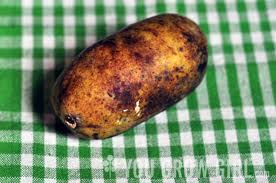
ripe paw-paw (not a potato. really.)
Although botanically classified as berries, paw-paws are about two inches in diameter and four or five inches long, the size of a nice baking potato. A properly ripe paw-paw looks much like a baking potato, too – brown and blotchy like a banana that has gone too far even for bread. Eaten at this stage, paw-paws have a texture like custard and a sweet, slightly fermented flavor that is wholly unique but reminds one faintly of mangoes.
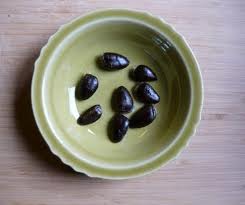
paw-paw seeds
The real trick to eating paw-paw is avoiding the large, flat seeds, which are a deep, glossy brown and very beautiful. (Some folks make jewelry out of them.) The seeds spiral throughout the fruit, making it difficult to cut up neatly. I start at one end and slice it crosswise every 1/3 inch or so, hoping to catch a seed with each slice.
Paw-paw is traditionally made into some kind of cold treat. According to several sources, chilled paw-paw was a favorite dessert of George Washington, and it’s often made into ice cream. I like it in smoothies, and usually freeze it for that purpose. This year I’m going to try it with a banana bread recipe, and one of these days I hope to make an old-fashioned paw-paw cream pie.
Although the fruits themselves don’t last too long, the fruiting season often goes into October, so I’m looking forward to a long, lovely fall filled with paw-paw.

 The Daily Compost