Tag Archives: parenting

Y is for yesterday

…which is when I was supposed to write and publish this post. But yesterday was a Saturday, which days are pretty busy around here. Unlike last Saturday (see S is for Skipping) I got to turn the computer on yesterday to take care of a few pressing items, but I didn’t get to spend more than half an hour.

Yesterday was also end-of-year assessment performances for area high school bands, hosted this year in a neighboring county. This means I spent a good chunk of the day dropping off, picking up, and generally schlepping myself and other people over several dozen square miles of the Bluegrass. I did get to enjoy concert performances by five excellent bands, though, which made it all seem worthwhile.

X is for Xanthippe

…because that name came up in a short story I recently read.* I will let you figure out for yourself how it might relate to this post.

My friend Murphala, over at FlourWaterYeast&Salt is knitting a third fingerless glove because she’s not happy with the color/pattern differences between the first two she made. I made a comment, to which she replied, but when I tried to respond to her response, Picatcha wasn’t working and wouldn’t let me make the comment, so this blog post will be my reply.

I sez: They all look find to me, but then again that sort of thing must not bother me because one of my kids regularly wears non-matching shoes to school.

She sez: Which kid?

So now I sez: The queen bee. It started in preschool, when she began mixing and matching socks. She’s the sort of child who goes barefoot at every opportunity, so I was just thrilled she had socks on at all. I was having coffee with some of the other preschool moms one day when a couple of them started complaining about how their daughters wanted to wear socks that didn’t match. I sheepishly confessed that was because of my daughter, and warned them that the next fashion craze coming their way was mix-n-match pony tails/pig tails. (The queen bee also had issues about brushing her hair.) I wasn’t invited to any more mom brunches.

She started in with the non-matching shoes last summer. The child is incredibly hard on flip-flops for some reason, and within a few weeks of getting a very sturdy and fairly expensive white pair, she had broken one of them. I foolishly bought her another pair (in a different color because they were out of white) which lasted her for about a month. As I lamented the demise of the second pair, she noticed that she had broken a different shoe in each and seized upon the idea of wearing the mismatched pair. The shoes were identical except for the color, so I decided there wasn’t any harm in it. I thought I might get more of my money’s worth out of them that way.

While shopping at the Goodwill this spring, she found two identical pairs of flats, one pink and one green. Seeing as they were only $2 each (significantly cheaper than the &^%$#@ flip-flops) I let her get them. So now she has TWO pairs of mismatched flats to go with the flip-flops.

Of such things are fashion icons made.

* “Seven Wonders,” by R. Garcia y Robertson, in Asimov’s Science Fiction, Dec. 1995

Ain’t misbehaving?

I’ve just returned from London, where we encountered groups of young people at every turn, most of them speaking languages other than English. The French-speaking school children were exceptional in their lack of discipline and consideration for other people. They consistently disregarded the direction of tour guides, train conductors, police officers, and their own chaperones. If there was a commotion at a museum, a restaurant, or on the street, the source was nearly always a group of French school kids.

The phenomenon was so apparent and widespread that it became a kind of running joke in our party. French school groups seemed to be everywhere, their disruptive behavior identifying them long before we were close enough to hear them speaking. We kidded that it was no wonder they’d all been sent abroad – their communities were probably relieved to be rid of them. We speculated that this was also the reason they couldn’t get chaperones: most groups had only one adult, maybe two, and 30 or more students. We dubbed them the scourge of Europe, opining that the Huns would be a welcome alternative, swift death by sword being preferable to death by unrelenting aggravation.

In short, I came away with a distinctly unfavorable impression of French children and, by extension, French methods of child-rearing. I hear there’s a new book out extolling French parenting, Pamela Druckerman’s Bringing Up Bebe: One American Mother Discovers the Wisdom of French Parenting. I’ve not read the book, so I don’t know what Ms. Druckerman saw that led her to conclude that American parents could take a page or two from French parents. Perhaps French children are well-behaved at home (which is where Ms. Druckerman probably saw them) and only act like hooligans when they’re not under the watchful eyes of their wise parents. I’m reminded of the genuine wisdom of my father-in-law, who once said of my own children: “They’re going to misbehave at one time or another; isn’t it better for them to do it at home, where you’re there to guide them, than out in public?”

Postscript: I realize it is completely unjust to paint an entire nation or generation with a single, broad stroke. In all fairness, there may have been a number of French school groups that we didn’t notice because they were so well-behaved. It’s quite likely that the groups which drew our attention did so because they were inadequately supervised, and the same children would have been ideal travel companions had they been accompanied by an appropriate number of adults. Nevertheless, I can’t help thinking it oddly significant that we encountered no school groups of other nationality that exhibited similar behavioral issues.

Internal clocks

(This post was inspired by my friend Murphala at FlourWaterYeast&Salt.)

When I was growing up, we kept all the clocks in the house set 15 minutes fast, because that’s about how much we always ran late. It actually worked pretty well. It takes my rational brain a few minutes to shift gears and say, “Whoa there, the clock is fast, remember?” In the meantime, my reactional brain has seen the time, yelped “Holy pancakes!” and sent a jolt of adrenaline through my system. By the time the rational brain kicks in, I’m already in gear and halfway out the door.

My S.O. is the sort of person who could have coined the expression, “To be early is to be on time; to be on time is to be late.” Living together all these years, I’ve come to appreciate that running a few minutes early means I don’t have to feel rushed, and he’s come to appreciate that the world really doesn’t end if he’s not fifteen minutes early to everything.

Unfortunately for the harmonious balance we have managed to strike, we have children.

One is reasonably well-organized and quite capable of punctuality. He frequently fails to live up to his potential in that area, however, largely because he is a teenager. He loves the thrill of pulling things off without a moment to spare, timing everything down to the last second so he can crow in triumph at the killjoy parents who have been anxiously clucking and fluttering him out the door. At least half the time, though, he leaves something out of his meticulous calculations, and, as his plan includes no margin for error, the whole scheme crashes and burns, accompanied by parental hair-pulling and scolding.

The other child has always been temporally challenged, a condition that has only intensified as she’s moved into her pre-teen years. She can stretch the briefest of tasks into an agonizing effort of Sysiphean proportions. When asked if she’s ready to leave, she’ll answer yes, only to begin rushing around at the moment of departure doing 37 things that have to be done so she can go. I can only guess that she understands “ready to leave” to actually mean “ready to think about getting ready to leave.”

The one good thing about this situation is that it has driven my S.O. and I to greater solidarity in the departure department. Of course, we’re also more unified in terms of elevated blood pressure. Assuming we both survive until the offspring are on their own, I’m pretty sure we’ll never again fuss at each other over being on time.

Of God and glitter: Why no self-respecting church would ever ordain me

I was writing in a coffee shop the other day and overheard some women sitting at a nearby table. Their conversation must have been about faith and parenting, because one woman said she found it difficult to talk with her children about God the Father when their own father had walked out on all of them. Another woman chimed in, wondering how she could convince her children that their heavenly Father loves them when their earthly father, who also supposedly loved them, had been so abusive.

I heard the struggle in these mothers’ stories, the anguish in their voices, and I wondered why they needed to teach their children that God is a loving heavenly father. Why try to stuff God into a metaphor that has no resonance in their lives? Why not talk about God as a loving heavenly mother who was willing to sacrifice everything, to an even greater extent than the mother whose living example is before her children daily?

Jesus didn’t randomly choose to refer to God as father; he had specific reasons for doing so, both personal and political. They were his reasons, a natural outgrowth of his life experience and the life experiences of those around him. And his doing so was considered quite scandalous at the time – how dare he cast the God of Israel, the Lord of Hosts, in such an intimate, human role! How dare he describe the one, true God in language so similar to that used by the hated, idolatrous Romans (paterfamilias)? I cannot imagine that Jesus would in any way fault us for doing the same scandalous thing in our time, out of our life experiences.

Christians have spoken of God in feminine and maternal terms throughout the ages, though these expressions have been largely overshadowed by the loud shouting of masculine and paternal images that became fossilized in the creeds. Jesus described himself as a mother hen who longed to shelter her chicks beneath her wings; why are we so reluctant to use this imagery ourselves?

I feel sad that those mothers found themselves struggling in the one place they and their children should have been able to find peace and comfort: their faith. I believe that Jesus, who was notorious for meeting people on their own terms, would have sat down at their table and told them marvelous stories of a God who is like a woman that asks a neighbor to watch the rest of her children while she goes out looking for the one who didn’t come home at curfew; a God whose kingdom is like the glitter you keep finding all over the house months after the art project has been turned in; a God who always makes room in bed for the child who has a bad dream, even if it means She has to spend the rest of the night clinging to the edge of the mattress.

Weird, true math story

Alas, hunky actors did not likewise appear.

As bedtime approached last night, my son casually mentioned a story problem from his algebra homework that had stumped him. He related the problem to me, and it was like a scene from Numb3rs: I could SEE the variables and their relationships, as if they were floating in the air before me. (Note: this has never happened before. Ever.)

My son wandered off to brush his teeth, and I scrambled for paper and pencil and began frantically writing down mathematical equations, afraid I would somehow lose them. (This also has never happened before.) When he came back, I handed the paper to him and went to deal with some laundry. His father took an interest, and I could hear the two of them puzzling over what I had written. I called down the hall words that I swear have never before crossed my mind, let alone my lips: “You need to set up a binomial equation.”

Where the heck did THAT come from? I can’t remember where I put my keys not five minutes before, but stuff I all but flunked over 30 years ago spontaneously pops into my brain? As dementia closes in and other faculties fade, am I becoming some kind of mathematical idiot savant?

Maybe I should sign up for some math courses at the community college…

(By the way, they were able to solve the problem by following my suggestions, though they resorted to using a calculator. Wimps.)

My favorite tantrum

At this remote point in history, I haven’t the faintest idea what triggered it, but there was our toddler son, throwing a classic tantrum on the kitchen floor. We had tears, a beet-red face, continuous screaming, pounding feet, and flailing arms. His father and I exchanged looks high above the rampage, eyebrows arched: this was a most impressive display. After a few more seconds, one of us shrugged and cocked a head toward the door. The other nodded, and we left the room.

We resumed our interrupted conversation on the living room couch, two rooms removed from the din.  Suddenly the noise from the kitchen ceased. We heard small feet pound through the dining room. Having located his stray audience, the indignant little performer flung himself at our feet and began the tantrum anew. After a brief, amazed silence, we burst into laughter, unable to help ourselves.

This was not at all the intended effect, and the offended actor stopped mid-fit and sat up to fix us with such a look of annoyance that we were further reduced to tears of hilarity. Summoning the autocratic dignity with which all children are born, he picked himself up, surveyed us with disgust, and walked out of the room.

A long moment later, we had recovered sufficiently to go in search of our budding Machiavelli. We found him in his room, busy at some new thing, the entire affair apparently blown over. Its lessons were not forgotten, however, for he’s a cagey little creature, possessed of a shrewdness that his sweet disposition both belies and (fortunately) moderates. He’s also a quick study: this was his one and only tantrum.

Good thing it was so memorable.

(I want to thank Marie of 1000 Reasons I’m a Bad Mom for inspiring this post, via Mamapedia: http://www.mamapedia.com/voices/barbarism-begins-at-home.)

Thoughts unbecoming a parent (or maybe not)

In college, I fell in with a crowd of card players. While other students were out learning about jello shots and frat parties, I was learning about bowers and meld and trump. We mostly played euchre (if four were playing) or pinochle (if more than four were playing). In fact, I met my SO playing cards with this bunch and eventually married into a serious card-playing family.

The family game is pinochle – the more players and decks, the better – though the oldest generation favored setback, which used to be played out of deference when they were around. (Sadly, none of them are anymore. Around, that is.) It has long been a milestone rite of passage to be allowed to play cards with the adults.

After dinner at the in-laws’ last night, someone made the inevitable suggestion that we play cards. My older child, whose friends play snap and Egyptian rat slap at school during lunch, jumped at the idea. The younger one wasn’t at all enthusiastic, but we persuaded her to play with us for one deal around the table – six hands. By the second hand, I was thinking about how much fun it would be to play five-handed.

She took FOREVER to pick up, sort, and look at her cards. She took FOREVER to bid. She took FOREVER to meld. She took FOREVER to play each and every card. (There were sixteen tricks per hand; you do the math.) And she demanded complete silence while she deliberated, getting irate if the rest of us so much as talked among ourselves.

Oh, and did I mention that she outbid everyone for four of the six hands?

To her credit, she’s a gutsy and creative player, seeing possibilities (and strands of luck) where more experienced players would see nothing at all. She takes outrageous chances and leads with a breathtaking disregard for orthodoxy that pays off surprisingly well. But she’s also very expressive, and when one of her unconventional stratagems falls through, she becomes visibly and audibly upset. This makes for a less-than-pleasant playing environment, and quickly had me thinking less-than-charitable thoughts.

Her father was remarkably patient, especially considering he was one of her partners. His forbearance gave me pause; I, too, am a more deliberate player than most, and I owe much of my present confidence and velocity (such as it is) in playing to the kindness and tolerance of players who nurtured me through my most awkward stages of learning. Then the Good Parent voice chimed in, “How will she ever learn to play with confidence and reasonable speed if she doesn’t get to practice in a supportive environment?”

A martyred sigh was poised on my lips; I modulated it into a long, meditative breath: slow exhalation, slow inhalation. With a much firmer grip on my composure, I closed my eyes and awaited the bidder’s next move, resolved not to be quite so persistent the next time she said she didn’t want to play. After all, it might be our own fault for pushing her to join us. Maybe we should let her come to us in her own time.


Snow day

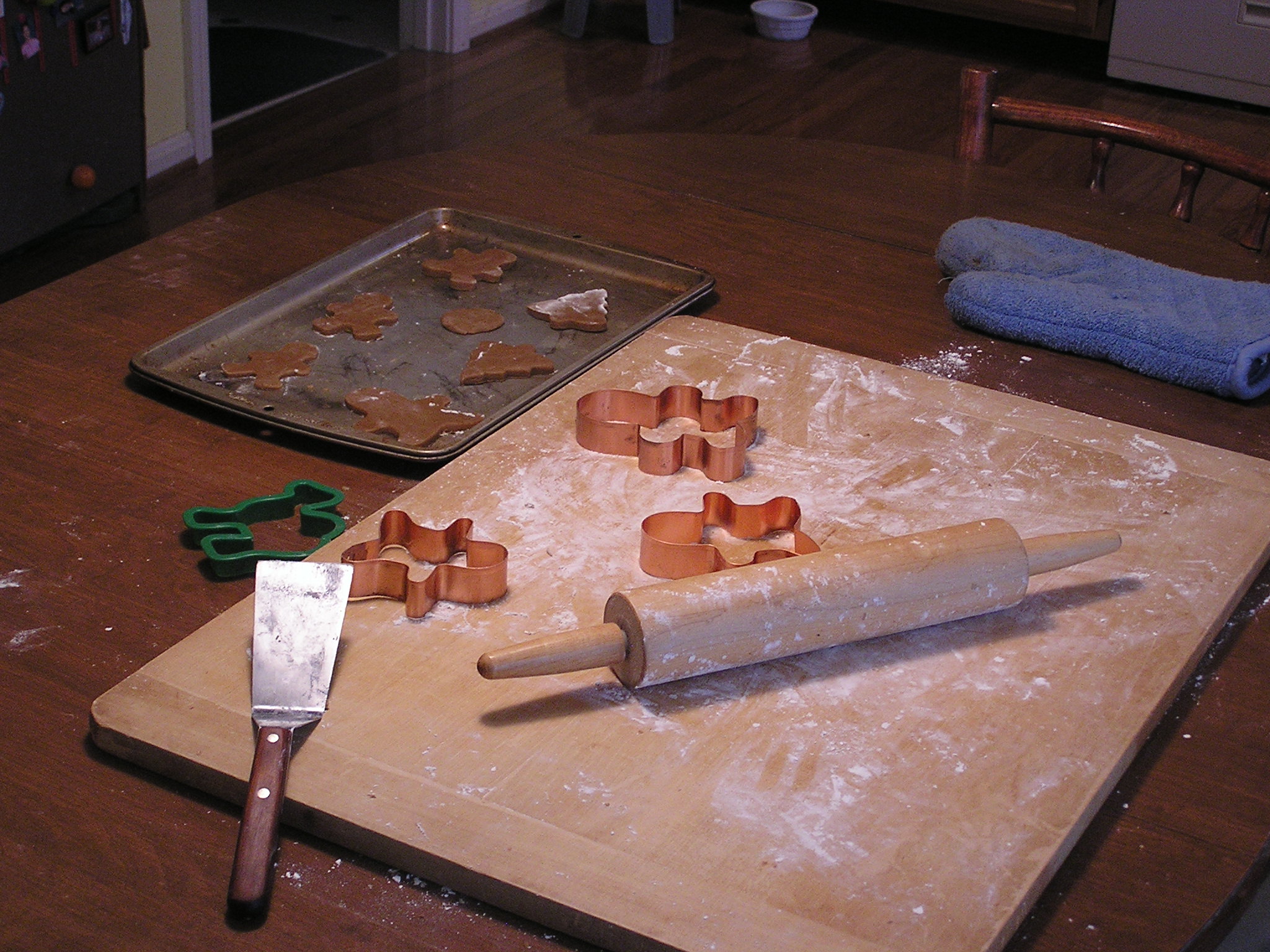
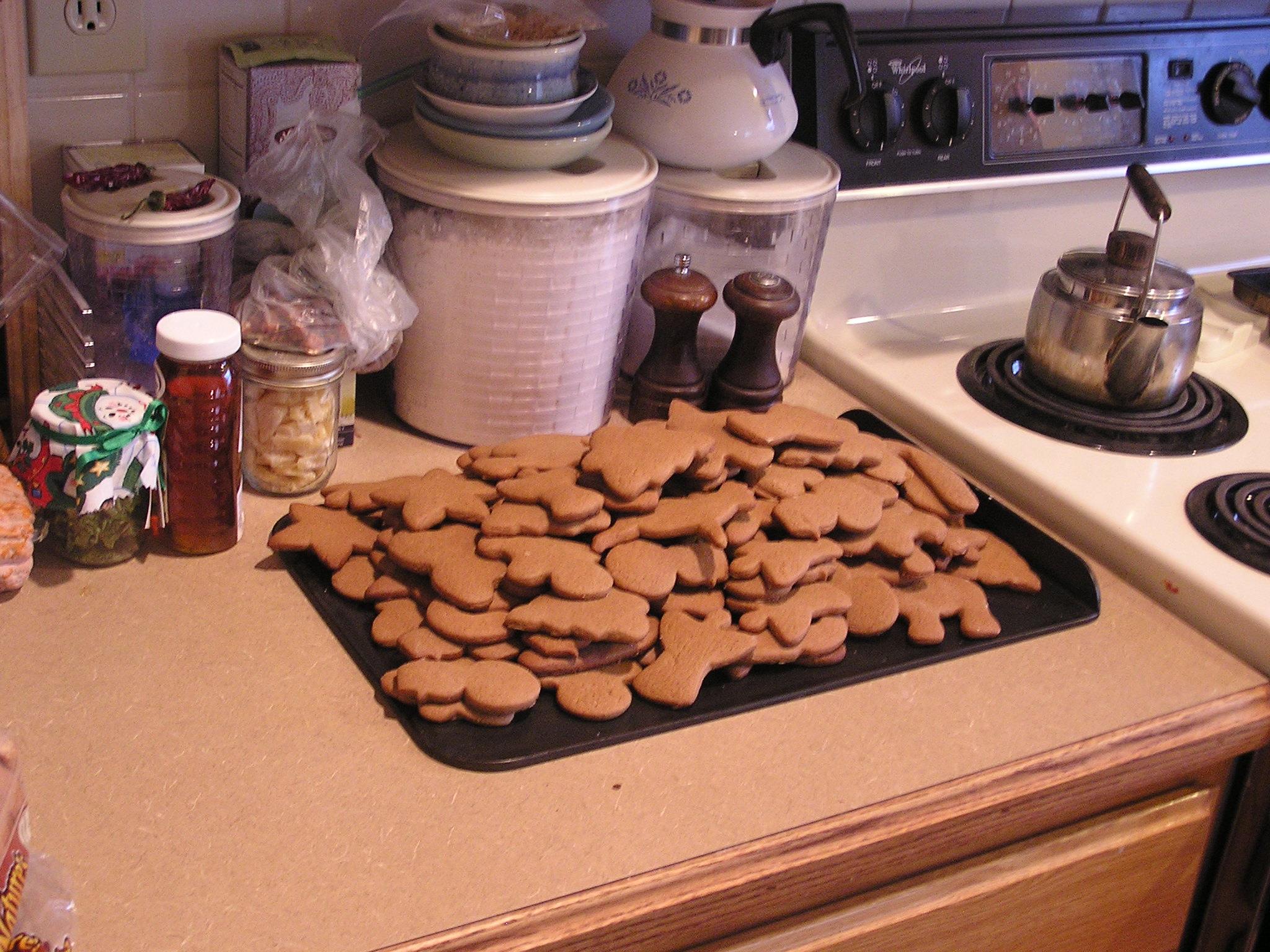
Today we have ice on top of the couple inches of snow that fell before the “warm” front moved through, so naturally school was closed. (Whatever.) That means the kids were home with me today, so we took advantage of this opportunity to get some holiday baking done: specifically, cookies for teacher gifts and classroom parties.

In two hours, we cranked out what my son very eloquently described as a “crapload” of cookies — 120-some, to be more exact. We only had to put four out of their misery: a reindeer with a broken leg, two maimed gingerbread men, and a decapitated angel. We will decorate them this evening, as they will be completely cooled by then.

Just as we finished baking, the doorbell rang and a several neighborhood kids invited them to play outside. After about an hour of chasing each other around, throwing ice at one another, and cleaning off my car (!), the boys flocked back inside to chase each other around imaginary worlds on the Ninetendo and throw virtual grenades at one another. (I detect a pattern here…) In addition to a symphony of surprisingly high-pitched shrieks, I just overheard the following dialogue:

M: I just have one question: why did we all die?
E: Because I blew us up.
M: Oh.
E: This time I promise to THROW the grenade.
[A moment later…]
Run away! Run away!

screenshot from GameSpyAhhh…there’s nothing like a houseful of 12- and 13-year-old boys. Good thing I put the cookies away before they came inside.

Pardon my lack of enthusiasm

Recently a friend asked me if I was getting excited about our upcoming vacation. I was a little surprised to be asked that; why should I get excited? What is there about a family vacation to get excited about? I shrugged my shoulders and said, “No.” He looked puzzled and mildly disappointed.

In reflecting on this exchange, which was clearly unsatisfying for both of us, I recognized some fundamental differences in our perspectives. As the primary breadwinner in his household, my friend holds down a full-time job at a place of business; when he goes on vacation, he doesn’t have to go to work. Whatever he does on vacation, it’s guaranteed to be entirely different from his usual daily/weekly routine.

When I go on vacation, my job comes with me. I still have to work, doing what I do every day. The setting and circumstances are different, but I’m still responsible for making sure people get up, get dressed, and get where they’re going on time. I still have to plan meals, even if I don’t prepare them or clean up after them. I still have to coordinate transportation and schedules, and I still have to enforce rules and arbitrate disputes.

This isn’t a bad thing; a change of scenery can be refreshing, as can a change in routine. But it hardly qualifies as “getting away from it all” when you bring most of it with you, now, does it?