Ain’t misbehaving?

I’ve just returned from London, where we encountered groups of young people at every turn, most of them speaking languages other than English. The French-speaking school children were exceptional in their lack of discipline and consideration for other people. They consistently disregarded the direction of tour guides, train conductors, police officers, and their own chaperones. If there was a commotion at a museum, a restaurant, or on the street, the source was nearly always a group of French school kids.

The phenomenon was so apparent and widespread that it became a kind of running joke in our party. French school groups seemed to be everywhere, their disruptive behavior identifying them long before we were close enough to hear them speaking. We kidded that it was no wonder they’d all been sent abroad – their communities were probably relieved to be rid of them. We speculated that this was also the reason they couldn’t get chaperones: most groups had only one adult, maybe two, and 30 or more students. We dubbed them the scourge of Europe, opining that the Huns would be a welcome alternative, swift death by sword being preferable to death by unrelenting aggravation.

In short, I came away with a distinctly unfavorable impression of French children and, by extension, French methods of child-rearing. I hear there’s a new book out extolling French parenting, Pamela Druckerman’s Bringing Up Bebe: One American Mother Discovers the Wisdom of French Parenting. I’ve not read the book, so I don’t know what Ms. Druckerman saw that led her to conclude that American parents could take a page or two from French parents. Perhaps French children are well-behaved at home (which is where Ms. Druckerman probably saw them) and only act like hooligans when they’re not under the watchful eyes of their wise parents. I’m reminded of the genuine wisdom of my father-in-law, who once said of my own children: “They’re going to misbehave at one time or another; isn’t it better for them to do it at home, where you’re there to guide them, than out in public?”

Postscript: I realize it is completely unjust to paint an entire nation or generation with a single, broad stroke. In all fairness, there may have been a number of French school groups that we didn’t notice because they were so well-behaved. It’s quite likely that the groups which drew our attention did so because they were inadequately supervised, and the same children would have been ideal travel companions had they been accompanied by an appropriate number of adults. Nevertheless, I can’t help thinking it oddly significant that we encountered no school groups of other nationality that exhibited similar behavioral issues.


Pear blossoms

Not to be outdone by my friend Murphala, who posted a lovely picture of cherry blossoms on her blog, here’s a nice photo of the ornamental pear blossoms:

“Snow” followup

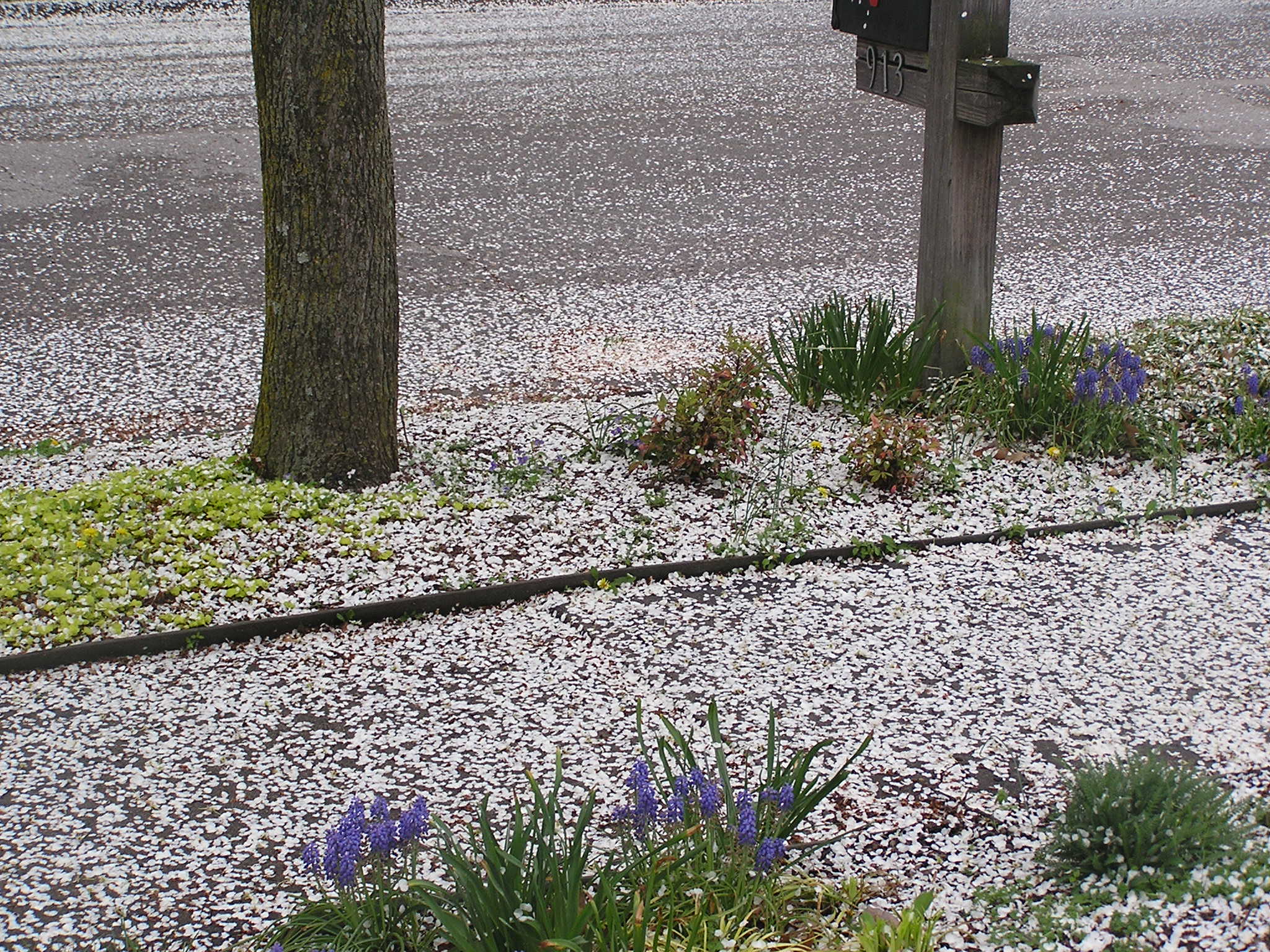
Today there are almost as many petals on the ground as on the trees.

They even make the same kind of shushing sound that snow does when I drive through it.

Not enough for sledding, but still…magical.

It’s snowing!

Not really; it’s been in the upper 80’s (F) all week. But the ornamental pear trees that line the street  look a lot like they did a couple weeks ago (minus the tiny green leaves), when each branch was weighed down with a tiny mound of snow.

Each time a bird alights in or takes off from a tree, there’s a little shower of white petals. Last evening I heard small voices giggling and shrieking, “It’s snowing!” Down the street, two children were tossing twigs into the trees and dancing around in the resulting cascade.

For a few magical days, snowy white petals will swirl on the breezes and form car-blown drifts in the street. Despite the ridiculous heat, it really is only spring.

Geek holiday overload

March 14 is such an exciting day!

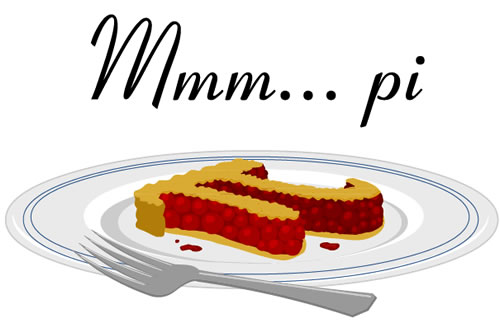
1. Pi Day – Today’s date can be written in month/day format like this: 3.14, which happens to match the first three digits of the mathematical constant, pi. People around the world celebrate this holiday by eating pie, reciting as many digits of pi as they can, and talking about both (pie and pi). Happy Pi Day!

2. Albert Einstein’s birthday – The world’s most respected patent clerk was born on this date in 1879. People around the world commemorate the occasion by discussing physics — or at least reciting the equation E = mc (squared) — and wearing fabulously big hair.

3. Save a Spider Day – This is my favorite thing about today, because I love spiders! (See my other spider-related posts for details.) I haven’t seen any since the large jumping spider my son found hiding in his bath towel last month. (I’m not sure who was more freaked out by the encounter, but I’m happy to report that both survived.) I did walk through a bit of spider web in the yard yesterday, though, which I was pretty excited about (once I stopped ninja dancing to get it off me, of course.)

In the spirit of the day, I invite you to eat some pie, tease your hair, and read this winning contest entry by Brandon J., “Spider Day.” A fellow spider dork salutes you, Brandon!

Lenten devotion for 10 March 2012

[The following meditation was based on the hymn, “God Loved the World” (Hymn 323 in Evangelical Lutheran Worship). It was published in Lenten and Easter Devotions (2012) by the East Kentucky Conference of the Indiana-Kentucky Synod of the Evangelical Lutheran Church in America.]

“God loved the world.” Everything begins there, with a love that made the world, sustains the world, and redeems the world. We tend to think of this relationship as an opposition: God on one side, the world on the other. These words remind us that God doesn’t see it that way.

In fact, God is so head-over-heels in love with the world that God does crazy-fool things with and for and in the world, all the time. Things like free will, and mosquitoes, and causing the sun to shine on evildoers as well as on those who do good. Things like quarks, and dinosaurs, and coming among us to live and suffer and die. God sends the world flowers and blue-footed boobies and rainbows like some love-sick teenager, undeterred by rejection or indifference or outright hostility.

It’s easy during Lent to focus on our failings as the cause of Jesus’ advent. But it’s not really about us in that way. Although our sin might provide the occasion, it is not the reason for Jesus’ coming—love is. Jesus lived and died and was raised because God loved the world. Let us live and die in hope because of that love.

Love-struck God, help us remember that your love is all around us, even in things we do not see and in ways we do not understand. Lead us to love the world as you do—truly, madly, deeply—and follow the example of Jesus, in whose name we pray. Amen.

This explains so much…

According to my sources, the second week of March is National Procrastination Week. This brings a number of things to mind:

– Does that mean the second FULL week, or simply the second row of days on the calendar for the month of March? It could go either way, you know.

– Was this week actually scheduled earlier, say in January, and we only just got around to it?

– Why only a week? Why not a month? I don’t know about you, but for me, procrastination is a year-round sport.

– Is this like Women’s History Month, where the point is to honor women’s history? Or is it more like American Diabetes Month, where the point is to raise awareness of a serious health issue? Are we supposed to procrastinate MORE in celebration, or find a 12-step program now that we’ve recognized that we are powerless over procrastination and our lives have become unmanageable?

My source also noted that lack of organization is one of the top reasons people procrastinate, then listed a whole bunch of organizing tips and resources. This reminded me of a great book I picked up a couple years ago, Organizing for Your Brain Type, by Lanna Nakone. There’s a quiz to determine how your brain works and which organizational style goes best with it. I love those kinds of quizzes! I just know I’m going to learn something new and interesting about myself. Anyway, it turns out that the best thing for me to do would be to have an administrative assistant. I knew it! I’m not disorganized; I’m understaffed!

So in honor of National Procrastination Week, I’m going to retake the quiz in Lanna Nakone’s book and review all the suggestions she makes for people with my kind of brain. And then I’ll think about implementing them.

Happy procrastinating!

Internal clocks

(This post was inspired by my friend Murphala at FlourWaterYeast&Salt.)

When I was growing up, we kept all the clocks in the house set 15 minutes fast, because that’s about how much we always ran late. It actually worked pretty well. It takes my rational brain a few minutes to shift gears and say, “Whoa there, the clock is fast, remember?” In the meantime, my reactional brain has seen the time, yelped “Holy pancakes!” and sent a jolt of adrenaline through my system. By the time the rational brain kicks in, I’m already in gear and halfway out the door.

My S.O. is the sort of person who could have coined the expression, “To be early is to be on time; to be on time is to be late.” Living together all these years, I’ve come to appreciate that running a few minutes early means I don’t have to feel rushed, and he’s come to appreciate that the world really doesn’t end if he’s not fifteen minutes early to everything.

Unfortunately for the harmonious balance we have managed to strike, we have children.

One is reasonably well-organized and quite capable of punctuality. He frequently fails to live up to his potential in that area, however, largely because he is a teenager. He loves the thrill of pulling things off without a moment to spare, timing everything down to the last second so he can crow in triumph at the killjoy parents who have been anxiously clucking and fluttering him out the door. At least half the time, though, he leaves something out of his meticulous calculations, and, as his plan includes no margin for error, the whole scheme crashes and burns, accompanied by parental hair-pulling and scolding.

The other child has always been temporally challenged, a condition that has only intensified as she’s moved into her pre-teen years. She can stretch the briefest of tasks into an agonizing effort of Sysiphean proportions. When asked if she’s ready to leave, she’ll answer yes, only to begin rushing around at the moment of departure doing 37 things that have to be done so she can go. I can only guess that she understands “ready to leave” to actually mean “ready to think about getting ready to leave.”

The one good thing about this situation is that it has driven my S.O. and I to greater solidarity in the departure department. Of course, we’re also more unified in terms of elevated blood pressure. Assuming we both survive until the offspring are on their own, I’m pretty sure we’ll never again fuss at each other over being on time.

Of God and glitter: Why no self-respecting church would ever ordain me

I was writing in a coffee shop the other day and overheard some women sitting at a nearby table. Their conversation must have been about faith and parenting, because one woman said she found it difficult to talk with her children about God the Father when their own father had walked out on all of them. Another woman chimed in, wondering how she could convince her children that their heavenly Father loves them when their earthly father, who also supposedly loved them, had been so abusive.

I heard the struggle in these mothers’ stories, the anguish in their voices, and I wondered why they needed to teach their children that God is a loving heavenly father. Why try to stuff God into a metaphor that has no resonance in their lives? Why not talk about God as a loving heavenly mother who was willing to sacrifice everything, to an even greater extent than the mother whose living example is before her children daily?

Jesus didn’t randomly choose to refer to God as father; he had specific reasons for doing so, both personal and political. They were his reasons, a natural outgrowth of his life experience and the life experiences of those around him. And his doing so was considered quite scandalous at the time – how dare he cast the God of Israel, the Lord of Hosts, in such an intimate, human role! How dare he describe the one, true God in language so similar to that used by the hated, idolatrous Romans (paterfamilias)? I cannot imagine that Jesus would in any way fault us for doing the same scandalous thing in our time, out of our life experiences.

Christians have spoken of God in feminine and maternal terms throughout the ages, though these expressions have been largely overshadowed by the loud shouting of masculine and paternal images that became fossilized in the creeds. Jesus described himself as a mother hen who longed to shelter her chicks beneath her wings; why are we so reluctant to use this imagery ourselves?

I feel sad that those mothers found themselves struggling in the one place they and their children should have been able to find peace and comfort: their faith. I believe that Jesus, who was notorious for meeting people on their own terms, would have sat down at their table and told them marvelous stories of a God who is like a woman that asks a neighbor to watch the rest of her children while she goes out looking for the one who didn’t come home at curfew; a God whose kingdom is like the glitter you keep finding all over the house months after the art project has been turned in; a God who always makes room in bed for the child who has a bad dream, even if it means She has to spend the rest of the night clinging to the edge of the mattress.

Dreams of blogging

Last night I dreamed about blogging. I dreamed that I had plenty to say, no difficulty saying it, and time enough to post it.

I dreamed I had some thoughts that were so compelling I had to stop what I was doing and post them.

If only I could recall what they were.