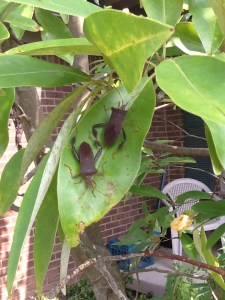
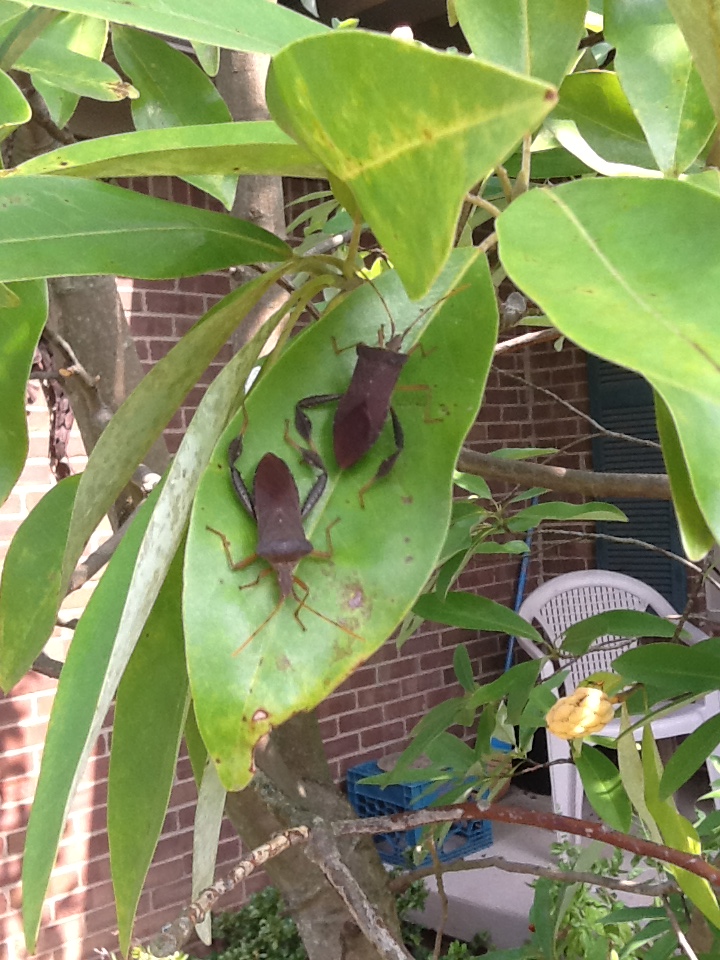
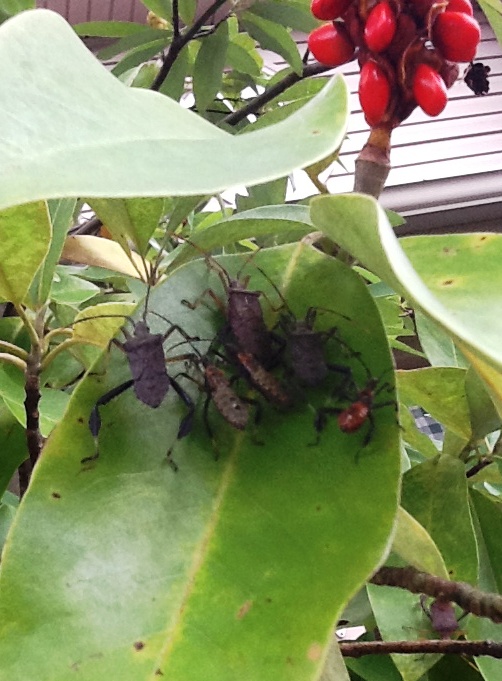
I noticed some familiar arthropods on the leaves of my swamp magnolia (Magnolia virginiana) the other day. These are Leptoglossus fulvicornis, commonly called leaf-footed bugs because of the shape of their hind legs (“foliaceous hind tibia” in entomologese). The two adults in the photo at right show the characteristic flattened shape of those rear leg segments.
They are true bugs, members of the suborder Heteroptera, along with squash bugs and stink bugs. Leptoglossus fulvicornis is also known by the species name magnoliae because it only feeds on the fruits of magnolia trees.
I first met these critters in college, where they were frequent visitors in our dorm rooms once the weather turned cold. This now makes perfect sense to me because the courtyard of the dormitory sheltered several ancient and glorious magnolia trees from the harsh winds that blew off Lake Michigan.
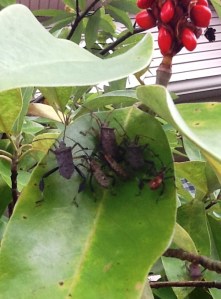 Anyway, back to the present. This photo shows a cluster of nymphs of various ages — the youngest have bulbous red bodies, somewhat reminiscent of the bright red magnolia fruits they eat (also shown in the photo). Six juveniles are huddled together on the leaf in the foreground, with an adult on another leaf in the lower background. They are hiding because a female cardinal (not pictured) has figured out that this tree offers not only delicious fruit but yummy bugs. She’s been in the front yard a lot lately (I hear her out there now, in fact), and I’ve noticed much fewer leaf-footed bugs on the tree than in previous years.
Incidentally, this tree stands next to the porch where the parsley sits in its pot. It seems this cardinal also has a taste for grasshoppers (you go, girl!) and swallowtail larvae (sadly). She flew off the step when I opened the front door one day, and I found the swallowtails all gone, save for half of one she dropped when I startled her, and odd bits of grasshopper scattered about the porch.
Saddened as I am at the loss of the swallowtails, it is affirming to see the ways in which my little corner of the ecosystem reflects the resourceful adaptability of the whole. It also lets me experience myself and my yard as part of that larger system, and reminds me that most imbalances will correct themselves if I only give them time.




 The Daily Compost